Why Most Enterprise AI Projects Will Fail in 2026 and How to Prevent It
Discover why most enterprise AI projects fail and how to prevent it with key insights and strategies for successful implementation in 2026.
why most enterprise AI projects fail and how to prevent it | 11 min read | Adspro.xyz Editorial Team
Why Most Enterprise AI Projects Will Fail in 2026 and How to Prevent It
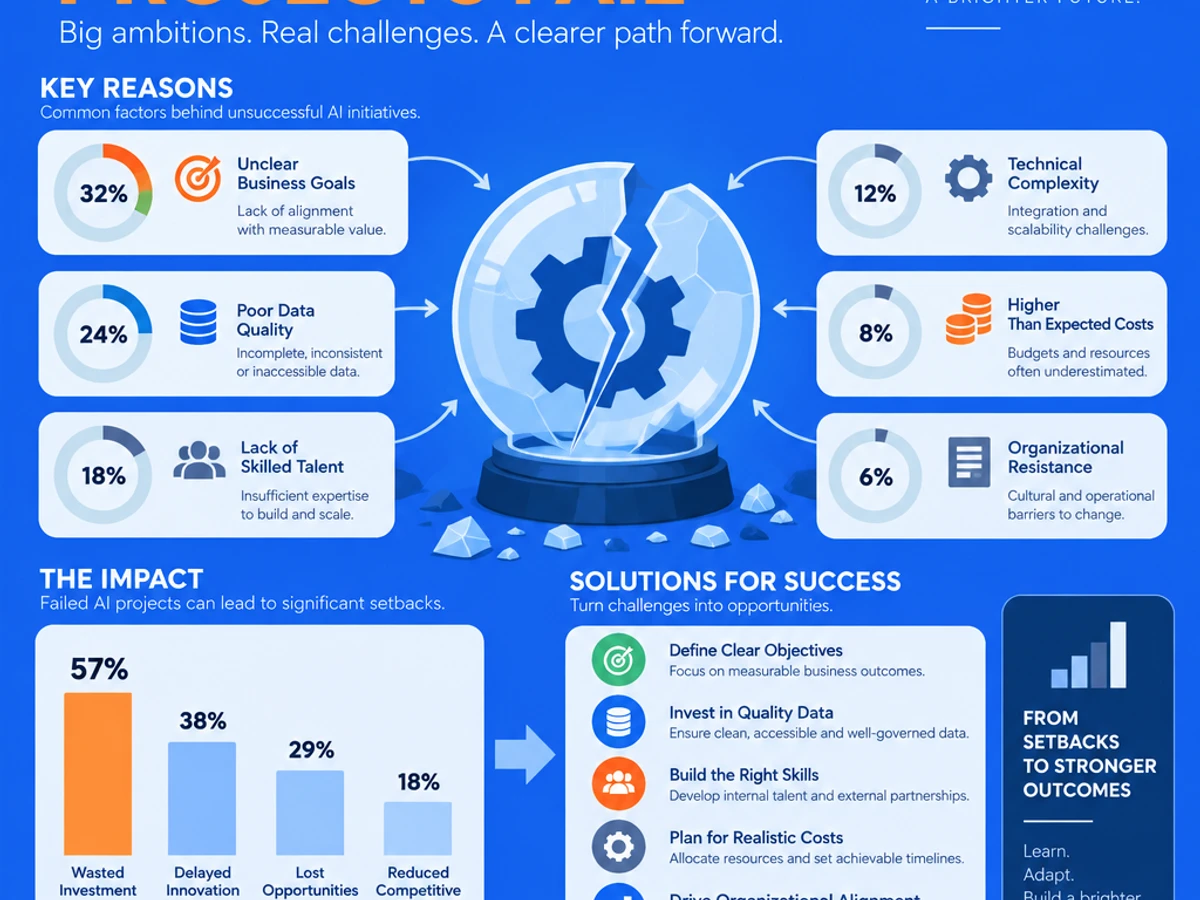
Most enterprise AI projects fail due to unclear business objectives, poor data quality, weak executive sponsorship, missing change management, and technology-first thinking that skips workflow redesign. Gartner projects that through 2026, 60% of AI projects will be abandoned unsupported by AI-ready data, while a July 2025 MIT study found that 95% of enterprise AI deployments fail to deliver value. RAND Corporation research shows more than 80% of AI projects fail, roughly twice the failure rate of conventional IT projects.
The problem is not weak models. The recurring causes trace back to unclear definitions of success, weak data foundations, poor workflow integration, chasing technology rather than business outcomes, and fading executive sponsorship. Enterprises pursuing digital transformation must adopt a discovery-first, outcomes-led approach before writing code.
The 85% failure statistic is not a verdict on artificial intelligence. It is a mirror held up to enterprise decision-making, data discipline, and organizational readiness. AI amplifies whatever foundation it is built on, whether that foundation is strong or broken.
Why Most Enterprise AI Projects Fail in 2026: What the Data Actually Shows
Most enterprise AI projects fail because organizations underestimate data readiness, workflow redesign, and organizational alignment. Research from Gartner, MIT, and RAND converge on failure rates between 70% and 95%.
The Numbers Behind the Headlines
Gartner research on data quality shows 25% to 30% of AI projects crash completely, while 80% never progress past the pilot phase. The MIT Project NANDA report found that despite $30-40 billion in enterprise investment, 95% of generative AI projects yield no measurable business return.
| Source | Reported Failure Rate | Primary Cause Cited |
|---|---|---|
| Gartner (2025) | 60% of AI projects abandoned by 2026 | Lack of AI-ready data |
| MIT Project NANDA (2025) | 95% of GenAI pilots show no P&L impact | Poor enterprise workflow integration |
| RAND Corporation | 80%+ of AI projects fail | Unclear problem definition, weak infrastructure |
| S&P Global (2025) | 42% of companies scrapped most initiatives | Unclear success metrics, weak sponsorship |
Spending continues to surge despite these numbers. Gartner forecasts worldwide spending on generative AI will reach $644 billion in 2025, a 76% increase, with 2026 forecast at $2.67 trillion. Census Bureau data shows 38.4% of US firms with 250+ employees use AI, yet few convert usage into measurable financial return.
Key Takeaway: The question is not whether enterprises are adopting AI, but whether they are prepared to convert pilots into production systems that deliver measurable ROI. This is a leadership question, not a technology question. For supporting data, see Why Enterprise AI Projects Fail Before Deployment.
What Are the Root Causes of Enterprise AI Project Failure?
Enterprise AI projects fail for organizational reasons far more often than technical ones. Research from McKinsey and Gartner shows failures cluster around predictable, preventable issues.
- Unclear or shifting objectives: Teams build before defining success. Gartner data shows business case no longer viable accounts for 29% of abandoned projects.
- Poor data quality and readiness: Gartner found data quality issues cited in 38% of abandoned projects, the single largest reason.
- Loss of executive sponsorship: Sponsorship evaporates within six months in 56% of failed cases.
- Technology-first thinking: Organizations select tools before redesigning workflows. Organizations that redesign end-to-end workflows are 2x more likely to see returns.
- Organizational resistance: About 59% of AI project failures are due to organizational factors rather than technical issues, including lack of sponsorship, user resistance, and insufficient training.
The Talent and Infrastructure Gap
Deloitte's 2026 survey of 3,000+ leaders found the AI skills gap is the number one barrier to integration, while 54% of enterprises report their current infrastructure cannot handle production-scale AI workloads.
McKinsey's research identifies a small set of behaviors distinguishing high-performing AI organizations: they are not particularly complex, but they are consistently applied.
Key Takeaway: Root causes point to the same conclusion: technology rarely fails on its own merits. It fails when enterprises skip discovery, scope poorly, and treat AI deployment as an IT rollout instead of business transformation. For deeper context, see Why 90% of Enterprise AI Projects Never Leave the Lab.
How Does Poor Data Quality Cause Enterprise AI Projects to Fail?
Data quality is the single most cited technical obstacle to enterprise AI success, but it is fundamentally an organizational discipline problem, not a model problem.
Where Data Readiness Breaks Down
Informatica's 2025 CDO Insights survey found data quality and readiness is the top obstacle at 43%, with only 12% of organizations reporting data of sufficient quality for AI applications. Organizations skipping proper data preparation pay 2.8x more in remediation later.
| Data Readiness Practice | Organizations Following It | Typical Outcome |
|---|---|---|
| Pre-defined success metrics before build | Minority of enterprises | 54% success rate vs. 12% without them |
| 40-50% of budget on data preparation | High-performing programs only | Lower remediation cost, faster scale |
| AI-ready data infrastructure | Roughly 12% (Informatica, 2025) | Higher likelihood of reaching production |
| No formal data governance | 63% of surveyed data leaders | Elevated abandonment risk |
A Fortune 500 manufacturer discovered production data stored in 47 formats across 23 legacy systems mid-project, costing $20M total before abandonment. A structured discovery phase, as Adspro applies before build begins, surfaces such surprises early.
Key Takeaway: Data quality failures are foreseeable consequences of skipping data audits before development starts. Enterprises need to budget real time for data discovery up front, not hope it works out later. For supporting data, see Why 95% of Enterprise AI Fails - and How to Be in the 5%.
Why Does Executive Sponsorship and Change Management Determine AI Success?
Executive sponsorship is one of the strongest predictors of AI project success, yet it is frequently underfunded. Passive, symbolic sponsorship is almost as damaging as having no sponsor.
- Active sponsorship drives adoption: Projects with sustained executive sponsorship succeed 68% of the time versus 11% without it.
- Change management budget matters: High-performing enterprises allocate 20-30% of budget to change management.
- Manager preparation is neglected: Prosci's 2026 research found only 35% of organizations adequately prepare managers for their change role.
- Employee trust is eroding: WRITER's 2026 survey found 29% of employees, and 44% of Gen Z, admit to sabotaging their company's AI strategy.
- Executives feel the strain: 54% of C-suite executives admit that adopting AI is tearing their company apart, despite 59% of companies investing over $1M annually in AI.
The Sponsorship-Abandonment Link
Research from RAND, MIT, Gartner, and S&P Global found sponsorship often disappears fast: sponsorship evaporates within six months in 56% of failed cases. Once it does, executives approve budgets but lose interest after the first demo, teams treat AI as a technology project, and no one owns outcomes.
Active, visible sponsorship is one of the strongest predictors of adoption success. A sponsor who signs the memo but never touches the tool sends the opposite signal to the one intended.
Key Takeaway: Enterprises pairing visible, ongoing executive sponsorship with dedicated change management budget consistently outperform those treating AI as purely technical. This is why any answer to why most enterprise AI projects fail must address people and governance. For deeper context, see What Actually Kills AI Projects: The People Problems Behind Failed.
How Can Enterprises Prevent AI Project Failure in 2026?
Preventing enterprise AI project failure requires a discovery-first sequence: define the business problem, assess data readiness, secure active sponsorship, redesign workflows, then select technology. Enterprises reversing this sequence-starting with tools rather than outcomes-are consistently represented in failure statistics.
A Practical Prevention Framework
| Phase | Core Question Answered | Common Shortcut That Causes Failure |
|---|---|---|
| 1. Discovery and problem definition | What specific business outcome changes, and how is it measured? | Starting with "improve productivity" instead of a concrete KPI |
| 2. Data and infrastructure audit | Is our data clean, governed, and accessible enough? | Assuming existing data is "good enough" without an audit |
| 3. Sponsorship and governance | Who owns this outcome at the executive level, ongoing? | One-time budget approval with no continued involvement |
| 4. Workflow redesign | How does the actual process change once AI is introduced? | Layering AI onto an unchanged workflow |
| 5. Scaled deployment | Does the pilot's value hold up at production scale? | Declaring victory at pilot stage without production validation |
This sequencing mirrors what Adspro applies as a digital transformation consultancy. Adspro's discovery-first process is built on the belief that strategy, data readiness, and partnership must come before technology selection.
- Start with strategy, not tools: Engagements begin by defining measurable business outcomes before selecting any platform, directly addressing the "unclear objectives" failure mode.
- Audit data before building: Structured data assessment surfaces costly surprises (fragmented systems, poor governance) that sink projects mid-build.
- Design for adoption: Because organizational resistance drives majority of failures, Adspro emphasizes partnership through rollout, not handoff after go-live.
- Measure outcomes continuously: Engagements are structured around measurable business impact, tying AI deployment directly to quantifiable results.
Key Takeaway: Enterprises wanting to beat the 70-95% failure rate need a partner treating AI as strategy-led transformation rather than software installation.
Conclusion
Why most enterprise AI projects fail comes down to consistent, well-documented organizational failures, not technology shortfall. Enterprises beating the 70-95% failure range share a common discipline: they define outcomes first, invest in data readiness, secure active sponsorship, and redesign workflows before deploying tools.
- Data quality is the top blocker: Poor data is the most cited reason projects are abandoned; remediation after the fact costs far more than getting it right up front.
- Sponsorship must be active: Projects with sustained, visible executive sponsorship succeed at dramatically higher rates.
- Change management is not optional: Organizational resistance accounts for the majority of failures, not model performance.
- Sequence matters: Workflow redesign before technology selection separates enterprises achieving measurable ROI from those stuck in pilot purgatory.
- Partnership reduces risk: Working with a discovery-first partner like Adspro helps enterprises avoid common, avoidable causes before capital is committed.
Enterprises evaluating AI initiatives for 2026 should treat the failure statistics above as a checklist of what to get right before the first dollar is spent.
FAQ
Why will most enterprise AI projects fail in 2026 and how can enterprises prevent it?
Most projects fail because organizations skip business-problem definition, underinvest in data readiness, and let executive sponsorship lapse. Prevention requires sequencing strategy before technology: define measurable outcomes, audit data quality, secure ongoing executive involvement, redesign workflows, then select AI tools. This approach mirrors Gartner's guidance on AI-ready data and the discovery-first process used by consultancies like Adspro.
What percentage of enterprise AI projects actually fail?
Estimates consistently range from 80 to 95 percent, depending on definition. Industry analysis notes estimates of outright project failure range from 80 to 95 percent, with Gartner, MIT, and RAND all publishing figures within that band.
Is poor data quality really the biggest cause of AI project failure?
Data quality is consistently ranked as the single largest technical obstacle, though rooted in organizational discipline. Gartner found data quality issues cited in 38% of abandoned projects, ahead of business case viability and lost sponsorship.
How important is executive sponsorship to AI project success?
Executive sponsorship is one of the strongest predictors of whether an AI project reaches production. Projects with sustained executive sponsorship succeed 68% of the time versus 11% without it, and sponsorship must remain active throughout, not just at kickoff.
Why do so many generative AI pilots fail to reach production?
Generative AI pilots stall because tools are not integrated into real workflows. MIT's 2025 research found 95% of pilots delivered no measurable P&L impact, largely because enterprise-built tools cannot retain feedback, adapt to context, or improve without deliberate integration work.
What role does change management play in enterprise AI adoption?
Change management addresses the human side of adoption, which research shows is the dominant cause of failure. About 59% of AI project failures are attributed to organizational factors rather than technical issues, underscoring why high-performing organizations budget as much for adoption support as for technology.
How much are US enterprises spending on AI, and is it paying off?
Spending has surged while measurable returns lag. Gartner's 2026 forecast reached $2.67 trillion, 49.5% more than in 2025, yet only 6% of adopters capture measurable company-wide profit, illustrating the gap between adoption and value realization.
What should enterprises do differently before starting an AI project in 2026?
Enterprises should run a structured discovery phase before selecting any AI tool, defining specific KPIs, auditing data readiness, and assigning an active executive owner. Organizations with pre-defined metrics achieve a 54% success rate versus 12% without them, a gap that a discovery-first partner like Adspro is structured to close.
This article synthesizes publicly available research from Gartner, MIT Project NANDA, RAND Corporation, McKinsey, Deloitte, Prosci, WRITER, and other named sources current as of September 2026. Failure-rate statistics vary by methodology; readers should consult original sources linked throughout before making budget or strategy decisions.