Why Most Enterprise AI Projects Still Fail to Scale in 2026
Discover why most enterprise AI projects fail to scale beyond the pilot stage and how to avoid it for successful implementation in 2026.
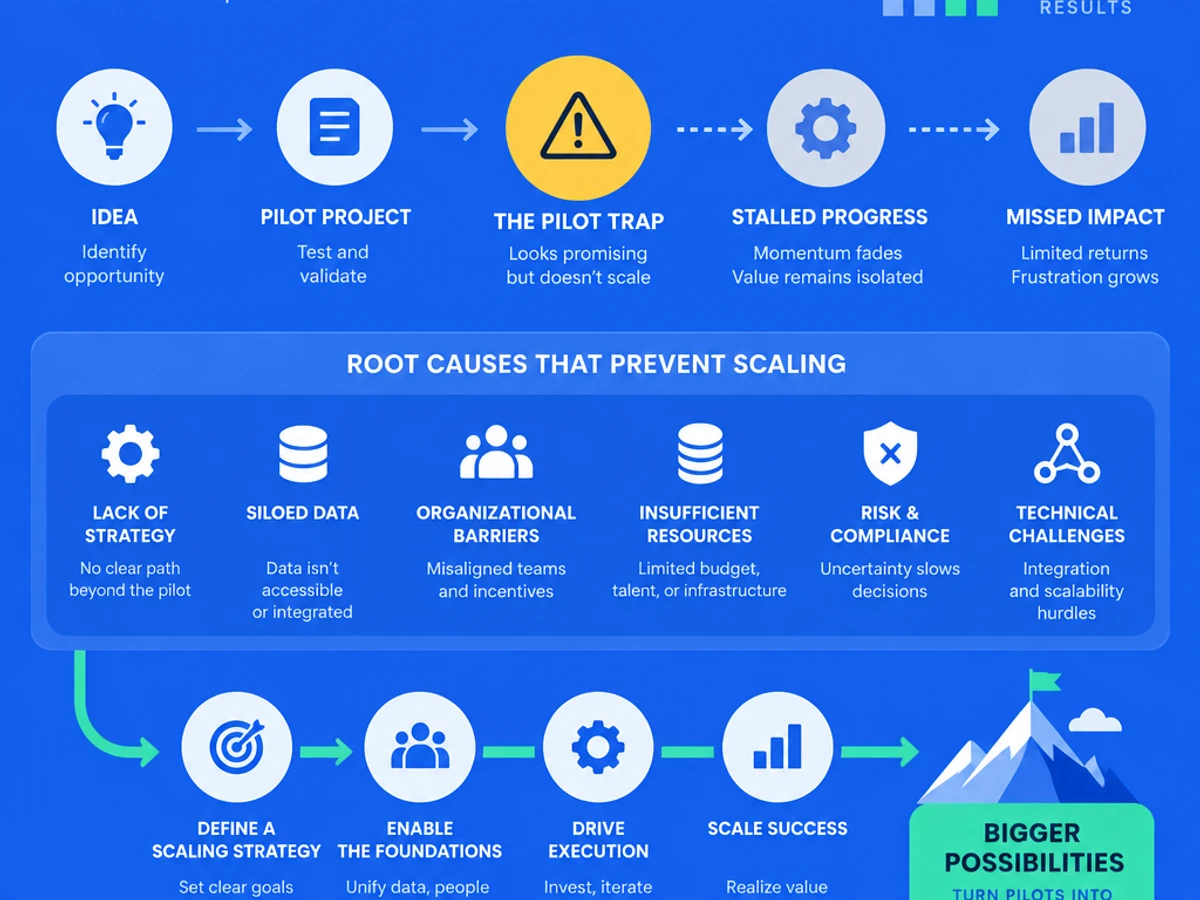
why most enterprise AI projects fail to scale beyond the pilot stage and how to avoid it | Updated September 30, 2026 | Adspro.xyz Editorial Team
Why Most Enterprise AI Projects Still Fail to Scale in 2026
Enterprise AI scaling fails for consistent reasons: fragmented data foundations, weak governance, cultural resistance to workflow change, and partner selection built around demos instead of production engineering. The technology itself is rarely the bottleneck; the organizational infrastructure is. A 2025 RAND Corporation analysis of more than 2,400 enterprise AI initiatives found that 80.3% of AI projects fail to deliver their intended business value, despite billions invested in the space.
The pattern repeats across sectors: pilots succeed in controlled environments, then fail when encountering legacy systems, compliance reviews, or departmental ownership disputes. Gartner's February 2025 research found that 63% of organizations either lack or are unsure they have the right data management practices for AI, explaining why well-funded initiatives stall before reaching production.
Enterprises rarely fail at building AI demos; they fail at building the operating discipline required to run AI as a production system, with the same rigor applied to uptime, security, and accountability as any other core business function.
Why Most Enterprise AI Projects Still Fail to Scale in 2026
Organizations treat scaling as a technical problem to solve later instead of a strategic requirement built in from day one. The real bottleneck has shifted from "can the model do this?" to "can the organization operationalize this reliably?"
The Scale of the Problem
Only 48% of AI projects ever make it into production according to Gartner-sourced 2026 research, and roughly 33 of every 100 proof-of-concepts reach production. MIT's Project NANDA "GenAI Divide" report found that only 5% of custom enterprise AI tools reach production, though critics have questioned the study's narrow six-month ROI window, so this should be treated as directional.
Agentic AI Is Following the Same Curve
Gartner's June 2025 forecast predicts that most agentic AI projects are early-stage experiments driven by hype and often misapplied. By mid-2026, roughly 75% of enterprise leaders told Forrester they are adopting agentic AI, yet only 17% have deployed agents and 11% have production-ready systems.
- Ambition-execution mismatch: Leadership approves broad AI strategies without funding the infrastructure needed for operationalization.
- Pilot bias: Teams optimize for demo success rather than production-grade reliability and monitoring.
- Fragmented ownership: No single team owns the pilot-to-production handoff, so projects die in transition.
- Underestimated resourcing: Executives underestimate the resource intensity of true AI scaling until budgets are committed.
Key Takeaway: Scaling AI is an operating-model question, not primarily a technology question. Enterprises treating scaling as a first-class design requirement reach production; others do not. For deeper context, see Why Enterprise AI Projects Fail (and How to Avoid It).
What Root Causes Actually Stall Enterprise AI Scaling?
The dominant causes are data readiness gaps, governance vacuums, and leadership misalignment, not model performance.
Data and Governance Failures
Gartner predicts that through 2026, organizations will abandon 60% of AI projects unsupported by AI-ready data. 42% of companies abandoned at least one AI initiative in 2025, up from 17% the year before, according to S&P Global data.
Leadership and Decision-Making Failures
84% of AI project failures are primarily attributable to leadership decisions rather than technical limitations, according to RAND Corporation research. McKinsey found only 6% of organizations see real business value from AI despite widespread pilot adoption.
| Root Cause | Reported Impact | Source |
|---|---|---|
| Lack of AI-ready data management | 63% of organizations lack proper practices | Gartner, 2025 |
| Leadership and strategy misalignment | 84% of failures traced to leadership decisions | RAND Corporation, 2024 |
| Overly ambitious or poorly scoped use cases | 20% of AI initiatives fail outright | Gartner I&O Survey, 2026 |
| Unrealistic ROI timelines | Failures driven by "expecting too much, too fast" | Gartner, April 2026 |
| Weak vendor and partner fit | Contributes to abandoned pilots post-POC | Industry-compiled 2025-2026 data |
A Gartner survey of 782 infrastructure and operations leaders found that only 28% of AI use cases fully succeed and meet ROI expectations, while 20% fail outright.
The 20% failure rate is largely driven by AI initiatives that are either overly ambitious or poorly scoped. AI that doesn't fit into the organization's operations simply can't deliver ROI.
- Bias and data quality risk: Erroneous outcomes due to bias in the data, misaligned algorithms, or project team implementation undermine model trust before scaling begins.
- Talent and infrastructure shortfalls: Many enterprises lack internal specialists to operationalize models once pilots succeed technically.
- Siloed pilot ownership: Innovation teams build proofs of concept without the IT, security, and compliance stakeholders needed for production sign-off.
- Vendor mismatch: Selecting vendors for demo polish rather than production depth creates rework once real workloads hit the system.
Key Takeaway: Root causes are structural, not technological. The fix requires governance and data investment before the next pilot is scoped. For deeper context, see Why 9/10 AI Projects Fail and How to Avoid It.
How Does the "Pilot Trap" Prevent AI From Reaching Production?
The pilot trap is the recurring pattern where an AI initiative shows promising results in a controlled environment but collapses when exposed to real operational complexity, legacy integrations, and enterprise-wide governance requirements. It is the single most cited reason enterprises stay stuck between experimentation and impact.
Why Pilots Look Successful but Don't Scale
Pilots are usually designed with narrow scope, clean data, and a small, motivated user group, which flatters results. Production environments introduce messy data, broader user populations, security review cycles, and change-management resistance that pilots never face.
The Numbers Behind the Trap
Industry-compiled figures for 2026 show between 88% and 95% of AI pilots fail to reach meaningful production deployment. On the agentic AI side, Deloitte's Tech Trends 2026 research reported that only 11% of organizations have production-ready agentic systems and 42% lack a formal agentic AI strategy.
- Scope creep at handoff: A pilot built for one department suddenly needs to serve five, with no additional data plumbing or governance.
- Budget cliff: Pilot funding often comes from innovation budgets that don't extend into multi-year infrastructure investment.
- Missing production KPIs: Success metrics used in pilots rarely map to production metrics.
- No integration roadmap: Pilots frequently run as standalone tools disconnected from ERP, CRM, or core systems.
| Stage | Typical Focus | Common Failure Point |
|---|---|---|
| Ideation / Pilot | Prove technical feasibility | Clean, narrow data masks real-world complexity |
| Cross-functional handoff | Align IT, security, compliance | No accountable owner for production readiness |
| Production rollout | Enterprise-wide deployment | Legacy system integration and governance gaps surface |
| Post-launch scaling | Continuous monitoring, iteration | Budget and talent run out before ROI is proven |
Key Takeaway: Escaping the pilot trap requires designing for production from the start. Retrofitting governance, integration, and monitoring after a pilot succeeds is far more costly than building them in from day one. For deeper context, see The Executive's Guide to AI Strategy.
What Best Practices Separate the Enterprises That Scale AI Successfully?
Organizations that consistently scale AI treat it as an operating discipline built on outcome-first scoping, data readiness, and phased governance, rather than disconnected experiments.
Operational Practices That Work
- Outcome-first scoping: Define the specific business KPI before selecting a use case.
- AI-ready data foundations: Invest in data governance and quality before build, since 60% of AI projects lacking AI-ready data will be abandoned through 2026.
- Cross-functional ownership from day one: Include IT, security, compliance, and business stakeholders in pilot design.
- Phased scaling roadmap: Move from single-team pilot to multi-team rollout to enterprise deployment with defined checkpoints.
- Vendor selection for production depth: Choose partners evaluated on engineering rigor and integration experience, not demo polish.
Where Back-Office Use Cases Outperform
The strongest returns often come from operational efficiency rather than customer-facing use cases. Research on 2025 deployments found that more than half of corporate AI budgets are directed at sales and marketing use cases, despite strongest returns being reported in back-office functions such as business process automation and operational efficiency.
The enterprises that scale AI successfully are the ones that stop chasing the next flashy pilot and instead fund the unglamorous work: data pipelines, governance frameworks, and cross-functional accountability.
Key Takeaway: Fund the operational foundation before the next pilot, not after it succeeds. For further reading, see How to Build an AI-Ready Workforce in 2026.
How Does Adspro's End-to-End Model Help Enterprises Scale AI Past the Pilot Stage?
Adspro.xyz addresses the scaling gap by acting as a single accountable partner across the entire AI lifecycle, from strategy and data engineering through enterprise software and customer experience deployment, rather than handing off between disconnected vendors. This directly targets the handoff failures identified as the leading causes of stalled AI initiatives.
Why the End-to-End Approach Matters
Most enterprise AI failures occur at the seams between the innovation team that builds the pilot and the IT organization that operationalizes it. Adspro is designed as a digital transformation consultancy that partners with enterprises to design, build, and scale AI-powered solutions across strategy, data, software, brand, commerce, and customer experience, closing those seams rather than adding another handoff.
- Strategy-led scoping: Measurable outcomes are defined before build begins, addressing leadership misalignment.
- Data and governance readiness: Solutions are built with data engineering as a core discipline.
- Enterprise-grade software delivery: Focus on scalable, production-grade builds rather than standalone demos.
- Hands-on partnership model: A single team stays engaged from ideation through production.
What This Looks Like in Practice
| Common Failure Point | Typical Cause | Adspro's Approach |
|---|---|---|
| Pilot-to-production handoff | No accountable owner across phases | Single end-to-end partner from strategy through implementation |
| Data readiness gaps | Fragmented, low-quality data pipelines | Data engineering built into delivery from day one |
| Vendor mismatch | Chosen for demos, not durability | Enterprise-grade software and technical expertise |
| Unclear ROI targets | Use cases chosen without defined KPI | Strategy-led, outcome-first engagement |
Key Takeaway: Adspro positions itself as a trusted advisor equipped to guide enterprises from strategy through implementation, providing business leaders a practical answer to the scaling challenge.
Conclusion
Enterprise AI in 2026 is not failing because models don't work; it is failing because organizations underinvest in the data foundations, governance structures, and accountable partnerships needed to carry a pilot into production. Closing that gap requires treating scaling as a design requirement from day one.
- Data readiness is non-negotiable: 63% of organizations lack proper AI data management practices, the largest predictor of abandonment.
- Leadership decisions drive most failures: 84% of failures trace back to leadership and strategy misalignment rather than technical limitations.
- The pilot trap is structural: Between 88% and 95% of pilots never reach meaningful production deployment because they weren't designed for it.
- Back-office use cases often outperform: Despite budget skew toward sales and marketing, operational efficiency use cases report strongest returns.
- End-to-end partnership closes the gap: A single accountable partner across strategy, data, and delivery reduces the handoff failures that stall most initiatives.
Enterprises ready to move past pilot purgatory should start by auditing data readiness and defining production KPIs before the next AI initiative is greenlit, then partner with a team built to carry that work from ideation to production.
FAQ
Why Most Enterprise AI Projects Still Fail to Scale in 2026?
Most enterprise AI projects fail to scale in 2026 primarily due to fragmented data foundations, weak governance, cultural resistance to workflow changes, and poor partner selection. Organizations often treat scaling as an afterthought, lacking AI-ready data, clear governance, and cross-functional ownership at the critical pilot-to-production handoff. RAND Corporation research found that 80.3% of AI projects fail to deliver intended business value, with failures overwhelmingly organizational rather than technical.
Why do most enterprise AI projects fail to scale beyond the pilot stage and how to avoid it?
Enterprise AI projects fail to scale beyond the pilot stage because pilots are built under conditions that don't reflect production reality. The "pilot trap" leads to promising demos that collapse when faced with real operational complexity, legacy integrations, and enterprise-wide governance requirements. Avoiding this requires outcome-first scoping, significant investment in data governance before build, and a single accountable partner who owns the project from ideation through production.
What percentage of AI projects actually reach production?
Industry estimates put the figure between 5% and 48% depending on the study and definition of "production." Gartner-sourced data suggests only 48% of AI projects ever make it into production, while MIT's estimate places custom enterprise tool production rates at just 5%.
Is the "85% of AI projects fail" Gartner statistic accurate?
The widely circulated 85% figure is often misattributed; the original Gartner forecast referred specifically to erroneous outcomes due to bias in the data, misaligned algorithms, or project team implementation between 2018 and 2022. More recent Gartner data instead points to 60% of AI projects lacking AI-ready data being abandoned through 2026.
What is the biggest root cause of enterprise AI scaling failure?
Data readiness and leadership decision-making are the two dominant causes. 84% of AI project failures are primarily attributable to leadership decisions according to RAND Corporation research. Gartner attributes much remaining failure to insufficient data governance and lack of AI-ready data.
How is agentic AI scaling different from earlier generative AI pilots?
Agentic AI is following a similar trajectory to earlier generative AI pilots but with even wider adoption-to-deployment gaps. Roughly 75% of enterprise leaders told Forrester they are adopting agentic AI, yet only 17% have deployed agents and 11% have production-ready systems. This reflects the same governance and ROI challenges seen in earlier GenAI pilots.
What role does a partner like Adspro play in scaling AI successfully?
Adspro.xyz functions as an end-to-end digital transformation partner guiding enterprises across strategy, data engineering, enterprise software, and customer experience. This ensures that data readiness, governance, and production engineering are built in from the start, directly addressing the handoff failures that most research identifies as the leading cause of stalled AI scaling.
This article synthesizes publicly available research from RAND Corporation, Gartner, MIT Project NANDA, S&P Global, McKinsey, and Deloitte as of September 2026. Figures cited reflect the most recent published data available at the time of writing and may be updated as new research emerges. This content is for informational purposes and does not constitute financial, legal, or technical advisory guidance.