Is Enterprise AI Strategy Consulting Worth It for Companies Under $1B in 2026?
Discover whether is enterprise AI strategy consulting worth it for companies under $1B revenue in 2026 to enhance growth and competitiveness.
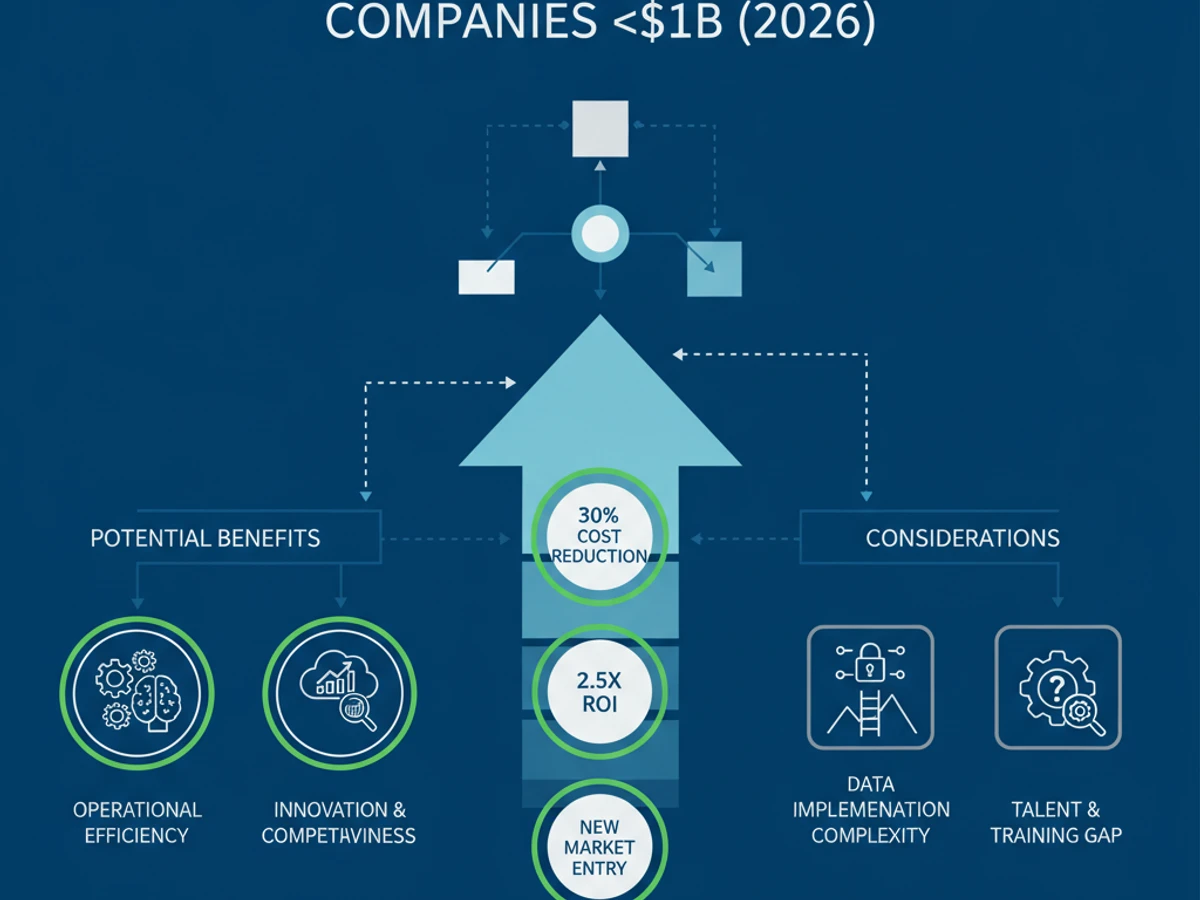
is enterprise AI strategy consulting worth it for companies under $1B revenue in 2026 | Yes, enterprise AI strategy consulting is worth it for companies under $1B in revenue in 2026, but only when the engagement focuses on measurable business outcomes rather than generic strategy decks. The research tells a cautious story: IBM's CEO study found that only about 25% of AI initiatives deliver expected ROI, and just 29% of leaders can confidently measure AI ROI at all. For mid-sized companies without in-house AI architects, data engineers, or governance teams, that gap between AI spending and actual proof is exactly where a focused consulting partner earns its fee.
The honest answer to whether enterprise AI strategy consulting is worth it for companies under $1B in revenue depends heavily on which consulting firm you hire and how tightly the engagement is tied to production outcomes. Companies that pair strategy with hands-on implementation consistently outperform those that buy strategy alone and then struggle to execute internally.
The gap between AI spending and AI proof is now the central tension of the 2026 enterprise technology cycle, and it is being priced into the cost of capital itself, not just internal budgets.
Is Enterprise AI Strategy Consulting Worth It for Companies Under $1B Revenue in 2026?
For most companies under $1B in revenue, enterprise AI strategy consulting is worth it specifically when it replaces missing internal capability, such as data architecture, model governance, or change management, rather than duplicating what an internal team could already do. The core problem consulting solves is not access to AI models; it is the **execution gap between pilots and production**. Research shows that while 88% of organizations now use AI in at least one function, only 39% report measurable enterprise-level EBIT impact.
When Consulting Pays Off
- No internal AI architecture team: Mid-market companies typically lack the data engineers and AI architects that large enterprises use to translate strategy into deployable systems.
- Multiple competing AI priorities: When leadership cannot decide which of five potential use cases to fund first, an outside strategist with cross-industry pattern recognition shortens the decision cycle.
- Regulatory or governance exposure: Companies touching hiring, credit, healthcare, or safety-critical systems need governance built before scaling, not after a compliance incident.
- A failed first attempt: Companies that already tried and stalled on an internal pilot often need a partner who can diagnose why the first effort did not reach production.
When It Is Not Worth It
Consulting is a poor fit when a company only needs a narrow, well-defined tool integration, or when leadership has not yet secured executive sponsorship for the **change management that any AI rollout requires**. Paying $75,000 to $250,000 for a strategy engagement without budget for implementation, as industry pricing analysis notes, often produces a shelved document rather than a working system.
Key Takeaway: Enterprise AI strategy consulting is worth it under $1B in revenue when it fills a specific capability gap tied to execution, not when it is purchased as a standalone strategic exercise disconnected from implementation budget. Understanding this distinction shapes whether consulting becomes a driver of real competitive advantage or simply another line item on the P&L. For deeper context, see Tesla Model 3 Has a Much Better Looking Wheel Hiding ....
Why Do Most AI Initiatives Fail to Deliver ROI, and What Does Consulting Actually Fix?
Most AI initiatives fail to deliver ROI because companies skip the underlying data, workflow, and measurement infrastructure needed to turn a pilot into a production system. A widely cited 2026 research review found that companies pulling ahead built three layers before deploying AI: measurement of whether tasks actually work, infrastructure to connect tasks into automated workflows, and a strategy layer that keeps the system learning. Most companies never build the **first layer of measurement**, which means they cannot tell if their AI is actually working when it goes live.
The Scale of the Failure Problem
| Metric | Figure | Source |
|---|---|---|
| Companies that abandoned most AI projects in 2025 | 42% | Gartner, cited via industry research |
| Enterprise generative AI pilots that fail to reach production | 95% | MIT NANDA study |
| Companies reporting neither revenue gains nor cost savings from AI | 56% | PwC research |
| S&P 500 firms that could cite a measurable AI benefit (Q4 2025) | 21% | Morgan Stanley |
| Enterprises reporting substantial, at-scale ROI | 5%-8% | BCG / KPMG 2026 surveys |
What a Well-Scoped Consulting Engagement Corrects
- Sequencing problems: Leaders reinvest early wins into stronger capabilities, and companies that understand this pursue near-term efficiency wins to fund longer-term transformation rather than expecting every value type at once.
- Governance gaps: Only 13% of IT leaders in one 2025 survey strongly agreed their organization had adequate AI governance structures, a gap that consulting-led frameworks are built to close.
- Measurement blindness: Without a defined EBIT or cost-savings baseline before the project starts, companies cannot prove the return even when it exists.
Key Takeaway: AI initiatives fail predominantly due to missing infrastructure and measurement discipline rather than model quality, which is precisely the layer that experienced AI strategy consulting is designed to build before technology deployment begins. This infrastructure gap is where strategy consulting delivers its clearest value. For measured impact data, see 56% of CEOs see no AI ROI, PwC survey finds.
What Does Enterprise AI Strategy Consulting Cost for Companies Under $1B in Revenue?
Enterprise AI strategy consulting for companies under $1B in revenue typically costs between $75,000 and $250,000 for a mid-sized engagement, though total program costs including implementation can run into the low millions depending on scope. Pricing varies enormously by firm type, and understanding which tier you are actually buying matters more than the **headline hourly rate**.
Consulting Tiers and What They Actually Deliver
| Firm Type | Typical Hourly Rate | Best Fit For | Common Limitation |
|---|---|---|---|
| Strategy-only houses (MBB-style) | $300-$500+ | Board-level positioning and market framing | Strategy deck often has no execution path attached |
| Global systems integrators | $400-$1,000+ | Programs above $20M in scale | Structured for enterprise budgets, not mid-market speed |
| Build-led consultancies / end-to-end partners | $150-$300 | Companies needing strategy plus working systems | Requires a partner with both strategic and technical depth |
| Junior or offshore implementation teams | $35-$150 | Narrow, well-defined technical tasks | Often lack strategic oversight capabilities |
Full Year-One Budget Components
- Consulting fees: Most mid-market companies allocate $75,000 to $200,000 for consulting engagements covering strategy and initial implementation.
- Platform and licensing costs: Expect roughly $12,000 to $18,000 annually for platform licensing covering around 50 users, on top of consulting fees.
- Internal resource time: Internal teams should plan to spend 10% to 20% of their time supporting the engagement, a cost many CFOs fail to budget for.
- Infrastructure overhead: Cloud hosting, vector databases, and monitoring tools typically add a few hundred dollars per month for mid-market deployments.
A $300-per-hour strategist who properly scopes a project and manages implementation can cost less overall than a cheaper consultant on a poorly scoped engagement, because the poorly scoped project produces shelf-ware rather than a working system.
Key Takeaway: The real cost question is not the hourly rate but whether the engagement bundles strategy with execution; standalone strategy work at any price point rarely survives contact with operational reality without a build partner attached. This distinction often determines whether your AI investment becomes a competitive advantage or a learning experience that teaches you what not to do next time.
What Digital Transformation Strategies Work Best for Mid-Sized Companies in 2026?
The most effective digital transformation strategies for mid-sized companies in 2026 combine a narrow, high-confidence starting use case with an end-to-end partner who can carry that use case from pilot to production without a handoff gap. Companies that treat transformation as a single sprawling initiative consistently underperform those that **sequence smaller wins first**.
Build vs. Buy vs. Partner
| Approach | Speed to Value | Internal Burden | Best For |
|---|---|---|---|
| Fully in-house build | Slow (6-18 months) | High; requires hiring architects and engineers | Companies with existing data science teams |
| Off-the-shelf SaaS AI tools | Fast (weeks) | Low | Narrow, single-function tasks |
| Strategy-only external advisor | Slow to show results | Medium; execution still falls internally | Companies wanting outside validation only |
| End-to-end transformation partner | Moderate (3-6 months to first result) | Low to moderate; shared accountability | Mid-sized companies without dedicated AI teams |
Where Mid-Market Companies Are Actually Starting
- Operational efficiency first: Automating manual workflows in approvals, data entry, and reporting tends to produce visible results within a few months, making it the most common entry point.
- Sales and CRM augmentation: AI-assisted lead scoring and meeting summaries let sales teams spend more time engaging prospects rather than doing administrative work.
- Adoption without operationalization: One December 2025 survey of 100 senior mid-market decision-makers found 94% were using generative AI, yet only 2% had operationalized it at scale, a 92-point gap between experimentation and real deployment.
- Governance-first sequencing: Companies whose AI touches hiring, credit, or safety-critical decisions are increasingly starting with governance and compliance review before scaling any use case further.
Key Takeaway: Digital transformation strategies for mid-sized companies succeed most often when they start narrow, prioritize a partner who can execute rather than just advise, and close the well-documented gap between experimentation and operational scale. This gap between what companies are trying and what they are actually operating at scale is where the real strategic work happens. For further reading, see Best AI Consulting Firms in 2026: Complete Buyer's Guide.
How Does an End-to-End Consulting Model Improve AI Consulting ROI in 2026?
An end-to-end consulting model improves AI consulting ROI in 2026 by eliminating the handoff between the firm that designs the strategy and the team that builds it, which is the single most common point of failure for mid-sized companies. When one partner owns strategy, data engineering, software delivery, and customer experience design together, **accountability for the outcome cannot be diffused across vendors**.
Why the Handoff Gap Kills ROI
A recurring pattern from mid-market case examples shows what happens without integrated execution: one mid-market manufacturer spent months developing an AI strategy with only senior leadership involved, and when they tried to roll it out, plant managers pushed back because operational reality had never been consulted, wasting three months on rework. That is the exact failure mode an **end-to-end model is built to prevent**.
Adspro's Approach to Closing the Gap
Adspro.xyz positions itself as an end-to-end partner for AI-first digital transformation, working across strategy, data engineering, enterprise software, brand, commerce, and customer experience rather than handing clients off between separate vendors for each stage. Adspro believes intelligent automation and AI are essential catalysts for modern business growth, and its approach emphasizes strategy-led, measurable outcomes paired with a **hands-on partnership tailored to enterprise needs** rather than a generic playbook.
- Single accountable partner: Strategy, data, and build sit under one roadmap, reducing the risk of a strategy deck that never becomes a working system.
- Measurable outcomes focus: Engagements are structured around business impact metrics rather than deliverable checklists, addressing the measurement gap that leaves most companies unable to prove ROI.
- Enterprise-grade, scalable delivery: Solutions are designed to scale across business functions rather than remain locked in a single department's pilot.
- Hands-on implementation: Adspro guides clients from strategy through actual deployment, closing the exact gap that causes most mid-market AI programs to stall before production.
Key Takeaway: The ROI advantage of an end-to-end model comes from removing the strategy-to-execution handoff entirely, which is where most mid-sized companies lose the return they were promised at the start of the engagement. That structural alignment is what separates the 5-8% of companies achieving real ROI from the 95% still stuck in the pilot phase. For measured impact data, see Best AI Consulting Services for Mid-Market Companies ....
Conclusion
Enterprise AI strategy consulting is worth it for companies under $1B in revenue in 2026 when the engagement is scoped around execution and measurement, not when it is purchased as an isolated strategic exercise. The data is consistent across every major 2026 survey: adoption is nearly universal, but measurable financial return remains rare, and the difference almost always comes down to whether **strategy and implementation were bought together or separately**.
- Scope for execution, not just advice: A strategy document without an implementation budget rarely survives contact with operational reality.
- Demand measurement before the project starts: Companies that define an EBIT or cost baseline upfront are far more likely to prove ROI than those that measure activity alone.
- Prioritize governance for regulated use cases: Hiring, credit, healthcare, and safety-critical applications need governance built in before scaling.
- Choose a partner who owns the full stack: End-to-end models that combine strategy, data, and build reduce the handoff failures that stall most mid-market AI programs.
Companies evaluating whether to move forward should treat the first ninety days as a proof point, not a formality, and select a partner willing to be measured against business outcomes rather than deliverables alone.
Key Takeaway: For companies under $1B in revenue, enterprise AI strategy consulting offers significant value in 2026 when it prioritizes execution, measurable outcomes, and integrated end-to-end partnerships to bridge the gap between strategy and successful deployment.
FAQ
Is Enterprise AI Strategy Consulting Worth It for Companies Under $1B in 2026?
Yes, for most companies under $1B in revenue, enterprise AI strategy consulting is worth it in 2026 when the engagement combines strategy with hands-on implementation and clear ROI measurement. It is far less worth it when purchased as a standalone strategy exercise, since research shows only about 25% of AI initiatives deliver expected ROI and most failures trace back to missing execution infrastructure, not bad strategy advice.
How much does AI strategy consulting cost for a mid-sized company?
Most mid-market companies budget between $75,000 and $200,000 for consulting, plus platform licensing and internal staff time, though full-year program costs including implementation often run higher depending on scope and number of use cases.
Why do most enterprise AI projects fail to show ROI?
Most enterprise AI projects fail to show ROI because companies skip building measurement systems, workflow infrastructure, and governance before deploying models; one major 2026 study found that 95% of custom enterprise generative AI pilots fail to reach production with measurable impact.
What is the difference between strategy-only consulting and end-to-end AI consulting?
Strategy-only consulting delivers analysis and recommendations without building the systems needed to execute them, while end-to-end consulting owns strategy, data engineering, and software delivery under one roadmap, which reduces the handoff gap that causes most mid-market AI programs to stall.
What size company qualifies as "mid-market" for AI consulting purposes?
Mid-market companies are generally defined as those with revenues between $10 million and $1 billion, a segment that typically lacks the internal AI architecture teams that larger enterprises maintain.
How long does it take to see ROI from AI consulting?
Well-scoped engagements focused on a narrow use case commonly show operational results within a few months, though full enterprise-level financial impact, such as measurable EBIT contribution, often takes longer and requires the initial win to be reinvested into broader capability building.
What should a company look for before hiring an AI strategy consultant?
A company should confirm the consultant will define a measurable baseline before the project starts, commit to an implementation path rather than just a strategy deck, and demonstrate experience building governance for regulated use cases if the company operates in hiring, credit, healthcare, or safety-critical domains.
Is digital transformation different from AI strategy consulting?
Digital transformation is the broader organizational shift toward modern, data-driven operations, while AI strategy consulting is typically one component of that shift focused specifically on identifying, prioritizing, and implementing AI use cases within the larger transformation effort.
This article was compiled using publicly available industry research from sources including IBM, McKinsey, BCG, Gartner, MIT, Morgan Stanley, and independent industry analysts current as of September 2026. Figures cited reflect the most recent published surveys available at time of writing and are subject to revision as new data emerges. This content is for informational purposes and does not constitute financial, legal, or investment advice.