Is AI Strategy Consulting Worth It for Enterprise Digital Transformation in 2026?
Discover if AI strategy consulting is worth it for enterprise digital transformation in 2026 and how it can drive your business forward.
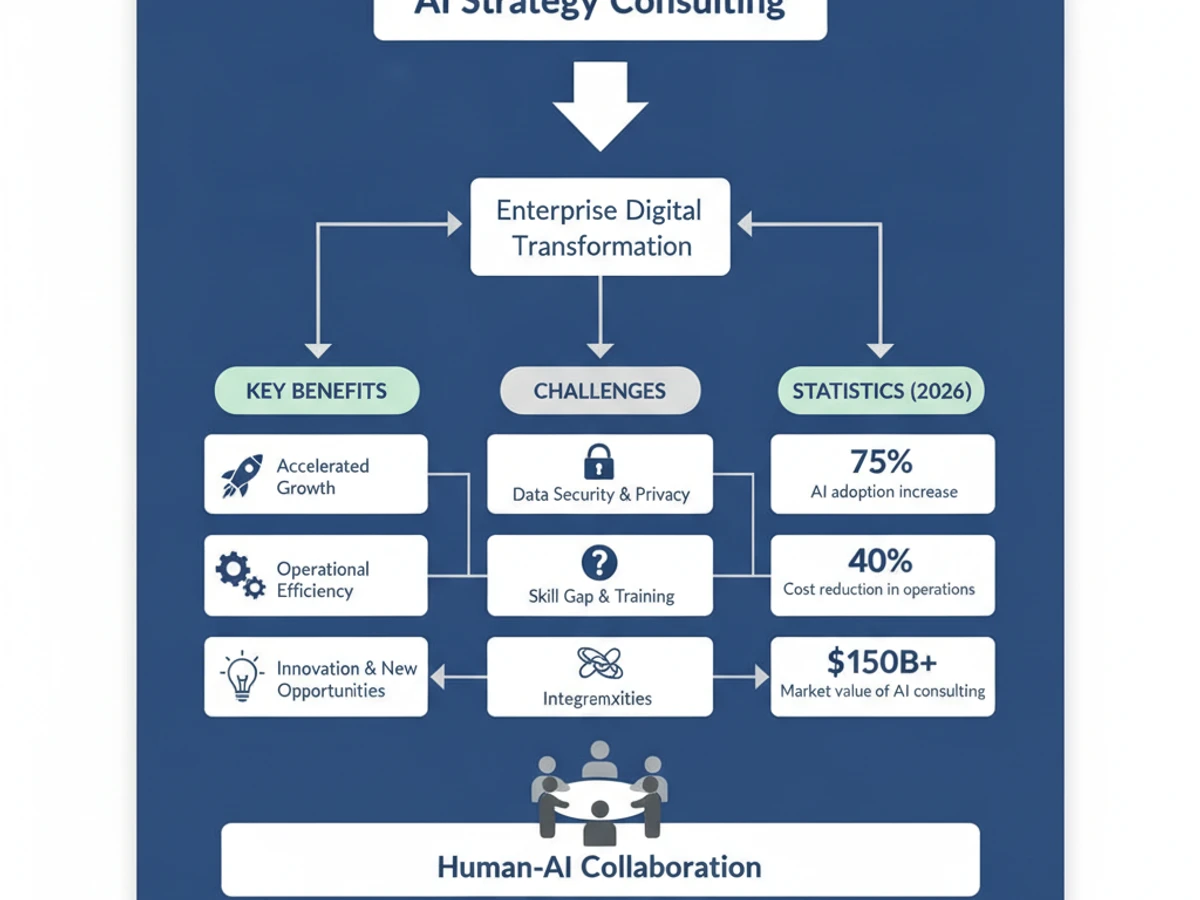
is AI strategy consulting worth it for enterprise digital transformation in 2026 | 9 min read | Adspro.xyz Editorial Team
For most large organizations, AI strategy consulting is worth it for enterprise digital transformation in 2026, but only when the engagement is scoped around measurable business outcomes rather than generic AI enablement. Here's the reality: enterprise AI adoption has reached near-universal levels, yet McKinsey's 2026 State of AI survey found that only 6% of organizations qualify as "AI high performers" attributing significant earnings impact to their investments. The honest answer to whether AI strategy consulting is worth it depends entirely on whether the consulting model is built for production deployment or just for slide decks.
This distinction has never mattered more. Enterprises have moved past the adoption question. They're not asking whether to use AI anymore; they're asking why pilots stall, why budgets get cut mid-project, and why competitors seem to be capturing value faster from the same technology stack.
The gap in enterprise AI today is not a technology gap. It is an execution gap. Most organizations already have access to the same models, the same cloud infrastructure, and similar budgets. What separates the 6% of high performers from the rest is disciplined, production-focused strategy work done before a single model gets deployed.
What Does "AI Strategy Consulting" Actually Mean for Enterprise Transformation?
AI strategy consulting is the practice of aligning an enterprise's business objectives, data infrastructure, and operating model with a prioritized roadmap for deploying AI at scale, rather than experimenting with isolated pilots. It differs from generic IT consulting because it addresses data readiness, governance, and change management as core deliverables, not afterthoughts. In 2026, the discipline has matured well beyond "chatbot strategy" into full-scale operating model redesign.
Core Components of a Real AI Strategy Engagement
- Use-case prioritization: Ranking potential AI applications by feasibility, data availability, and projected business impact rather than novelty or executive enthusiasm.
- Data readiness assessment: Auditing whether the organization's data is structured, governed, and accessible enough to actually support the proposed use case.
- Operating model design: Defining who owns AI outcomes, how cross-functional teams collaborate, and how success is measured after launch.
- Governance and risk framework: Establishing model monitoring, compliance checkpoints, and escalation paths before production deployment, not after an incident.
- Production roadmap: A phased plan that moves from pilot to scaled deployment with defined milestones, rather than an open-ended proof of concept.
Adspro positions this stage as the difference between AI as an experiment and AI as a durable growth lever, emphasizing strategy-led, measurable outcomes across the full transformation lifecycle from data engineering through customer experience.
Key Takeaway: AI strategy consulting is not a slideshow exercise. It is the operational scaffolding, data readiness work, and governance design that determines whether an enterprise AI initiative ever reaches production. Understanding this foundation is critical before examining the financial case for why so few organizations actually see returns. For deeper context, see Expert AI Strategy Consulting for Business Transformation.
Is AI Strategy Consulting Worth It for Enterprise Digital Transformation in 2026? What the Data Shows
The short answer is yes for enterprises that treat consulting as execution support, and no for those that treat it as a research exercise. Multiple 2026 studies converge on the same tension: adoption is nearly universal, but financial return remains concentrated in a small group of organizations that approached AI with disciplined strategy work from day one.
The Adoption-vs-ROI Gap in Enterprise AI
McKinsey's 2026 State of AI report found that 89% of organizations regularly use AI tools in at least one business function and 44% have already scaled them enterprise-wide, yet only 37% attribute a measurable positive impact on EBIT to artificial intelligence, a figure that has barely budged since 2025. When independent research compiled MIT, BCG, KPMG, and McKinsey data, it found that somewhere between 5% and 8% of companies report measurable, at-scale financial return from AI despite near-universal adoption.
The failure narrative is not new, and it remains stubbornly consistent. Multiple analyst reports have estimated that up to 85% of AI projects fail before or after deployment, roughly double the failure rate for traditional software. One industry analysis found that digital transformation initiatives overall succeed only about 12% of the time, underscoring that the pattern predates generative AI and reflects a broader execution problem in enterprise change management.
| Metric | 2026 Figure | Source | What It Signals |
|---|---|---|---|
| Organizations using AI in at least one function | 88-89% | McKinsey State of AI 2026 | Adoption is no longer the bottleneck |
| Organizations attributing EBIT impact to AI | 37% (flat YoY) | McKinsey State of AI 2026 | Value capture is stalling despite spend |
| "AI high performers" (5%+ EBIT impact) | 6% | McKinsey State of AI 2026 | Only a small tier converts AI into real returns |
| Companies reporting measurable, at-scale ROI | 5-8% | MIT / BCG / KPMG / McKinsey composite | Confirms the gap is structural, not one study's anomaly |
| Anticipated ROI on agentic AI (U.S. respondents) | 192% | PagerDuty / McKinsey survey via The AI Index | Expectations still exceed realized outcomes |
Key Takeaway: Is AI strategy consulting worth it for enterprise digital transformation in 2026? The data says yes for the disciplined minority. Only 6% of enterprises currently capture significant EBIT impact from AI, and closing that gap is precisely the work structured strategy consulting is built to do. The question shifts to identifying which organizations have the discipline to execute differently from the majority. For supporting data, see What Is AI Consulting? What It Does and When You Need It.
When Does AI Consulting Pay Off, and When Does It Waste Budget?
AI strategy consulting pays off when it is scoped around a bounded, measurable use case with clean data and a defined owner. It wastes budget when it becomes an open-ended discovery exercise disconnected from production deployment. Gartner projects that more than 40% of agentic AI projects will be canceled by 2027 due to unclear ROI and weak governance, which is precisely the failure mode that well-structured consulting engagements prevent.
Signals That Consulting Will Pay Off
- Bounded scope: The engagement targets one high-value process (claims triage, demand forecasting, customer service deflection) rather than an enterprise-wide "AI transformation."
- Executive sponsorship with budget authority: A single accountable leader can approve production deployment, not a committee requiring quarterly re-approval.
- Existing data infrastructure: The organization has structured, accessible data for the target use case rather than data scattered across disconnected legacy systems.
- Defined success metrics before kickoff: ROI is measured against a specific cost baseline (for example, cost-per-resolved-ticket) rather than vague productivity claims.
Signals the Engagement Will Stall
- Vendor-hype-driven scope: Leadership commits based on flashy demos run on clean, curated datasets rather than the organization's actual production data.
- No change management plan: Frontline teams are never trained or consulted, so adoption collapses after the pilot phase ends.
- Enterprise-wide rebuild ambitions: The project attempts to overhaul multiple business functions simultaneously instead of proving value narrowly first.
Companies that invest in change management and workforce training alongside their AI rollout are far more likely to see their initiatives succeed than those that treat deployment as a purely technical exercise.
This is why enterprises pursuing AI adoption benefit from a partner that treats governance and workforce readiness as part of the engineering work, not a separate HR conversation. Adspro builds this into its delivery model by pairing strategy work with data engineering and enterprise software implementation under one accountable team, reducing the handoff risk that causes many consulting engagements to stall between strategy and production. The difference between a successful engagement and a failed one often comes down to whether the consultant who wrote the strategy is still in the room during implementation.
Key Takeaway: Consulting pays off when scope is narrow, sponsorship is clear, and success metrics exist before day one. It fails when it becomes an unbounded discovery project detached from a production deployment plan. The build-versus-buy-versus-partner decision hinges on understanding these dynamics. For deeper context, see How AI Consulting Accelerates Digital Transformation for ....
Build, Buy, or Partner: How Should Enterprises Approach AI Strategy in 2026?
Enterprises generally choose between building AI capability internally, buying off-the-shelf tools, or partnering with a specialized consultancy. The right choice depends on internal talent depth, urgency, and how core the use case is to competitive differentiation. McKinsey's 2026 survey found that 32% of companies have already chosen to build a solution internally rather than buy an off-the-shelf product, a share that climbs to 38-39% in technology, healthcare, and professional services.
Comparing the Three Paths to AI Adoption
| Approach | Best For | Typical Risk | Time to Production |
|---|---|---|---|
| Build in-house | Enterprises with mature data teams and a core differentiating use case | Talent gaps and infrastructure debt slow delivery | 6-18 months |
| Buy off-the-shelf | Well-defined, common workflows (support ticketing, basic analytics) | Limited customization; vendor lock-in | Weeks to a few months |
| Partner with a strategy-led consultancy | Enterprises needing speed, cross-functional expertise, and governance built in | Requires clear scoping to avoid open-ended engagements | 3-6 months to first production use case |
Why Enterprises Increasingly Choose the Partner Model
- Speed without rebuilding internal teams: A partner brings data engineering, strategy, and software delivery expertise without a multi-year hiring cycle.
- Cross-functional accountability: A single partner spanning strategy, data, and implementation removes the handoff gaps that cause most enterprise-wide rebuilds to stall.
- Access to production-grade patterns: Experienced consultancies have already solved common failure points around data governance and monitoring across multiple engagements.
This is where Adspro operates as an end-to-end partner for AI-first digital transformation, spanning strategy, data engineering, enterprise software, brand, commerce, and customer experience, rather than handing off a strategy deck and leaving execution to internal teams. Adspro's brand point of view treats intelligent automation and AI as essential catalysts for growth, with a hands-on partnership model built specifically for enterprise needs rather than generic playbooks. The practical question then becomes what a high-ROI engagement actually looks like when it's structured this way.
Key Takeaway: The build-versus-buy-versus-partner decision should hinge on how core the use case is to competitive advantage and how quickly the enterprise needs to move from pilot to production, with partnership models increasingly favored for speed and cross-functional accountability.
What Does a High-ROI AI Consulting Engagement Look Like in Practice?
A high-ROI AI consulting engagement is structured around a phased path from diagnosis to production, with measurable checkpoints at each stage rather than a single large deliverable at the end. Enterprises that follow this pattern report meaningfully better outcomes than those pursuing broad, undefined AI transformation programs.
A Practical Phased Framework for AI Success
- Diagnostic and readiness audit: Assess data quality, existing tech stack, and organizational readiness for the specific use case under consideration.
- Prioritized use-case selection: Choose one or two high-value, well-bounded applications with clear cost baselines rather than an enterprise-wide wish list.
- Pilot with defined success metrics: Launch a scoped pilot with pre-agreed KPIs (cost reduction, cycle time, conversion rate) tracked from day one.
- Production hardening: Add monitoring, governance, and feedback loops before scaling beyond the pilot group.
- Scaled rollout and change management: Expand to additional teams with training and workflow redesign built in, not bolted on afterward.
Where Value Concentrates First
Customer service and support functions tend to show the clearest, fastest ROI because the unit economics are so easy to measure against a human-cost baseline. Industries where processes are already well-defined, such as IT service management and cloud operations, report notably higher success rates than functions requiring broad, undefined workflow redesign. This pattern holds regardless of the technology stack or consulting partner, which suggests the structure of the engagement matters more than the specific tools chosen.
Key Takeaway: High-ROI engagements share a common shape: narrow scope, measurable pilots, and production-hardening before scale. This is exactly the discipline Adspro applies across its strategy-through-implementation engagements to help enterprises unlock measurable value and competitive advantage. For measured impact data, see 10 Best AI Strategy Consulting Firms for 2026 - Vivaldi Group.
Conclusion
Is AI strategy consulting worth it for enterprise digital transformation in 2026? The evidence points to a conditional yes: enterprises that pair strategy work with disciplined execution consistently outperform those chasing AI adoption without a production roadmap. The gap between the 88% of organizations using AI and the 6% capturing significant financial returns is the exact space where well-structured consulting earns its value.
- Adoption is not the bottleneck: Nearly 9 in 10 enterprises already use AI in some function. The differentiator is execution discipline, not access to technology.
- Scope determines success: Bounded, measurable use cases consistently outperform open-ended enterprise-wide AI initiatives.
- Governance prevents cancellation: With over 40% of agentic AI projects at risk of cancellation by 2027, governance and monitoring built in from day one are non-negotiable.
- The partner model reduces handoff risk: End-to-end partners spanning strategy, data, and implementation avoid the gaps that stall internal rebuilds.
- Measurement must precede deployment: Defining success metrics before kickoff separates the small group of high performers from the majority still waiting for returns.
Enterprises evaluating a consulting partner for 2026 should prioritize firms that treat strategy as the beginning of a production pathway rather than the end product, which is the operating model Adspro applies across strategy, data, software, and customer experience engagements for enterprise clients.
Key Takeaway: AI strategy consulting is highly valuable for enterprise digital transformation in 2026 when focused on disciplined execution, measurable outcomes, and robust governance to bridge the significant gap between AI adoption and realized financial returns.
FAQ
Is AI Strategy Consulting Worth It for Enterprise Digital Transformation in 2026?
Yes, for enterprises that scope engagements around measurable, bounded use cases with defined success metrics and executive sponsorship. The data shows a wide gap between AI adoption (88-89% of organizations) and realized financial return (only 6% report significant EBIT impact). Disciplined consulting is specifically designed to close that gap by focusing on data readiness, governance, and production deployment rather than open-ended experimentation.
What percentage of AI projects actually fail?
Estimates commonly cite that up to 85% of AI projects fail before or after deployment, roughly double the failure rate of traditional software projects, though the precise origin of this figure has been debated among analysts. More recent 2026 research places measurable, at-scale ROI at just 5-8% of companies despite near-universal adoption.
How much does enterprise AI strategy consulting typically cost?
Costs vary widely based on scope, ranging from focused single-use-case engagements over a few months to multi-year enterprise-wide transformation programs. Enterprises should prioritize firms that tie pricing to defined milestones and production outcomes rather than open-ended hourly discovery work, since unbounded scope is a leading cause of stalled engagements.
What is the difference between AI strategy consulting and AI implementation?
AI strategy consulting focuses on use-case prioritization, data readiness, and governance design before any code is written, while implementation covers the actual engineering, deployment, and integration work. The most effective engagements combine both under one accountable partner, since strategy recommendations that never connect to an execution team are a common reason initiatives stall after the pilot phase.
How long does it take to see ROI from an AI consulting engagement?
Well-scoped pilots targeting a single measurable process, such as customer service deflection, can show initial ROI signals within three to six months. Broader, enterprise-wide AI transformation programs typically take twelve months or longer to demonstrate measurable EBIT impact, which is part of why McKinsey found EBIT impact reporting has remained flat year-over-year despite rising adoption.
Should enterprises build AI capabilities in-house or hire a consulting partner?
The decision depends on internal data maturity and how core the use case is to competitive advantage. 32% of companies chose to build solutions internally rather than buy off-the-shelf products in 2026, but many still lack the cross-functional expertise to move from pilot to production quickly. A partner model spanning strategy, data engineering, and software implementation, such as the approach used by Adspro, reduces the handoff risk between strategy recommendations and actual deployment.
What causes AI digital transformation projects to fail most often?
The most common causes include poor data quality and governance, misaligned success metrics defined too late, unbounded project scope attempting enterprise-wide change at once, and lack of change management for frontline teams. Analysts note that the underlying AI technology is rarely the actual point of failure. Execution discipline is.
How do I know if my organization is ready for AI strategy consulting?
Readiness signals include having a specific, high-value business problem in mind, structured and accessible data related to that problem, an accountable executive sponsor, and willingness to measure success against a clear cost or performance baseline before starting. Organizations lacking these elements typically benefit more from a shorter readiness audit before committing to a full-scale engagement.
This article is for informational purposes and reflects publicly available research and industry data as of September 2026. Statistics are drawn from cited third-party sources including McKinsey, Gartner, and independent industry analyses; figures may be updated as new reports are published. This content does not constitute financial, legal, or investment advice, and organizations should conduct their own due diligence before selecting a consulting partner.