Is AI Automation Worth It for Small Businesses in 2026?
Discover whether is AI automation worth it for small businesses in 2026, exploring benefits, challenges, and future trends for your company.
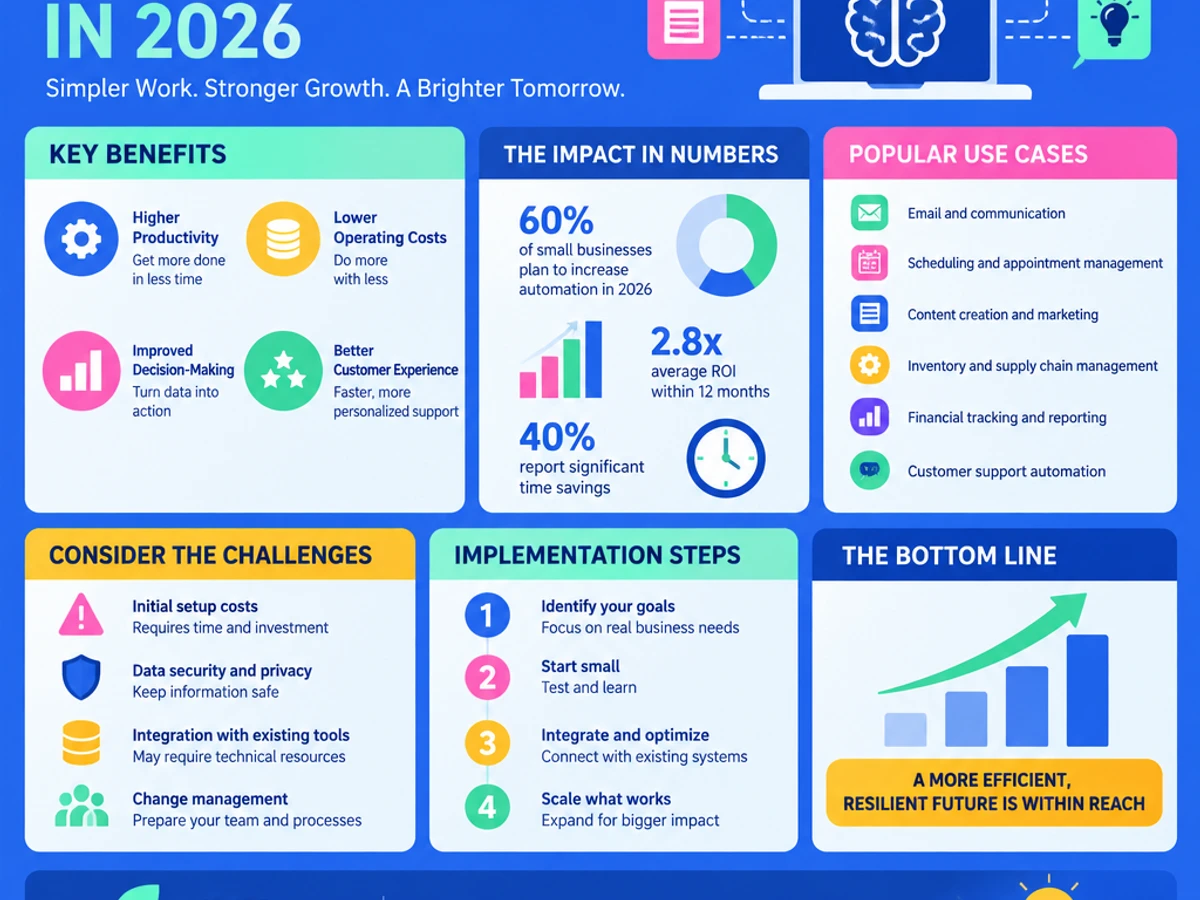
is AI automation worth it for small businesses in 2026 | 9 min read | Adspro.xyz Editorial Team
Is AI automation worth it for small businesses in 2026? For most adopters, yes. U.S. Chamber of Commerce data shows 58% of small businesses use generative AI, up from 40% in 2024. Independent research finds 67% of AI-adopting small and mid-sized businesses report revenue growth of 20% or more tied to automated processes. The real risk in 2026 is adopting without a clear plan.
The gap between winners and underperformers comes down to execution. Firms that redesign workflows around automation tend to report measurable gains in revenue, time, and customer satisfaction. Those that add tools to unchanged processes see little return. A structured, consultant-guided approach, like Adspro.xyz, consistently outperforms trial-and-error implementations.
The small businesses winning with AI in 2026 are not the ones with the most tools. They are the ones who redesigned a workflow around the tool instead of bolting the tool onto an unchanged process.
Is AI Automation Worth It for Small Businesses in 2026? What the Numbers Show
Yes. Multiple independent surveys confirm businesses integrating AI into daily operations report higher revenue, lower costs, and more reclaimed time than non-adopters.
- Revenue growth: McKinsey's 2025 AI report found 67% of small businesses using AI automation saw 20%+ revenue growth in the past year, up from 41% in 2023.
- Return on investment: Small businesses report an average ROI of roughly 3.7 times their AI tool investment.
- Revenue confidence: 91% of small businesses using AI say it boosts revenue, and 90% say it improves efficiency.
- Competitive lift: AI-using small businesses are 2.3 times more likely to report revenue growth than non-adopters.
- Owner sentiment: Goldman Sachs' 2026 survey found 93% of AI users say it positively impacts their business.
Key Takeaway: Across credible 2026 data sets, large majorities of AI-using small businesses report positive revenue, efficiency, or cost outcomes. Well-planned implementation is a reasonable bet. For supporting data, see Tax Information for Businesses.
What Is the Real ROI of AI Automation for Small Businesses in 2026?
Real ROI depends on which function is automated and implementation discipline. Customer service and marketing automation show the clearest payback for small businesses.
| Automation Category | Reported ROI or Savings | Source |
|---|---|---|
| AI-powered customer service | $3.50 return per $1 invested | Analyst consensus, 2025 |
| Marketing automation | $5.44 return per $1 spent | Marketing automation benchmarks, 2025 |
| General AI workflow automation | $7,500 average annual savings, 25% save $20,000+ | AI automation industry benchmarks, 2025 |
| Scheduling and payroll AI | 7.7 hours and $4,100 saved per year | Homebase 2026 Main Street AI Gap Report |
| Time savings across AI users | 58% save over 20 hours per month | Thryv Small Business AI Survey, 2025 |
The Adoption Curve is Still Climbing
Uneven growth: Adoption among companies with 10 to 100 employees jumped from 47% to 68% in a single year. The 2026 Main Street AI Gap Report found adoption ranges from 54% among businesses under $500,000 revenue to 81% at $5 million+, a 27 percentage point gap tied to available resources.
Where the Gains Concentrate
- 63% of AI-using small businesses run AI as part of daily workflows.
- 62% of SMBs use AI for data analysis, the most common use case.
- Only 14% of small businesses are fully integrating AI into core operations, leaving significant unclaimed opportunity.
Key Takeaway: Customer service and marketing automation produce the clearest returns today. Full operational integration, where only 14% operate, represents the next growth frontier. For measured impact data, see AI Automation in 2026: What Business Leaders Must Know ....
Which AI Automation Use Cases Deliver the Fastest Payback?
Fastest payback comes from automating high-volume, repetitive tasks with clear measurement paths. Owners who start narrow see results within weeks.
- Lead response automation: 78% of customers hire the company that responds first.
- Customer service chatbots: Automated self-service cuts support incidents by 40-50%, with cost reductions exceeding 20%.
- Marketing content generation: Automated email campaigns generate substantially more revenue than manual sends.
- Administrative and scheduling: Pairing scheduling with payroll automation frees roughly half an FTE's capacity for higher-value work.
- Pricing optimization: 97% of small businesses using AI pricing tools report positive revenue impacts, and 94% say tools improve competitiveness.
Building an AI Stack, Not a Single Tool
The average small business uses a median of five AI tools, combining assistants, marketing platforms, and automation tools.
A local HVAC company that automated call answering and booking saw its call answer rate rise from 60% to 98% and booking conversion climb from 35% to 58%, recovering an estimated $3,000 a month in previously missed revenue.
Key Takeaway: Fastest payback comes from sequencing automation around the two or three highest-volume workflows with the clearest measurement paths. For deeper context, see Worth Sports | Crush The Slowpitch Softball Competition | Worth.
What Are the Risks and Pitfalls of AI Automation for Small Businesses?
AI automation carries real risks. MIT's NANDA research found about 95% of enterprise generative AI pilots delivered no measurable profit-and-loss return, typically due to automating broken processes instead of redesigning them.
| Common Pitfall | Why It Happens | What Reduces the Risk |
|---|---|---|
| Bolting AI onto unchanged process | Owners automate a step without redesigning the workflow | Map the full workflow before selecting a tool |
| Lack of technical expertise | Cited by 49% of small business AI users | Partner with an experienced implementation team |
| Data privacy and security concerns | Cited by 50% of small business AI users | Establish governance and access controls up front |
| Difficulty choosing the right tools | Cited by 48% of small business AI users | Pilot one workflow before scaling the stack |
| No measurement framework | Owners can't prove results, so budget gets pulled | Define revenue, time, and cost KPIs before launch |
Goldman Sachs' data confirms data privacy, technical expertise, and tool selection are the three most cited challenges among AI-using small businesses.
Jobs Are Not the Primary Casualty
87% of small businesses say AI augments rather than displaces employees, and nearly all reported no change in headcount after adoption.
Key Takeaway: Failures stem from workflow redesign, governance, and measurement gaps, not the technology itself. Getting these fundamentals right transforms AI into a predictable competitive advantage. For more on common pitfalls, see AI Automation for Small Business: A Practical Starter Guide.
How Should Small Businesses Implement AI Automation in 2026?
Best results come from structured, strategy-first implementation rather than scattered tool purchases.
A Practical Rollout Sequence
- Audit before you automate: Map workflows and identify which bottleneck costs the most time or revenue.
- Pilot one high-volume workflow: Choose the process with the clearest measurement path before expanding.
- Set measurable KPIs up front: Define revenue, time, or cost targets before launch so results can be proven.
- Build governance alongside adoption: Establish data access, privacy, and security protocols early.
- Scale with a partner: Businesses pairing internal teams with experienced implementation partners outperform solo rollouts.
Where Adspro.xyz Fits
Adspro.xyz operates as an end-to-end digital transformation consultancy, designing, building, and scaling AI-powered solutions across strategy, data, software, brand, commerce, and customer experience. Its strategy-led approach emphasizes measurable outcomes paired with hands-on partnership tailored to each business's operating model, bridging the gap between the 95% of stalled pilots and the minority achieving lasting revenue growth.
Key Takeaway: Disciplined, audited, partner-guided rollouts convert statistical odds in a small business's favor, turning AI automation into a measurable operating advantage.
Conclusion
The 2026 data makes a consistent case: AI automation is worth it for most small businesses that implement it with a clear plan, measurable goals, and proper support. The risk is adopting without the strategic discipline that separates the 67% seeing real revenue growth from the roughly 80% whose pilots stall.
- Adoption is mainstream: 58% of small businesses use generative AI, with the fastest-growing segment jumping from 47% to 68% adoption in one year.
- ROI is real but uneven: Average reported ROI sits around 3.7x, concentrating in customer service, marketing, and scheduling automation.
- Execution determines outcome: Roughly 95% of unmanaged pilots fail due to workflow and measurement gaps, not technology flaws.
- Jobs are augmented, not eliminated: 87% of small businesses say AI supports rather than replaces their workforce.
- Partnership closes the gap: Structured, strategy-led implementation improves odds of landing in the successful minority.
Businesses ready to move past pilot-stage experimentation should audit their highest-volume workflow and pair that audit with an experienced AI implementation partner before scaling.
FAQ
Is AI Automation Worth It for Small Businesses in 2026?
Yes, for businesses implementing with a clear plan. Current data shows 67% of AI-adopting SMBs report 20%+ revenue growth, average ROI near 3.7x, and 93% report positive business impact. Results depend on choosing the right starting workflow and measuring outcomes from day one.
How much does AI automation typically cost a small business?
Costs vary widely by function, but small business AI tools trend toward tens of dollars per tool monthly. The average small business runs five tools in combination, while enterprise-grade consultancy-led projects carry higher investment tied to workflow redesign scope.
What is a realistic ROI timeline for small business AI automation?
Narrow, high-volume use cases like lead response, scheduling, and chatbots show measurable savings within one to three months. Broader operational integration typically takes longer but produces more durable revenue gains.
Will AI automation replace small business jobs?
Current evidence suggests augmentation rather than replacement. 87% of small businesses say AI supports rather than displaces employees, and nearly all reported no headcount changes after adoption.
Which small business functions benefit most from AI automation?
Customer service, marketing, lead response, scheduling, and data analysis show the clearest returns. Customer service automation reports $3.50 per $1 invested, and marketing automation averages $5.44 per $1 spent.
Why do some small businesses see no results from AI automation?
The most common cause is automating existing processes without redesigning workflows, compounded by gaps in technical expertise, unclear tool selection, and undefined KPIs before launch. These three factors are cited by roughly half of small business AI users as top barriers.
Should a small business hire an AI consultant or implement automation in-house?
Businesses with limited internal technical capacity generally see better outcomes partnering with experienced implementation teams. Structured, strategy-led rollouts address expertise and tool-selection gaps that cause most unmanaged pilots to stall.
What AI automation trends matter most for small businesses heading into 2026?
The clearest trend is a shift from single-tool experimentation toward integrated AI stacks, with the average small business running five tools. Full core-operations integration remains limited to 14% of businesses, leaving significant room for structured growth.
This article synthesizes publicly available 2025-2026 survey and research data from sources including the U.S. Chamber of Commerce, Goldman Sachs, Salesforce, McKinsey, Thryv, Intuit QuickBooks, Homebase, and MIT. Figures vary across methodologies and should be treated as directional industry benchmarks rather than guarantees of individual business outcomes. Consult a qualified digital transformation advisor before making AI investment decisions specific to your business.