How to Scale AI from Pilot to Production — Step-by-Step Guide (2026)
Discover essential strategies on how to scale AI from pilot to production in large enterprises effectively in 2026 with our step-by-step guide.
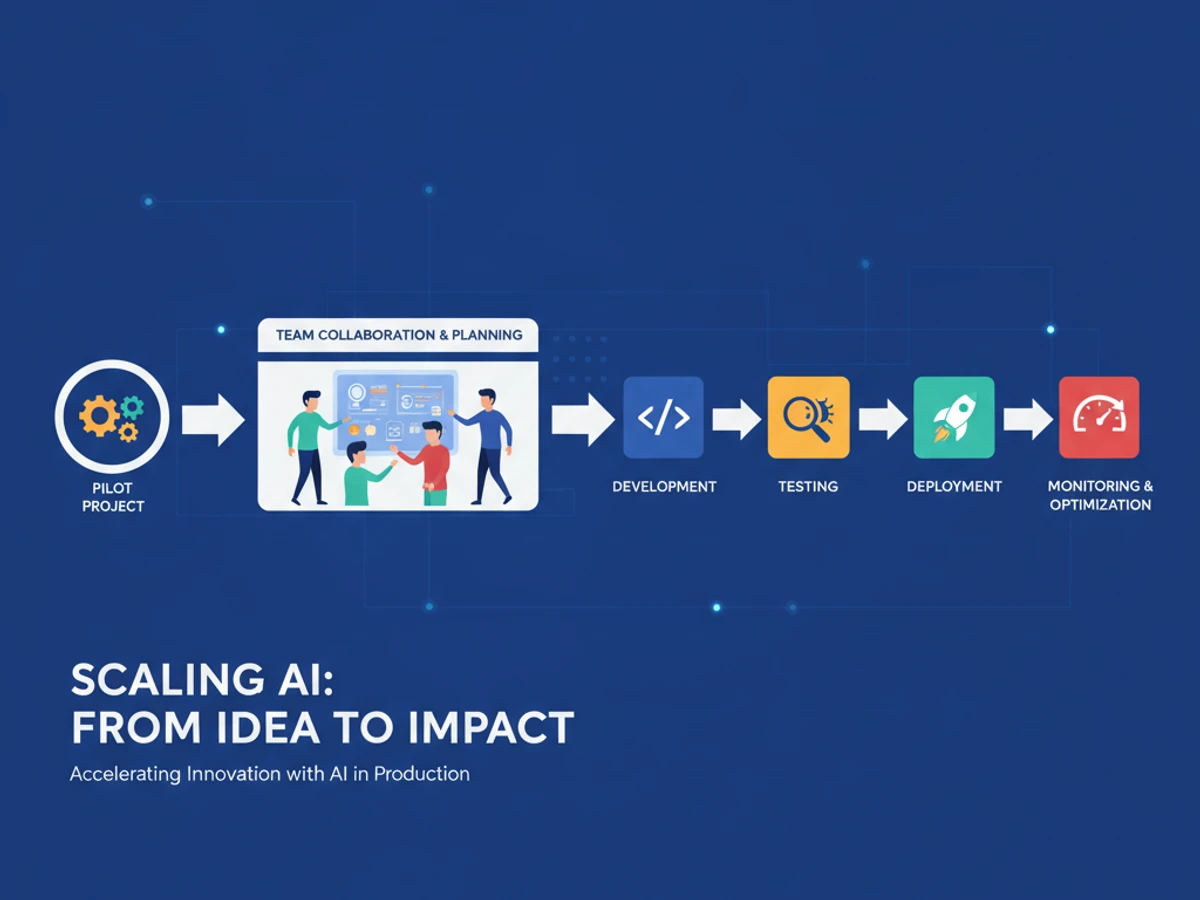
how to scale AI from pilot to production in large enterprises | Updated August 2026 | Adspro.xyz Editorial Team | 3–9 months (phased rollout) | Beginner
What You'll Learn
You're asking the right question. Most enterprises get AI pilots working in the lab, but scaling them into live operations is where things fall apart. This guide cuts through the noise and gives you the exact process that works: anchor every initiative to a business outcome with measurable ROI before writing any code, assess where your data and infrastructure actually stand, design the pilot to rehearse production conditions (not just look good in a demo), embed governance and MLOps infrastructure early, and execute a real change management program so people actually use the system. Each step eliminates a specific failure mode before it becomes expensive to fix. Adspro sees this pattern repeatedly across enterprises—organizations that treat AI as a strategy-led, measurable investment with hands-on governance and cross-functional ownership scale successfully. Those that skip any of these steps end up with expensive pilots that never ship.
- Identify and prioritize AI use cases tied directly to measurable business value.
- Assess and close data, infrastructure, and skills gaps before scaling begins.
- Build MLOps and governance infrastructure that sustains models in production.
- Execute a change management program that drives lasting enterprise adoption.
Prerequisites: Executive sponsorship, at least one completed or near-complete AI proof of concept, and basic familiarity with your organization's data landscape and technology stack.
Why Scaling AI from Pilot to Production Matters in 2026
The numbers tell a sobering story. According to McKinsey & Company's State of AI 2025 report, nearly two-thirds of organizations remain stuck in the experimentation or pilot stage. Meanwhile, a March 2026 survey of 650 enterprise technology leaders found that AI agent pilots are now nearly universal—78% have at least one running. But here's the gap: only 14% have successfully scaled an agent to organization-wide operational use.
The financial stakes are real. IDC and Microsoft measure a 3.7x average return per dollar invested in generative AI. Yet IBM's 2025 CEO study finds only 25% of AI initiatives delivered expected ROI. The organizations that solve the pilot-to-production problem now will capture a first-mover advantage in a competitive landscape that's about to restructure around AI operational capability.
Here's the thing: the scaling gap isn't a technology problem. The models work. The tooling has matured. The gap is organizational and operational. Most enterprises lack the evaluation infrastructure, monitoring tooling, and clear ownership structures needed to move a promising pilot into reliable production. This guide walks you through all of those gaps systematically—giving business leaders and technology decision-makers a repeatable path forward.
Key Takeaway: Despite widespread experimentation, most enterprises struggle to scale AI from pilot to production due to organizational and operational gaps, not technology limitations, creating a significant first-mover advantage for those who solve this challenge. For supporting data, see AI Pilot to Production: Why 95% of AI Projects Stall.
The Process at a Glance
| Step | Action | Time | Outcome |
|---|---|---|---|
| 1 | Define business outcomes and success criteria | 2–4 weeks | Funded use case with measurable ROI target |
| 2 | Run an AI readiness assessment | 3–6 weeks | Gap report with prioritized remediation plan |
| 3 | Design the pilot as a production rehearsal | 6–10 weeks | Validated model ready for production lift |
| 4 | Build governance and MLOps infrastructure | 4–8 weeks (parallel) | Monitored, compliant, production-grade system |
| 5 | Execute structured change management rollout | 8–12 weeks | Enterprise-wide adoption with tracked KPIs |
Total estimated timeline: 3–9 months, depending on organizational data readiness, governance approval cycles, and change management scope.
Step 1: Define Business Outcomes and Success Criteria
What You're Doing
You're anchoring the entire AI initiative to a specific, measurable business problem before any technical build begins. This step ensures the project has a production justification beyond a compelling demo. It's the difference between an AI project that ships and one that becomes a permanent line item on the budget.
How to Do It
- Identify a business problem with a clear owner, a defined cost or revenue impact, and existing data coverage. Avoid use cases chosen because they're technically interesting. The sexiest AI problem isn't worth shipping if it doesn't move the needle on something the business cares about.
- Define two to three KPIs that will determine production go/no-go—for example, error rate reduction, processing time per transaction, or revenue lift per customer segment.
- Set a minimum acceptable performance threshold. Below this threshold, the pilot does not proceed to production regardless of sunk cost. This is hard to enforce, but it's non-negotiable.
- Secure documented executive sponsorship at the VP level or above, with budget authority that survives the pilot phase.
Example
| Use Case | Business Owner | KPI | Minimum Production Threshold |
|---|---|---|---|
| Invoice processing automation | CFO / Finance Operations | Processing time per invoice | 60% reduction vs. manual baseline |
| Customer churn prediction | VP Customer Success | Precision/recall on 90-day churn | Precision >75%, recall >65% |
| Demand forecasting | VP Supply Chain | Forecast error (MAPE) | MAPE <12% across SKU portfolio |
Best Practices
- Every AI initiative must connect directly to a business problem with measurable impact. Deploying AI because competitors are doing it is one of the most common and expensive mistakes enterprises make. You'll see this play out: six months in, someone asks "What's the actual dollar value?" and nobody has a clear answer. By then, the project is funded, the team is hired, and nobody wants to kill it.
- Treat the use case like a capital allocation decision: require a written business case reviewed by Finance before greenlighting pilot spend.
Common Mistakes
- No defined exit criteria: Pilots built to showcase capability have no production justification when the demo ends. Without a measurable business case, AI never clears the budget gate. You'll hear things like "Well, the model was accurate" or "The team learned a lot." Neither of those buys you production deployment.
What Done Looks Like
A one-page use case brief exists, approved by a named executive sponsor, with at least two quantified KPIs and a documented minimum production threshold. Finance has reviewed it. It's not a presentation—it's a decision document.
Key Takeaway: Successful AI scaling begins with a clear, measurable business outcome and executive sponsorship, treating the AI initiative as a capital allocation decision with defined go/no-go criteria to avoid costly pilots without production justification. For a more detailed walkthrough, see Enterprise AI - From Pilot Projects to Production Success.
Step 2: Run an AI Readiness Assessment
What You're Doing
You're systematically auditing data quality, infrastructure, and team capabilities to surface the gaps that would cause a production deployment to fail—before committing engineering resources to a full build. This is where many organizations discover their data is messier, more fragmented, and less accessible than they thought. That's actually good information to have early.
How to Do It
- Data audit: Assess AI readiness across three dimensions: data quality and governance, infrastructure and integration architecture, and team ownership and skills. Flag data sources that are siloed, inconsistently labeled, or inaccessible to automated pipelines. If your data lives in spreadsheets passed between email inboxes, this is the step where that becomes a real problem.
- Infrastructure audit: Determine whether existing compute, cloud, and API infrastructure can handle production-level data volumes and latency requirements. Pilots can run on spreadsheets and small sandboxes. Production needs an operating model: MLOps for machine learning or LLMOps for large language model practices, monitoring, cost controls, and repeatable deployment patterns across environments. This is not optional.
- Skills gap audit: Map current data engineering, ML engineering, and domain expertise against what production will require. Identify whether to hire, train, or partner.
- Produce a written gap report with a prioritized remediation plan and owner assigned to each item.
Best Practices
- Pilots work with a curated subset of enterprise data. Production requires continuous, automated, governed access to live operational data across multiple systems and business units. That infrastructure does not exist by default in most mid-to-large enterprises. Building it after a pilot succeeds is expensive, slow, and politically complicated. Start infrastructure work during the pilot phase, not after. Engage Adspro or an equivalent transformation partner to co-facilitate the readiness assessment, particularly when legacy systems and data silos require independent evaluation. Adspro empowers organizations to unlock value and competitive advantage through advanced AI and digital transformation, positioning itself as a trusted advisor equipped to guide clients from strategy through implementation, with deep technical expertise and a proven track record across AI strategy, data engineering, enterprise software, and next-gen customer experience design.
Common Mistakes
- Skipping data quality validation: Pilots often run on pre-cleaned, filtered datasets. Real-world enterprise data is a collection of legacy silos and inconsistent schemas. A model that looks accurate in the pilot will degrade quickly in production when fed raw operational data. This is a common reason why AI pilots fail to scale. You can avoid this by testing your model against messy, real data during the readiness assessment itself.
What Done Looks Like
A written readiness report exists with a RAG-status (Red / Amber / Green) for data, infrastructure, and skills—and every Red item has a named owner and a resolution deadline before pilot kickoff. This isn't a shelf document. It becomes your remediation roadmap.
Key Takeaway: A thorough AI readiness assessment across data, infrastructure, and skills is crucial to identify and remediate gaps *before* committing to a full build, as production environments demand robust MLOps and access to live, messy operational data, unlike curated pilot conditions.
Step 3: Design the Pilot as a Production Rehearsal
What You're Doing
You're structuring the pilot so that every architectural and operational decision made during experimentation translates directly to the production environment. This is the single biggest lever for eliminating the most common cause of pilot failure when learning how to scale AI from pilot to production in large enterprises. Most pilots fail at scale not because the model is bad, but because the pilot was run under conditions that don't exist in production.
How to Do It
- Use the same data pipelines, access controls, and integration architecture that production will use. Avoid "lab conditions" that cannot be replicated at scale. If your pilot runs on a Jupyter notebook, your production won't be a Jupyter notebook. So don't build the pilot that way.
- Launch the solution in a limited, controlled environment with a defined user group and timeline. Collect structured feedback, track performance metrics, and document unexpected behaviors carefully. Real users will find edge cases you never imagined.
- Run the model against a representative sample of real, uncleaned operational data—not a curated subset. Performance on messy data is the only reliable predictor of production performance.
- Establish decision gates: define explicitly what metrics must be achieved before the pilot advances to staging, and what conditions trigger a redesign or cancellation.
- Document integration dependencies—every upstream data source and downstream system the production model will need to connect to.
Example
| Pilot Design Choice | Wrong Approach | Production-Rehearsal Approach |
|---|---|---|
| Data source | Manually cleaned spreadsheet export | Live API pull from the ERP system |
| User group | Data science team only | 5–10 end users from the target business unit |
| Evaluation | Accuracy on held-out test set | Business KPI impact over a 4-week live period |
| Infrastructure | Local Jupyter notebook | Cloud-hosted container matching the production environment |
Best Practices
- Run short, measurable pilots with business-backed success criteria—ideally four to six weeks of live operation before any scaling decision is made. Longer pilots often become political negotiations rather than technical evaluations.
- Establish measurable KPIs before the pilot, automate repeatable tasks, and embed subject-matter experts in delivery teams. Document assumptions, failure modes, and decision gates so that the organization learns and scales efficiently. This discipline separates pilots that inform production decisions from pilots that just consume time and budget.
What Done Looks Like
The pilot has completed at least four weeks of operation on real production data, hit or exceeded its minimum performance threshold, and produced a written integration map ready for the engineering team to execute against. You have a go/no-go decision, not a "let's see what happens" deployment.
Key Takeaway: Design your AI pilot as a direct rehearsal for production by using real data, production-like infrastructure, and actual end-users, ensuring that every decision made during experimentation is scalable and directly translates to the live environment.
Step 4: Build Governance and MLOps Infrastructure
What You're Doing
You're putting in place the operational backbone—model monitoring, deployment pipelines, and governance policies—that keeps AI systems accurate, compliant, and trustworthy after launch. This is the infrastructure that most enterprises skip, and it's exactly why their production systems start degrading six weeks after deployment. This step is essential for how to scale AI from pilot to production in large enterprises responsibly.
How to Do It
- Select your MLOps stack: The 2026 field has consolidated around a few credible options: Databricks and the hyperscaler platforms—SageMaker, Azure ML, and Vertex AI—compete at the top, with DataRobot serving specific automation needs and open-source stacks like MLflow, Weights & Biases, and Kubeflow for organizations with engineering depth. Choose based on your existing cloud footprint and engineering team capability, not on which platform has the best demo.
- Implement model monitoring: Real-time model monitoring is now expected. Batch monitoring—checking model performance weekly—is no longer sufficient for production AI. Platforms without real-time drift detection and alerting are losing ground in evaluations. You need to know when your model starts degrading before your business stakeholders find out.
- Define governance ownership: Every high-risk AI system needs a named accountable executive, typically at the VP level or above. Below that executive, organizations must define three distinct roles: the model owner, responsible for technical performance and monitoring; the business owner, responsible for the use case and downstream impact; and the compliance owner, responsible for regulatory alignment and documentation. This clarity prevents the "nobody's responsible" trap.
- Align to regulatory standards: Three external anchors define the structural expectations: the NIST AI Risk Management Framework (AI RMF 1.0), the NIST Generative AI Profile (AI 600-1), and ISO/IEC 42001:2023. These aren't optional. They're becoming the table stakes for enterprise AI deployment.
- Automate the deployment pipeline: MLOps practices—model versioning, automated testing, reproducible pipelines, and deployment orchestration—form the backbone of reliable production systems. Without these, you're manually deploying models and hoping nothing breaks.
Best Practices
- Balance innovation and governance through "governance by design" approaches that embed controls into AI development workflows rather than treating them as bottlenecks. This includes using automated governance tools, dashboards, and AI model management platforms to streamline approval processes, bias testing, and audit logging. Speed and compliance aren't opposites when you design the system right.
- Implement tiered governance based on risk levels: allow low-risk AI applications to move faster while high-risk systems receive appropriate scrutiny. A chatbot doesn't need the same governance overhead as a loan approval model.
Common Mistakes
- Bolting on governance after deployment: Without clear ownership, policies, and risk controls, AI programs can frequently stall, encounter avoidable security incidents, or fail altogether to earn stakeholder trust. Build governance in parallel with the pilot, not as an afterthought. If you wait until after the pilot succeeds, you'll face resistance from teams who are already running the system.
What Done Looks Like
A CI/CD deployment pipeline is live; real-time drift monitoring is alerting on a defined threshold; model, business, and compliance owners are named in a system of record; and the AI system has cleared a documented production readiness review. You're not shipping anything without this checklist complete.
Key Takeaway: Establishing robust MLOps and governance infrastructure, including real-time monitoring, clear ownership roles, and alignment with regulatory standards, is paramount for maintaining accurate, compliant, and trustworthy AI systems in production, and should be built in parallel with the pilot.
Step 5: Execute a Structured Change Management Rollout
What You're Doing
You're transitioning the AI system from a technically ready deployment into an operationally embedded capability that people actually use. This is where most scaling efforts quietly fail. You can have the best model in the world, but if your users don't adopt it, it's just an expensive research project. This is a crucial aspect of how to scale AI from pilot to production in large enterprises successfully.
How to Do It
- Redesign affected workflows: Identify every process step the AI system changes or replaces, document the new process clearly, train operators on the exception-handling protocol—what to do when the AI output is wrong—and establish manager accountability for adoption within their teams. People won't use a system if they don't understand how it fits into their actual job.
- Run a 90-day adoption program: This is not a one-time training event. It's a 90-day program with adoption metrics tracked weekly. Assign adoption KPIs to line managers, not just the central AI team. When managers' performance reviews include adoption metrics, adoption happens.
- Communicate clearly: Explain to end users what the AI does, what it does not do, and how to escalate when it's wrong. Uncertainty about AI behavior drives shadow processes and reversion to old workflows.
- Track leading adoption indicators: Log-in rate, task completion rate via the AI system, and error escalation rate are more actionable than lagging indicators like productivity gains, which take 60–90 days to manifest. You want to know in week two if adoption is stalling, not in month three.
Best Practices
- Education and training employees on AI tools is the top talent response to AI adoption, per Deloitte's 2026 State of AI in the Enterprise report. Budget for ongoing upskilling, not just a launch-day session. Your team will get better at using the system over time, and they need support for that.
- Cross-functional AI teams that blend product, data, and domain expertise consistently outperform centralized AI teams. Embed a domain expert from the business unit into the AI team for the full rollout period. That person is your translator between the technical team and the actual work.
Common Mistakes
- Treating rollout as a training event: Adoption without workflow redesign produces shadow processes: operators use the new system when it's convenient and revert to the old process when it's not. Within 60 days, usage drops to a minority of transactions, and the system never achieves the operational impact the ROI case projected. This is a primary reason why AI initiatives fail to deliver expected ROI. Training alone doesn't change behavior. Workflow redesign does.
What Done Looks Like
At least 70% of target users are completing AI-assisted tasks within the first 60 days, adoption metrics are being reported to leadership weekly, and the exception-handling process has been tested and documented. You have proof that the system is actually in use.
Key Takeaway: Structured change management, including workflow redesign, a 90-day adoption program with manager accountability, and clear communication, is critical to ensure AI systems are actually used and deliver their projected ROI, preventing reversion to old processes.
What to Do After Scaling AI to Production
Phase 1: Stabilize and Optimize (Months 1–3 Post-Launch)
Focus on model performance monitoring, data drift detection, and closing any user experience gaps identified during rollout. Run a formal 90-day post-launch review against the KPIs defined in Step 1. Use this review to build the ROI evidence base that will fund the next use case. Real numbers from real operations carry weight that pilot results never do.
Phase 2: Expand the Portfolio (Months 3–6)
Apply the readiness and pilot framework developed in Steps 1–3 to a second use case—ideally one that shares data infrastructure with the first. Gartner estimates that 40% of enterprise applications will embed AI agents by 2026, meaning the compounding benefit of a shared MLOps platform and governance model accelerates with every additional use case layered on top of it. Your second project moves faster than your first. Your third faster still.
Phase 3: Build an AI Factory Capability (6–12 Months)
Transition from managing individual AI projects to operating a repeatable AI delivery engine—with a shared data platform, a standard model registry, a governance committee, and a cross-functional team that can launch and scale new use cases in weeks rather than months. Worker access to AI across enterprises rose 50% in 2025, and the number of companies with at least 40% of their AI experiments running in production is on track to double within six months, according to Deloitte's 2026 State of AI in the Enterprise report. The organizations reaching that threshold are those that invested in the factory model rather than managing projects one at a time. Scale happens through systems, not heroics.
Key Takeaway: After initial AI production deployment, focus on stabilization and ROI validation, then strategically expand the AI portfolio by leveraging shared infrastructure, ultimately aiming to build a repeatable AI factory capability for continuous, accelerated value delivery.
Resources You'll Need
| Resource | Role in the Process | Required / Recommended / Optional | Cost |
|---|---|---|---|
| Adspro.xyz | End-to-end AI transformation partner: strategy, data engineering, enterprise software, and change management | Recommended | Engagement-based (contact for scope) |
| MLflow | Open-source model registry, experiment tracking, and deployment management | Required (or equivalent MLOps platform) | Free (open-source); managed version via Databricks |
| Amazon SageMaker | End-to-end managed MLOps for AWS-native enterprises: training, deployment, and monitoring | Recommended for AWS environments | Pay-per-use (AWS pricing) |
| NIST AI Risk Management Framework (AI RMF) | Governance and risk management reference standard for production AI | Required | Free |
| Databricks | Unified data + MLOps platform for enterprises managing large-scale data pipelines and LLM workflows | Optional (strong fit for data-intensive environments) | Subscription-based (contact for enterprise pricing) |
See also, see Scaling AI from Pilot to Production: The 4-Stage Enterprise ....
Troubleshooting Common Issues
Problem: Model performance degrades rapidly after production launch
Likely cause: When the production deployment processes data at volume, without the manual curation the pilot data received, the model's performance degrades to a level that would have caused the pilot to be cancelled if it had been evaluated on the same data. It's a classic bait-and-switch: the pilot worked because the data was clean. Production data isn't.
Fix: Implement automated data quality monitoring upstream of the model. Set retraining triggers based on drift thresholds—not calendar schedules. Even well-governed models can degrade as data distributions shift. Teams should establish automated monitoring pipelines to track performance metrics, fairness indicators, and policy compliance in production. This isn't optional. It's how you keep the system working after launch.
Problem: End users revert to manual processes within weeks of launch
Likely cause: Adoption without workflow redesign produces shadow processes: operators use the new system when it's convenient and revert to the old process when it's not. You can train people all day, but if the old way is still available and sometimes faster, they'll use it.
Fix: Map and formally retire the old process. Assign adoption rate targets to line managers and make them a standing agenda item in business reviews. Create a clear, documented escalation path for edge cases so users aren't left to improvise. Treat adoption like you'd treat any other operational change—with a plan, accountability, and tracking.
Problem: The AI initiative stalls waiting for data or IT approvals
Likely cause: Integration complexity with legacy systems, inconsistent output quality at volume, absence of monitoring tooling, unclear organizational ownership, and insufficient domain training data are the five root causes cited most frequently in scaling failures. Unclear ownership of data access is the most common administrative bottleneck. Nobody owns the problem, so nobody solves it.
Fix: Establish a cross-functional AI steering committee with pre-approved data access protocols for AI use cases that have cleared a security and privacy review. Treat data provisioning as a product, not a one-off request. That means SLAs, documentation, and accountability for response time.
Problem: No budget approval for scaling beyond the pilot
Likely cause: The pilot produced accuracy metrics rather than business impact metrics. Finance and leadership cannot connect model performance to revenue or cost outcomes. You're speaking the language of data scientists, not the language of business.
Fix: Reframe the pilot results in business KPI terms defined in Step 1—cost per transaction, error rate reduction, or revenue uplift. BCG's research found that 60% of companies are reaping "hardly any material value" from their AI investments. Pilots that lack a business-outcome narrative are the primary driver of that statistic. If the business KPI data doesn't exist, run a 30-day controlled measurement period before presenting to leadership.
Key Takeaway: Common AI scaling issues like performance degradation, user non-adoption, approval stalls, and budget rejections stem from a lack of automated monitoring, inadequate change management, unclear data ownership, or failure to link pilots to measurable business outcomes. For more troubleshooting advice, see Scaling AI from Pilots to Enterprise-Wide Deployment.
Conclusion
Key Takeaways
- Outcome recap: Knowing how to scale AI from pilot to production in large enterprises comes down to five disciplined steps—anchoring to business outcomes, assessing readiness, designing pilots as production rehearsals, building governance and MLOps infrastructure, and executing structured change management. Each step prevents a specific failure mode that keeps organizations stuck in pilot mode.
- Key insight: Most enterprises lack the evaluation infrastructure, monitoring tooling, and dedicated ownership structures needed to move a promising pilot into reliable production. The technical gap is smaller than the organizational gap. Address both simultaneously, and you'll win.
- Next action: Start with Step 1 this week—identify one use case, assign a business owner, and write down two KPIs with minimum acceptable thresholds. That single act separates organizations that eventually scale AI from those that remain in pilot purgatory.
FAQ
How do you scale AI from pilot to production?
Scaling AI from pilot to production requires five sequential actions. First, anchor every AI initiative to a specific business outcome with measurable KPIs and a minimum performance threshold before any engineering begins. Second, run a structured AI readiness assessment across data quality, infrastructure, and team skills to identify gaps that would cause a production deployment to fail. Third, design the pilot as a production rehearsal—using real data pipelines, real integration architecture, and real end users rather than lab conditions. Fourth, build the governance and MLOps infrastructure (model monitoring, drift detection, CI/CD pipelines, and ownership roles) in parallel with the pilot rather than after it. Fifth, execute a 90-day change management program that redesigns affected workflows, trains users on exception handling, and tracks adoption weekly. This is the core framework covered in this How to Scale AI from Pilot to Production — Step-by-Step Guide (2026).
Why do most enterprise AI pilots fail to reach production?
Recent research reveals that 88% of AI proofs of concept never reach wide-scale deployment. This gap between pilot success and enterprise implementation has created what industry leaders call "pilot purgatory"—a stage where AI applications become derailed and fail to reach production. The root causes are organizational rather than technical: no defined business outcome, data infrastructure that cannot handle production volume, absent governance ownership, and no structured change management to drive adoption. The technology works. The organization doesn't.
How long does it take to move from AI pilot to production?
Most enterprise deployments take between three and nine months depending on data readiness, governance approval, and change management needs. Pilots progress faster when baseline metrics and clear success criteria are set from the start. Organizations with mature data infrastructure and executive sponsorship in place can compress the timeline to three to four months. Organizations with significant legacy data debt or unclear ownership typically take six to nine months before a stable production system is operating.
What is MLOps and why is it essential for production AI?
MLOps is the practice of managing machine learning models throughout their full lifecycle—from training and testing through deployment, monitoring, and retraining. It applies software development discipline to AI, ensuring models remain accurate, auditable, and maintainable in production environments rather than becoming stale one-time deliverables. Without MLOps, production models degrade silently as data distributions shift, and there is no automated mechanism to detect the degradation or trigger retraining. It's the difference between a system you can operate and a system you're just hoping doesn't break.
What governance framework should enterprises use for production AI?
An AI governance framework is the structured set of policies, decision rights, technical controls, and oversight mechanisms that determines how AI systems are built, deployed, monitored, and retired across the entire AI lifecycle. Three external anchors define structural expectations: the NIST AI Risk Management Framework (AI RMF 1.0), the NIST Generative AI Profile (AI 600-1), and ISO/IEC 42001:2023. These anchors map cleanly to existing data governance functions and to responsible AI deployment standards. Enterprises should layer these frameworks with internal RACI matrices that assign clear accountability for model performance, business impact, and compliance across every production AI system.
What role does change management play in AI deployment?
Change management is the most frequently underestimated step in the entire pilot-to-production process. Deloitte's 2026 report found that worker access to AI rose 50% in 2025, but 84% of organizations have not redesigned jobs or workflows around it. Adoption without workflow redesign produces shadow processes. Within 60 days, usage drops to a minority of transactions, and the system never achieves the operational impact the ROI case projected. A structured 90-day adoption program—with weekly tracking, manager accountability, and documented exception-handling procedures—is the minimum viable investment to protect a production deployment.
How do you build an AI readiness assessment for a large enterprise?
An effective AI readiness assessment covers three dimensions: data (quality, completeness, accessibility, and governance), infrastructure (compute capacity, integration architecture, and latency requirements), and people (data engineering skills, ML engineering skills, and domain expertise in the target business unit). Each dimension should produce a RAG status—Red, Amber, or Green—with a named owner and remediation deadline for every Red item. According to BCG's 2025 analysis, only 14% of business leaders believe their data maturity can support AI at scale, making the data dimension the most common gap and the most important to assess honestly before committing to a production timeline.
When should an enterprise engage an external AI transformation partner?
An external partner adds the most value at three points: during the readiness assessment (to provide an independent view of data and infrastructure gaps that internal teams may normalize), during pilot design (to prevent the architectural shortcuts that create production failure later), and during governance setup (to translate frameworks like NIST AI RMF into operational policies tailored to the organization's risk profile). Adspro believes that intelligent automation and AI are essential catalysts for modern business growth, with an approach that emphasizes strategy-led, measurable outcomes and a hands-on partnership tailored to enterprise needs. Adspro empowers organizations to unlock value and competitive advantage through advanced AI and digital transformation, positioning itself as a trusted advisor equipped to guide clients from strategy through implementation, offering deep technical expertise and a proven track record with leading enterprises across AI strategy, data engineering, enterprise software, and next-gen customer experience design.
Methodology: This guide synthesizes publicly available enterprise AI research from Deloitte, McKinsey, BCG, Gartner, IDC, NVIDIA, and KPMG (all published between 2025 and mid-2026), alongside best-practice frameworks from practitioners across financial services, retail, healthcare, and manufacturing. Statistics are cited with source attribution inline. Timeframes represent typical enterprise ranges and will vary based on organizational data maturity, regulatory environment, and executive sponsorship. This article is intended as an educational resource and does not constitute professional consulting advice. For organization-specific guidance, engage a qualified AI transformation partner or legal counsel where regulatory compliance is involved.