How to Measure AI ROI and Prove Business Impact to the C-Suite in 2026
Discover effective strategies on how to measure AI ROI and prove business impact to the C-suite and board in 2026 for better decision-making.
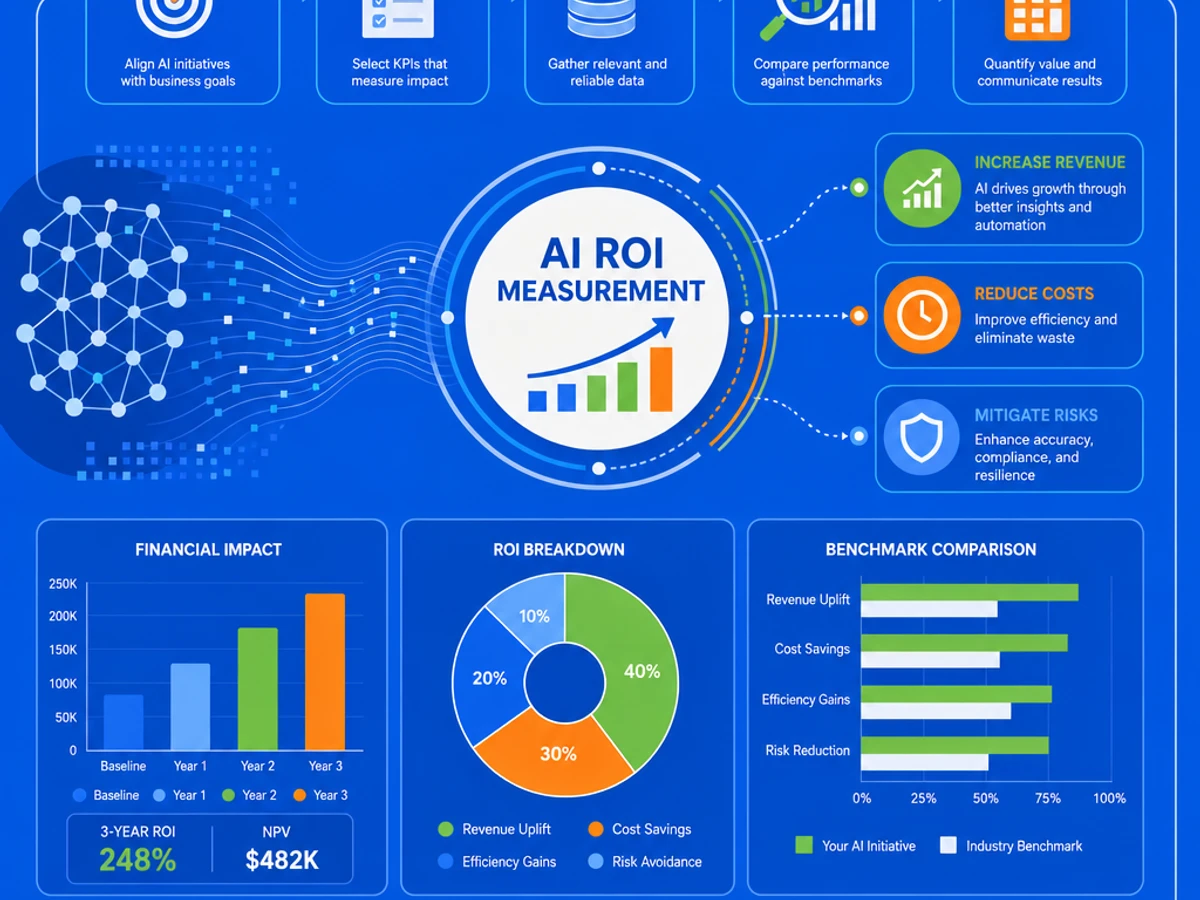
how to measure AI ROI and prove business impact to the C-suite and board in 2026 | September 27, 2026 | Adspro Editorial Team | 4-6 weeks to build a full measurement framework | Beginner
What You'll Learn
You've invested in AI. Now comes the harder part: proving it actually works. This guide walks you through a structured approach to measure AI Return on Investment (ROI) and demonstrate real business impact to your C-suite and board. Instead of guessing at value or defending soft metrics, you'll learn how to build a repeatable framework that defines success before you deploy anything. Here's what you'll get:
- How to choose an AI ROI formula that holds up under CFO scrutiny, not one that collapses the moment finance asks questions.
- How to establish a pre-AI baseline so your gains are provable, not just assumed or hoped for.
- How to build a board-ready reporting cadence that ties AI spend directly to P&L outcomes.
- How to sidestep the measurement traps that cause most AI programs to stall at the pilot stage.
Prerequisites: At least one live or near-live AI use case, access to finance and operations data owners, and executive sponsorship to define success metrics jointly with finance.
Why Measuring AI ROI Matters in 2026
Here's the uncomfortable truth: most organizations have no idea whether their AI spending is actually paying off. According to Deloitte's 2026 State of AI in the Enterprise report, only 29% of executives report being able to measure AI ROI with confidence. IBM research found that only around 25% of AI initiatives deliver expected ROI, with just 16% having scaled enterprise-wide. The independent data gets starker: only 5% to 8% of enterprises report measurable AI ROI in 2026, despite average AI budgets of $186 million and 88% adoption across industries, based on data compiled from KPMG, MIT, BCG, and McKinsey.
Your board has noticed this gap. Board-level AI value reporting is currently practiced by just 4% of respondents but is expected to become mandatory for public companies and large enterprises by the end of 2026. Meanwhile, 92% of C-suite executives express full confidence in AI impact. That disconnect? It's a problem. 58.2% of organizations cite unclear or fragmented ownership as their primary barrier to measuring AI performance, and CFOs are now actively challenging AI budgets in reviews because of it.
This is the exact environment where Adspro operates: helping enterprises prove AI value in financial terms, not just in productivity stories. Getting ahead of this shift now, rather than scrambling when your board asks pointed questions, is the practical reason this framework matters.
Key Takeaway: In 2026, boards and C-suite executives demand clear, measurable AI ROI. Anecdotal evidence no longer cuts it. You need financial and operational proof, and you need it fast. A robust measurement framework isn't optional anymore; it's the price of admission for continued investment and scaling.
The Process at a Glance
| Step | Action | Time | Outcome |
|---|---|---|---|
| 1 | Define business-aligned AI KPIs before deployment | 3-5 days | Success criteria agreed with finance upfront |
| 2 | Build a pre-AI baseline and pick ROI formula | 1-2 weeks | Defensible before/after comparison point |
| 3 | Set up a measurement dashboard and data pipeline | 1-2 weeks | Real-time visibility into AI performance |
| 4 | Translate metrics into financial, board-ready language | 2-3 days | One-page value narrative for executives |
| 5 | Report on a recurring cadence and iterate | Ongoing, monthly/quarterly | Continuous, trusted proof of business impact |
Total time to first board-ready report: approximately 4-6 weeks from kickoff to first presentation, with ongoing monthly or quarterly reporting thereafter.
Step 1: Define Business-Aligned AI KPIs Before You Deploy
What You're Doing
Before your team trains a single model or deploys a single agent, you're going to agree, in writing, on what "success" actually means. Not technical accuracy scores. Not usage metrics. Real, measurable business outcomes tied directly to financial or operational results. Key Performance Indicators (KPIs) are the quantifiable measures you'll use to evaluate whether your AI initiative meets its objectives.
How to Do It
- Get finance, operations, and the AI project owner in a room before build starts. This is non-negotiable.
- Document baseline metrics tied to the process AI will touch: cost per transaction, cycle time, error rate, and FTE allocation.
- Choose 2-4 KPIs maximum per use case. One financial (cost saved, revenue lifted), one operational (cycle time, throughput), and optionally one quality or risk metric (error rate, compliance incidents).
- Get written sign-off from the finance owner on the exact formula that will calculate ROI later. This document becomes your contract.
Best Practices
- Tie KPIs to financial outcomes from day one. Successful programs don't measure adoption rates or task completion percentages. They measure what matters: cost per transaction, cycle time, error rate, and FTE allocation before deploying. This changes how you think about success before you write any code.
- Treat this as a pre-deployment decision, not an afterthought. If you don't define success before you start, you will measure the wrong things after. ROI isn't a post-deployment question; it's a pre-deployment design decision. Skip this step and you'll spend months arguing with finance about what the numbers mean.
Common Mistakes
The most costly mistake is measuring adoption or usage volume instead of financial impact. A chatbot with 10,000 conversations that saves zero labor cost is not an ROI win, no matter how impressive the adoption numbers sound. The second mistake is skipping finance sign-off. Without it, skeptics will dismiss your numbers later as self-reported and biased.
What Done Looks Like
You have a one-page KPI charter, signed by finance, that names the exact formula and data source that will define success for this AI initiative. This charter is a concrete, observable artifact. You can hand it to someone else and they'll know exactly how to measure results.
Key Takeaway: Proactive, finance-aligned KPI definition before AI deployment is critical to ensure measurable business impact. Skip this and you'll face post-hoc challenges from finance that could kill your program's credibility.
Step 2: Build a Pre-AI Baseline and Choose Your ROI Formula
What You're Doing
Now you're capturing what the process looked like before AI touched it. This baseline is your foundation. Every future ROI claim needs a credible before/after comparison, not an estimate or a projection. Return on Investment (ROI) is the performance measure that tells you whether your investment is actually delivering efficiency. It's calculated as: (Financial gain from AI minus cost of AI program) divided by cost of AI program, expressed as a percentage or multiple.
How to Do It
- Pull 3-6 months of historical data on your chosen KPIs (cost, time, error rate) from existing systems of record. Go back far enough to smooth out seasonal noise.
- Calculate a simple ROI formula: (Financial gain from AI - cost of AI program) divided by cost of AI program, expressed as a percentage or multiple. Write it down. Don't change it later.
- Separate hard-dollar savings (headcount reduction, contract elimination) from soft-value gains (faster decisions, improved satisfaction) and report them independently. Boards understand hard dollars; soft value raises questions.
- Document total program investment including technology, implementation, and change management. Don't just count software licensing; that's how you hide the real cost.
Example
| Use Case | Baseline Metric | Post-AI Result | Reported ROI |
|---|---|---|---|
| Manufacturing predictive maintenance | Unplanned downtime hours/month | Reduced downtime | 12-month payback period |
| Financial services back-office automation | Manual processing cost per transaction | Automated processing | 3.7x return on investment |
These figures reflect industry patterns from 2026 industry ROI benchmarking research. Manufacturing predictive maintenance typically delivers 12-month payback periods, while financial services back-office automation reports 3.7x returns on investment. Use these as directional references, not guarantees for your own program.
What Done Looks Like
You can state, in one sentence with a number attached, exactly how much better the process performs today versus before AI. You have a data source finance already trusts backing that number. This means a clear, quantifiable statement of improvement that survives scrutiny.
Step 3: Set Up a Measurement Dashboard and Data Pipeline
What You're Doing
You're moving from spreadsheet-based, manual reporting to a live system that pulls KPI data automatically. Numbers presented to the board will be current and auditable, not stale and questionable. A data pipeline is a set of tools and processes that move data from one system to another, often transforming it along the way. This infrastructure becomes the backbone of your measurement system.
How to Do It
- Identify the systems of record for each KPI. Where does the truth live? CRM, ERP, ticketing system, finance ledger?
- Build or commission a lightweight dashboard that refreshes on a defined schedule (daily or weekly, not quarterly). Stale data kills credibility.
- Assign a single owner accountable for data accuracy. Unclear ownership is the top reason measurement programs stall, and that owner needs to be named and empowered.
- Layer in a governance view showing which AI applications are actually in production. Most organizations lack this basic inventory, and that's a problem.
Best Practices
- Fix ownership early. 58.2% of organizations cite unclear or fragmented ownership as their primary barrier to measuring AI performance. As a result, 62% lack a comprehensive inventory of applications in use. Don't be that organization. Name the owner before you build the dashboard.
- Consider bringing in a partner for this phase. Enterprises undertaking this at scale often find that building from scratch is slower and messier than expected. Adspro supports exactly this phase, combining data engineering and enterprise software expertise to build the tracking infrastructure boards can trust. Adspro's approach emphasizes strategy-led, measurable outcomes and hands-on partnership tailored to enterprise needs.
What Done Looks Like
A named owner can pull up a live dashboard at any moment and answer "what is our AI ROI right now" without needing to build a new spreadsheet. This is an observable, real-time capability. No delays. No excuses.
Key Takeaway: Transitioning from manual spreadsheets to an automated, live measurement dashboard with clear data ownership is crucial. It prevents the governance gaps that cause most measurement programs to stall.
Step 4: Translate AI Metrics into Financial Language the Board Understands
What You're Doing
Your dashboard is working. Your data is clean. Now you need to speak the language your board actually uses. Technical metrics like accuracy, latency, and adoption rate mean nothing to executives. Revenue impact, cost avoidance, margin improvement, and payback period: that's the vocabulary boards understand. The C-suite refers to a company's most important senior executives, typically including the Chief Executive Officer (CEO), Chief Financial Officer (CFO), and Chief Operating Officer (COO).
How to Do It
- Build a one-page value narrative per AI initiative. Problem, investment, baseline, result, dollar figure. Nothing longer.
- Move beyond cost savings alone. Organizations still measuring AI ROI through cost savings alone will struggle to justify increasing AI investment. Boards now demand evidence of strategic, not just operational efficiency.
- Frame results using a multi-dimensional value lens: financial, operational, strategic, and risk. Don't reduce everything to a single number. Organizations that build multi-dimensional value frameworks now will know where AI is working, where to invest next, and how to make the case internally.
- Where AI directly touches revenue or margin, prioritize that framing. Enterprise AI ROI measurement is shifting structurally. Direct financial impact combining revenue growth and profitability nearly doubled to 21.7% of primary responses in recent industry surveys. That's where board attention is going.
What Done Looks Like
A board member with no technical background reads your one-pager and repeats back the dollar impact and payback timeline in their own words within thirty seconds. If they can't do that, rewrite it.
Key Takeaway: To secure continued AI investment, translate technical metrics into a concise, multi-dimensional financial narrative for the board. Emphasize revenue impact and strategic value over mere cost savings.
Step 5: Report on a Recurring Cadence and Iterate the Framework
What You're Doing
You're not done after the first report. You're institutionalizing measurement as a recurring board or executive committee agenda item. This becomes a living system that improves over time, not a one-time justification exercise that gets forgotten. A recurring cadence is a fixed, regular schedule for reporting or review. It signals to your board that AI ROI is a permanent part of how you manage the business.
How to Do It
- Set a fixed reporting cadence: monthly for operational leadership, quarterly for the board. Mark the calendar. Make it predictable.
- Review which KPIs are proving predictive of real value and retire ones that aren't. ROI measurement should be treated as a learning system, not a fixed scorecard. If a metric isn't driving decisions, drop it.
- Compare performance against industry benchmarks periodically. This contextualizes your numbers for the board and helps them understand whether you're ahead or behind peers.
- Escalate governance gaps immediately. Boards respond better to a transparent gap being closed than a confident number later found to be wrong. Transparency builds trust.
What Done Looks Like
The board anticipates and requests the AI value report each quarter rather than the finance team needing to justify why AI spend continues. This is an observable shift in executive engagement. You've moved from defense to strategy.
Key Takeaway: Establish a fixed, recurring reporting cadence for AI ROI. Treat the framework as a dynamic learning system that adapts and improves. This ensures continuous executive trust and proactive engagement.
What to Do After You've Built Your AI ROI Framework
Phase 1 (Months 1-3): Prove one use case fully. Resist the urge to measure everything at once. A single well-documented win builds executive trust faster than five partially measured programs.
Phase 2 (Months 3-6): Scale the framework, not just the AI. Apply the same KPI-baseline-dashboard model to your next two or three use cases. Reuse the governance structure you already built. You're not starting from scratch anymore.
Phase 3 (Months 6-12): Move to strategic, portfolio-level reporting. Shift board conversations from "did this project work" to "which category of AI investment returns the most." This is the multi-dimensional maturity Deloitte expects to become standard practice by the end of 2026.
Resources You'll Need
| Resource | Role | Requirement Level | Cost |
|---|---|---|---|
| Adspro | End-to-end AI strategy, data engineering, and measurement infrastructure partner | Recommended | Custom enterprise engagement |
| IBM Institute for Business Value AI ROI research | Benchmarking and CEO-level survey data | Recommended | Free |
| Deloitte State of AI in the Enterprise report | Multi-dimensional value framework guidance | Recommended | Free |
| Internal BI/dashboarding tool (existing stack) | Live KPI tracking and visualization | Required | Varies (often already licensed) |
| Finance/FP&A partner or team | Sign-off on ROI formula and cost data | Required | Internal resource |
See also, see How CEOs Should Measure the Business Value of AI.
Common Plateaus and How to Break Through
Plateau: Confident executives, unclear ownership
Likely cause: No single accountable owner for AI measurement. This is why 92% of C-suite executives express full confidence in AI impact even though 58.2% of organizations cite unclear or fragmented ownership as their primary barrier.
Fix: Assign one named owner per AI initiative whose job explicitly includes measurement, not just deployment. Make it part of their performance review.
Plateau: Pilots that never prove financial impact
Likely cause: Pilots are designed to prove technical feasibility, not financial return. A controlled pilot proves the conditions were right for a demo, but it does not automatically prove the organization is ready to scale.
Fix: Redesign pilots from the start with the same KPI-baseline structure used in Step 1. Don't make measurement an afterthought once results look promising.
Plateau: Reporting cost savings only, and the board stops being impressed
Likely cause: Boards have moved past accepting efficiency metrics alone as proof of AI value in 2026.
Fix: Layer in strategic and revenue-linked metrics. Boards now demand evidence of strategic, not just operational efficiency, before approving further AI investment.
Plateau: Numbers that finance won't sign off on
Likely cause: ROI was calculated by the project team in isolation, without finance involvement or a shared formula.
Fix: Bring finance into the KPI definition stage (Step 1), not the reporting stage. The final number should be co-owned, not contested.
Key Takeaway: Overcome common AI ROI measurement plateaus by establishing clear ownership, integrating financial metrics into pilot design, expanding beyond cost savings to strategic value, and ensuring early finance involvement for co-owned results. For more troubleshooting advice, see Measuring AI ROI for Executives | C-Suite Playbook for Growt.
Conclusion
Measuring AI ROI and proving business impact to the C-suite and board in 2026 comes down to sequencing. Define KPIs before you build. Baseline before you deploy. Instrument before you scale. Translate before you present. Enterprises that follow this order consistently outperform those chasing ROI retroactively after a board asks hard questions.
Key Takeaways
- A defensible AI ROI story requires pre-deployment KPI agreement, a real baseline, and a live dashboard, not a retroactive spreadsheet built under pressure.
- Boards in 2026 expect multi-dimensional, financially framed value narratives. Cost-savings-only reporting is losing credibility fast.
- Your next action: pick one live AI use case this week and run it through the five-step framework above before adding any new initiatives.
FAQ
How to measure AI ROI and prove business impact to the C-suite?
To measure AI ROI and prove business impact to the C-suite, start by defining 2-4 business-aligned KPIs (Key Performance Indicators) before deployment. Establish a pre-AI baseline using 3-6 months of historical data to create a credible before/after comparison. Next, build a live dashboard tied to systems of record for real-time, auditable performance tracking. Finally, translate these results into financial language, focusing on revenue impact, cost avoidance, and payback period, for a recurring board report. This sequence matters because only 29% of executives currently report being able to measure AI ROI with confidence, and skipping the baseline or KPI-definition steps is the single biggest reason ROI claims get challenged by finance later.
What is a realistic AI ROI benchmark by industry in 2026?
Manufacturing predictive maintenance typically delivers 12-month payback periods, financial services back-office automation reports 3.7x returns on investment, and logistics companies with AI-mature supply chains outperform peers by 23% on profitability. Benchmarks vary significantly by use case maturity and data quality, so use these as directional references, not guarantees.
Why do most AI initiatives fail to show ROI?
The core issue is measurement design, not the technology itself. Many organizations misinterpret pilot test results. A controlled pilot proves the conditions were right for a demo, but it does not automatically prove the organization is ready to scale, which is why only around 25% of AI initiatives deliver expected ROI and just 16% have scaled enterprise-wide.
What KPIs should I track before deploying an AI initiative?
Document baseline metrics before build starts, specifically cost per transaction, cycle time, error rate, and FTE allocation. Limit yourself to 2-4 KPIs per use case so the report stays clear enough for a board member to understand at a glance.
How often should AI ROI be reported to the board?
Most enterprises reviewing this in 2026 are moving toward monthly operational reviews and quarterly board reporting. This cadence matters because board-level AI value reporting, currently practiced by just 4% of respondents, is expected to become an expected capability for public companies and large enterprises by end of 2026.
What's the difference between AI adoption and AI ROI?
Adoption measures how widely AI is used; ROI measures whether that use generates financial or strategic value. The gap between the two is large. 88% of organizations use AI in at least one business function, but realized financial return sits in the single digits almost everywhere researchers have measured it independently.
Do I need a dedicated platform to measure AI ROI, or can I use spreadsheets?
Spreadsheets can work for a single early pilot, but they break down once you're tracking multiple use cases across departments, mainly because ownership and data freshness become unclear. A lightweight dashboard connected to systems of record, potentially built with a partner like Adspro, scales far better and reduces the governance gaps that cause 62% of organizations to lack a comprehensive inventory of AI applications in use.
How do I get board approval for continued AI investment?
Present a multi-dimensional value narrative, not a single efficiency metric: financial impact, operational improvement, and strategic positioning together. Organizations that build multi-dimensional value frameworks now will know where AI is working, where to invest next, and how to make the case internally, which is precisely the evidence boards are asking for in 2026.
Methodology: This guide synthesizes publicly available 2026 enterprise AI research from IBM's Institute for Business Value, Deloitte's State of AI in the Enterprise report, KPMG's Global AI Pulse survey, McKinsey, MIT, and independent industry benchmarking sources. Figures and benchmarks are cited inline; readers should validate specific ROI targets against their own industry and use-case data before presenting to a board.