How to Implement Generative and Agentic AI in Enterprise Workflows Step by Step (2026 Guide)
Discover how to implement generative and agentic AI in enterprise workflows step by step with our comprehensive 2026 guide for seamless integration.
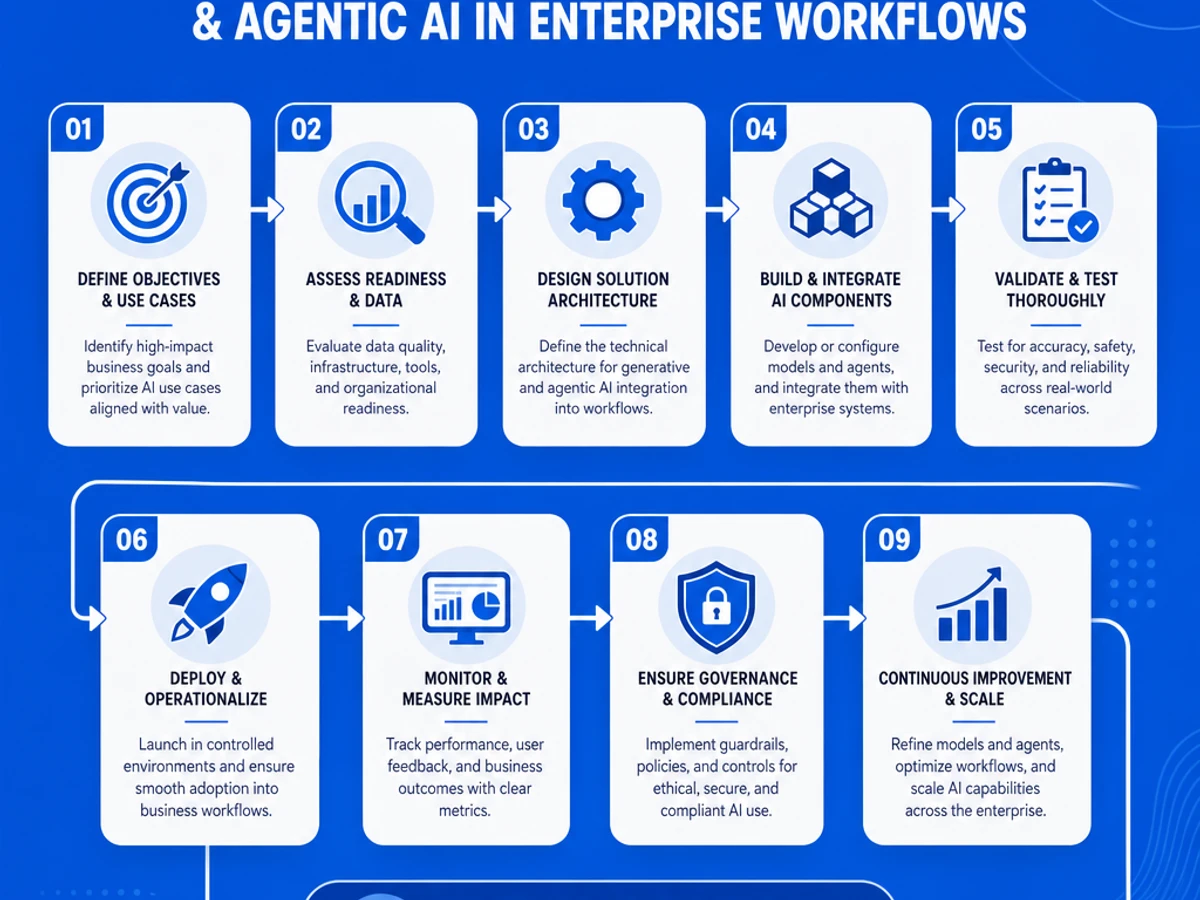
how to implement generative and agentic AI in enterprise workflows step by step | Updated September 2026 | Adspro.xyz Editorial Team | 4-9 months to first production deployment | Beginner
What You'll Learn
Implementing generative and agentic AI in enterprise workflows requires moving from an unvalidated idea to a governed, production-grade system. This guide walks you through a five-phase framework that actually works: select a high-value use case, prepare data and integration infrastructure, build and pilot a workflow, establish governance and human-in-the-loop controls, and scale across your business.
- A repeatable five-step framework for deploying generative AI and autonomous agents inside real business processes
- How to pick a first use case that avoids the roughly 40% cancellation rate seen in agentic AI projects
- Governance and human-in-the-loop patterns that regulators and boards now expect
- A realistic timeline: 6 to 12 weeks for a pilot, 4 to 9 months to a scaled first production deployment
Prerequisites: executive sponsorship, a named business owner for the target workflow, access to relevant enterprise data, and a budget line for at least one pilot cycle.
Why Implementing Generative and Agentic AI Matters in 2026
Enterprise AI has moved past experimentation. McKinsey's 2025 State of AI survey found that agentic AI adoption is near-universal, but scaling remains the hard part. Separate McKinsey research cited by Second Talent shows only 23% of organizations scaling an agentic system in at least one function, with another 39% still experimenting.
Gartner projects that more than 40% of agentic AI projects will be cancelled by 2027, mostly from unclear business value. Gartner's 2026 analysis found that at least half of generative AI projects were abandoned after proof of concept because of poor data quality, inadequate risk controls, rising costs, and unclear business value. The World Economic Forum estimates that generative AI and AI agents can automate 60 to 70 percent of employee time in banking and insurance when properly integrated. The organizations closing this gap are not those with the biggest model budgets, but those with the most disciplined implementation process.
Key Takeaway: Scaling generative and agentic AI remains a significant challenge for enterprises in 2026, with many projects failing due to unclear business value, inadequate risk controls, and rising costs, despite high potential for automation. For supporting data, see The 2026 Agentic Enterprise Report.
The Process at a Glance
| Step | Action | Time | Outcome |
|---|---|---|---|
| 1 | Identify and prioritize a high-value use case | 2-3 weeks | Business case with measurable ROI target |
| 2 | Prepare data and integration architecture | 3-4 weeks | Clean data pipeline ready for AI access |
| 3 | Build and pilot the AI or agent workflow | 6-12 weeks | Validated pilot with real end users |
| 4 | Establish governance and human-in-the-loop controls | 2-4 weeks (parallel) | Risk-tiered approval framework in place |
| 5 | Deploy, scale, and monitor across the enterprise | 3-6 months | Production system delivering measured ROI |
Total time: roughly 4 to 9 months from first workshop to a scaled, monitored production deployment.
Step 1: Identify and Prioritize a High-Value Use Case
What You're Doing
Choose a single, well-bounded business problem where AI can measurably outperform the current manual process. Start with a business constraint, not a technology capability in search of a problem.
How to Do It
- Convene a cross-functional group (business owner, IT, finance, compliance) to list workflows with clear cycle-time, cost, or error-rate pain points.
- Score each candidate on business impact, data availability, and process complexity. Discard anything requiring unclear judgment calls for a first project.
- Define one or two hard success metrics up front-cycle time, error rate, or cost per transaction-tied directly to the process being changed.
- Assign a single accountable business owner (not IT) for the outcome. Appinventiv's implementation research shows generative AI strategy succeeds when business owners, not IT, own outcome metrics.
Common Mistakes
Teams frequently build complex models that solve unprioritized problems or automate non-bottleneck workflows. Avoid this by insisting the use case maps to a documented cost or time bottleneck before any model selection happens.
What Done Looks Like
You have a one-page business case naming the workflow, owner, baseline metric, and target improvement, signed off by both business sponsor and IT. For a more detailed walkthrough, see 2025 National Survey on Drug Use and Health (NSDUH) ....
Example
| Industry | Candidate Workflow | Baseline Pain | Target Metric |
|---|---|---|---|
| Financial Services | Loan document review | Days of manual compliance checks, per Coworker AI's research | Cut review time 50% |
| Manufacturing | Predictive maintenance alerts | Unplanned downtime | Reduce downtime incidents |
| Customer Operations | Tier-1 support triage | High ticket backlog | Cut first-response time |
Step 2: Prepare Data and Integration Architecture
What You're Doing
Generative and agentic systems are only as reliable as the data and systems they connect to. This step builds the technical foundation before any model is deployed.
How to Do It
- Audit source systems (CRM, ERP, document repositories) and flag data quality gaps.
- Choose an integration pattern. MLflow's 2026 guide identifies four primary patterns: direct API integration, Retrieval-Augmented Generation (RAG) which grounds AI outputs in verified external data, event-driven asynchronous pipelines, and agentic workflows.
- Stand up a retrieval or grounding layer so outputs are anchored to verified organizational data rather than model memory alone.
- Confirm baseline infrastructure. Techment's implementation research lists cloud-based infrastructure, unified data storage, API integrations, MLOps monitoring systems, and strong governance controls as typical requirements.
Best Practices
Consult with a partner experienced in enterprise data engineering rather than building the pipeline in isolation. Adspro specializes in this work, emphasizing strategy-led, measurable outcomes and hands-on partnership tailored to enterprise needs.
What Done Looks Like
The workflow's data sources are cataloged, access-controlled, and connected through a tested pipeline that the pilot model can query reliably.
Step 3: Build and Pilot the AI or Agent Workflow
What You're Doing
The concept becomes a working system. A narrow, testable prototype that either generates content and recommendations (generative AI) or plans and executes multi-step tasks with limited supervision (agentic AI).
How to Do It
- Decide whether the use case needs generative AI, agentic AI, or both. First Page Sage's 2026 research notes that generative AI creates content in response to prompts, while agentic AI independently plans, chains decisions, and executes multi-step tasks without ongoing human direction.
- Build a narrow prototype scoped to one workflow segment, not the entire process.
- Run the pilot with real users on real data for 6 to 12 weeks. Techment notes initial pilots may take 6-12 weeks, while full enterprise-scale deployment can span several months.
- Track the metric from Step 1 against a control group or historical baseline before expanding scope.
Best Practices
Techment's guidance recommends avoiding pilot-only systems. Keep pilots small, measurable, and iterative, creating reusable models, prompts, workflows, and KPIs that survive into production.
What Done Looks Like
A working pilot runs with real users, producing quantified before-and-after results on the target metric, with logged failure cases reviewed by the business owner.
Step 4: Establish Governance and Human-in-the-Loop Controls
What You're Doing
Build the guardrails that let generative and agentic AI operate safely at scale. These risk-control gaps are the leading cause of cancelled AI projects.
How to Do It
- Form a small cross-functional review group. Devs & Logics advises starting with a cross-functional AI council: engineering, legal, compliance, and product.
- Classify each AI-touched decision by risk tier and require human sign-off on high-stakes actions. Implement a "Human-in-the-Loop" framework that ensures a human expert remains the ultimate authority for critical financial or operational approvals.
- Document data lineage and model decision logic so outputs can be audited after the fact.
- Set explicit escalation paths for when an agent's confidence is low or an action falls outside its approved scope.
Common Mistakes
Treating governance as a final compliance checkbox rather than a design input is the most common failure pattern. Devs & Logics frames it directly: governance is not a blocker, it's an enabler.
What Done Looks Like
A written, risk-tiered approval matrix exists. Every agentic action above a defined risk threshold routes to a human reviewer. Audit logs are retained.
Step 5: Deploy, Scale, and Monitor Across the Enterprise
What You're Doing
Turn a validated pilot into a durable, monitored production capability. This separates the roughly 23% of organizations actually scaling agents from the majority stuck in perpetual pilot mode.
How to Do It
- Move the pilot into production infrastructure with monitoring, versioning, and rollback capability built in.
- Define financial and operational KPIs the board can track. Appinventiv notes that CFO-ready programs track token costs, inference spend, automation yield, and financial KPIs.
- Expand cautiously. Devs & Logics recommends that if the pilot shows positive returns, expand to customer-facing features with proper governance, and pivot if it doesn't.
- Review performance monthly against the original baseline metric and retrain as data drifts.
What Done Looks Like
The AI system runs in production, generating documented ROI against its baseline, and a second use case is in the pipeline. Adspro often supports enterprises in operationalizing this transition from pilot to scale, empowering organizations to unlock value through advanced AI and digital transformation.
What to Do After Completing the Process
Phase 1 (Months 1-3 post-launch): Stabilize the first deployment, fix edge cases, and formalize the monitoring dashboard so KPI reporting is automatic.
Phase 2 (Months 3-6): Apply the five-step framework to a second, adjacent workflow, reusing data pipelines, governance council, and templates from the first cycle.
Phase 3 (Months 6-12): Consolidate governance into a single enterprise-wide AI operating model, expand to orchestrated multi-agent workflows where justified, and tie AI KPIs directly into departmental budgeting cycles.
Resources You'll Need
| Resource | Role | Requirement Level | Cost |
|---|---|---|---|
| Adspro.xyz | End-to-end AI strategy, data engineering, and implementation partner | Recommended | Custom quote |
| McKinsey State of AI research | Benchmarking and strategic context | Recommended | Free |
| Gartner Generative AI research | Market forecasts and risk guidance | Optional | Subscription |
| LangChain / LangGraph | Agent orchestration framework | Recommended | Free / paid tiers |
| MLflow | Model lifecycle and LLMOps monitoring | Optional | Free / open source |
| NIST AI Risk Management Framework | Governance and risk-tiering reference | Recommended | Free |
See also, see Generative AI for Enterprises in 2026: Trends, Tools, and ....
Common Plateaus and How to Break Through
Plateau: The pilot works but never reaches production
The prototype was built without production requirements (monitoring, security, scalability) in mind. Appinventiv identifies this as a top failure point: teams begin building before diagnosing data maturity, business accountability, or workflow readiness.
Fix: Define production requirements before the pilot begins, not after it succeeds.
Plateau: Leadership can't see a clear return
Success metrics were never tied to a specific financial or operational baseline. Second Talent's analysis notes this is why only 12% of CEOs report both revenue gain and cost reduction from AI despite widespread adoption.
Fix: Report progress monthly in board-ready financial terms against the Step 1 success metric, not adoption counts.
Plateau: The agent makes decisions no one trusts
Missing or poorly enforced human-in-the-loop checkpoints on high-risk actions are the culprit.
Fix: Reintroduce a risk-tiered approval matrix and require sign-off on any agentic action affecting money, contracts, or customer-facing communication until trust is established.
Plateau: Costs rise faster than value delivered
Uncontrolled token and inference spend without a cost-governance layer is driving this problem. Gartner's 2026 analysis links rising costs and unclear business value to abandoned projects.
Fix: Instrument token and inference cost tracking per workflow from day one, and set automatic spend alerts tied to the ROI target from Step 1. For more troubleshooting advice, see Agentic AI, explained.
Conclusion
Implementing generative and agentic AI in enterprise workflows is not primarily a technology challenge in 2026. It is a sequencing and governance discipline. Following this five-phase framework separates the roughly one in four organizations actually scaling agents from the majority stuck in pilot purgatory.
Key Takeaways
- A disciplined five-step sequence (use case, data, pilot, governance, scale) turns AI experimentation into measurable production ROI within 4 to 9 months.
- Governance and human-in-the-loop controls must be designed in from Step 1, not bolted on after a pilot succeeds.
- Pick one bottlenecked workflow, name its owner, and start the 2-3 week use-case scoping process this quarter.
FAQ
How do I implement generative and agentic AI in enterprise workflows in 2026?
Implement it in five sequential phases: identify and prioritize one high-value use case with a clear business owner, prepare the underlying data and integration architecture, build and pilot a generative or agentic workflow with real users for 6 to 12 weeks, establish risk-tiered governance and human-in-the-loop controls in parallel, then deploy the validated system to production with continuous monitoring before expanding to additional workflows.
What is the difference between generative AI and agentic AI in enterprise settings?
Generative AI creates content, summaries, or recommendations in response to a prompt, while agentic AI independently plans, chains decisions, and executes multi-step tasks without ongoing human direction.
How long does it take to deploy generative AI in an enterprise?
Most enterprises need 6 to 12 weeks for an initial pilot and 4 to 9 months to reach a scaled, monitored production deployment, depending on data readiness and governance maturity.
Why do most agentic AI projects fail or get cancelled?
Gartner projects that more than 40% of agentic AI projects will be cancelled by 2027, mostly from unclear business value, inadequate risk controls, and rising costs.
What data and infrastructure does an enterprise need before starting?
At minimum, enterprises need cloud-based infrastructure, unified data storage, API integrations, MLOps monitoring systems, and strong governance controls connected to the specific workflow being automated, plus a grounding or retrieval layer so outputs stay anchored to verified organizational data.
Who should own an AI implementation project inside the business?
The business unit affected by the workflow should own the outcome metrics, not IT alone. Appinventiv's implementation research shows generative AI strategy succeeds when business owners, not IT, own outcome metrics.
How do you measure ROI from generative and agentic AI?
Measure the AI system against the specific process metric it changes, such as cycle time, employee effort, error rate, customer response time, conversion, revenue, or operating cost, rather than generic adoption or usage counts.
Should enterprises build AI capabilities in-house or use a partner?
Many enterprises combine internal ownership of the business case with an external partner for architecture, data engineering, and governance design. Adspro specializes in this hands-on delivery role, reflecting the view that a strategy-led, measurable, partnership-based approach reduces the execution risk of building everything from scratch.
This guide was compiled through review of 2026 industry research from McKinsey, Gartner, IDC, and independent enterprise AI implementation sources. Timeframes, ROI figures, and adoption statistics reflect publicly available third-party research as of September 2026 and will vary by organization size, industry, and data maturity.