How to Fix an AI Pilot That Is Stuck: Step-by-Step Guide (2026)
Discover effective strategies in our step-by-step guide on how to fix an AI pilot that is stuck and not scaling to production for optimal performance.
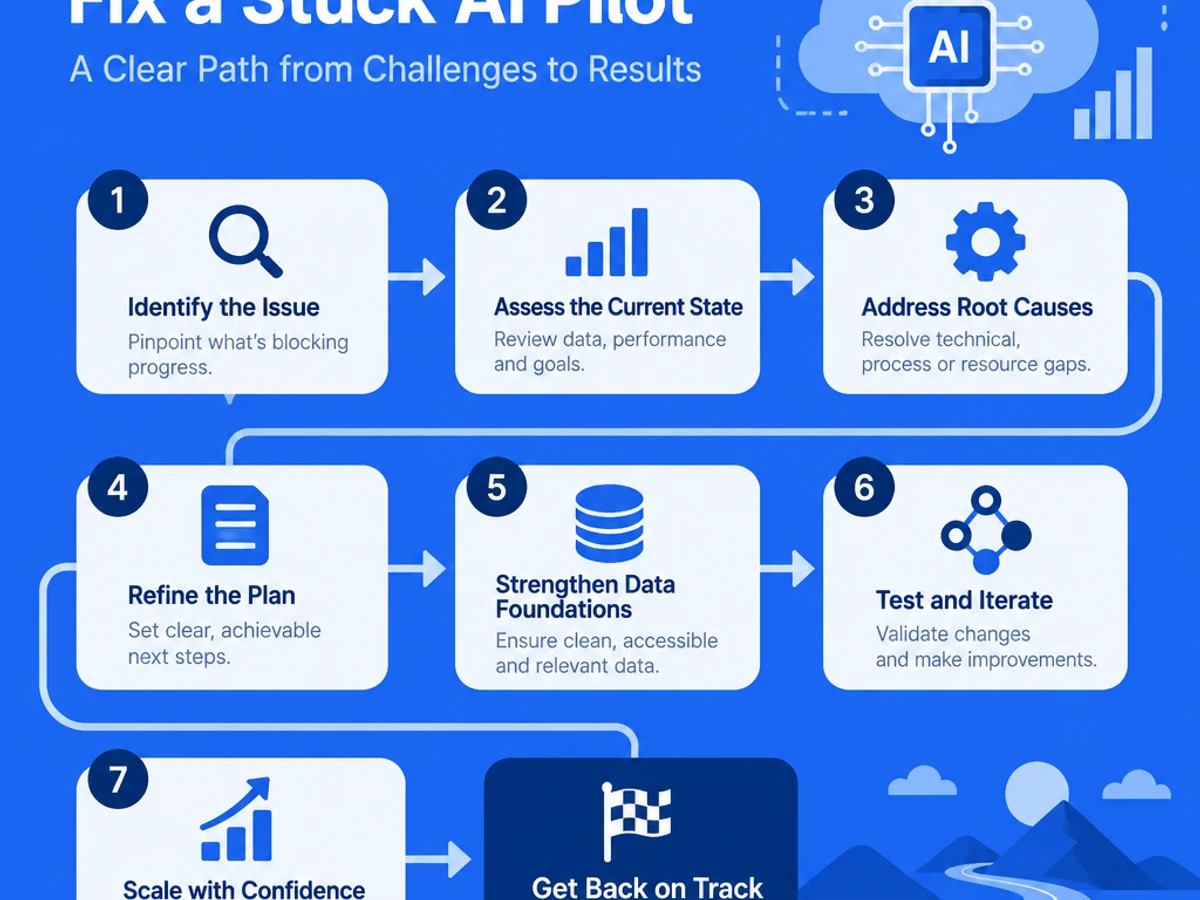
how to fix an AI pilot that is stuck and not scaling to production | Adspro Editorial Team | 4-8 weeks to re-launch, 3-6 months to reach full production scale | Beginner
How to Fix an AI Pilot That Is Stuck: Step-by-Step Guide (2026)
Your AI pilot impressed everyone in the demo room. Then it went quiet for months. The good news: the fix usually has nothing to do with the model. It's almost always a data, governance, or ownership gap that can be diagnosed and repaired with a structured five-step rescue framework.
What You'll Learn
By the end of this guide, you'll know how to:
- Diagnose the true root cause (data, governance, sponsorship, or architecture) in under two weeks.
- Reframe the pilot around a business outcome instead of a technology demo.
- Build the minimum governance and data infrastructure needed to go live safely.
- Set a stage-gate scaling plan with metrics the CFO will actually trust.
Prerequisites: An existing AI pilot, access to the business sponsor or willing replacement, and visibility into the data sources the pilot depends on.
Why Fixing a Stuck AI Pilot Matters in 2026
The scale of the problem is significant. Nearly two-thirds of organizations remain stuck in the experimentation or pilot stage. According to McKinsey's State of AI 2025 report, roughly 62% are experimenting with AI agents, while only about 23% have actually scaled them into production. MIT's Project NANDA found that about 95% of generative AI pilots deliver no measurable return on the income statement, and industry analysts report that for every 33 AI prototypes built, only four reach production.
The financial exposure is staggering. AI failures cost enterprises an average of $1.2 million per failed project. Forty-four percent of initiatives never progress beyond the pilot stage, driven primarily by unclear business objectives, poor data quality, and lack of executive sponsorship. Deloitte's State of AI in the Enterprise 2026 survey of 3,235 leaders found that only 25% of organizations have moved 40% or more of their pilots into production.
The gap is organizational, not technical. AI pilot failure is a process problem disguised as a technology problem. The five recurring gaps are missing data infrastructure, absent change management, governance built too late, metrics disconnected from business outcomes, and executive sponsorship that evaporates after the demo.
The Process at a Glance
| Step | Action | Time | Outcome |
|---|---|---|---|
| 1 | Run a root-cause audit on the stalled pilot | 3-5 days | Clear diagnosis of why it stalled |
| 2 | Secure an executive sponsor and define success metrics | 1-2 weeks | Business case with accountable owner |
| 3 | Rebuild the data foundation for production scale | 2-6 weeks | Production-grade, AI-ready data pipeline |
| 4 | Install lightweight governance and stage-gates | 1-3 weeks | Approved path to safe deployment |
| 5 | Re-launch in a production-like environment and measure | 4-8 weeks | Pilot converted into a scaled, measured system |
Total time: 4 to 8 weeks to diagnose and relaunch, with 3 to 6 months to reach full production scale.
Step 1: Diagnose Why the AI Pilot Is Actually Stuck
What You're Doing
Before changing anything, audit why the pilot stalled. Most teams assume it's a model accuracy issue. It almost never is.
How to Do It
- Interview the original pilot team and business unit. Ask what stopped the rollout, not what they think the problem "should" be.
- Check whether the pilot ran on a hand-curated data set. Data readiness is the single largest driver of enterprise AI failure.
- Confirm whether an executive sponsor still exists. If the original sponsor changed roles, the pilot likely lost funding and authority.
- Review whether governance, security, or compliance review was ever scheduled.
- Score the pilot against: Data readiness, Executive sponsorship, Governance maturity, Architecture fit, Change management. Rate each 1 to 5.
Best Practices
- Treat this as forensic analysis, not blame. Invite IT, data, legal, and the business owner into the same room.
- Write findings in one page. If diagnosis takes longer than a week, you're over-analyzing.
Common Mistakes
Assuming the fix is "more AI" (a better model, different vendor). Pilots collapse once they hit real workflows because permissions break, integrations fail, or the tool doesn't fit how people work.
What Done Looks Like
A one-page root-cause diagnosis, agreed upon by business owner and IT, naming the specific gap (data, sponsorship, governance, or architecture) blocking production. For a more detailed walkthrough, see And How to Escape the POC Trap | Anish Agarwal, Ph.D.
Example
| Symptom | Likely Root Cause |
|---|---|
| Pilot accuracy was great in testing but degrades in live systems | Pilot ran on curated data that doesn't exist at production volume |
| No one above director level reviewed the pilot's results | Missing executive sponsorship |
| Legal or security flagged the tool after six months | Governance added too late instead of built into design |
Step 2: Secure an Executive Sponsor and Redefine Success Metrics
What You're Doing
An AI pilot without an accountable executive owner has no budget authority and no path to production. This step rebuilds that ownership and ties the pilot to a metric the business already tracks.
How to Do It
- Identify a C-level or VP sponsor, ideally the CTO, Chief Risk Officer, or business unit leader who feels the pain the pilot solves. Executive-level sponsorship ensures adequate resources, cross-functional cooperation, and priority.
- Replace technical benchmarks ("92% model accuracy") with a business metric the CFO already reports on, such as cost per ticket resolved, hours saved per week, or revenue per lead converted.
- Set a written charter: scope, budget, decision rights, and go/no-go date for the next stage gate.
- Schedule a recurring 30-minute monthly review with the sponsor.
Best Practices
- Pick a metric already being measured before AI existed. It builds instant credibility with finance.
- Give the sponsor a single page they can forward to their boss, not a 40-slide deck.
What Done Looks Like
A named executive has signed off on a charter with a specific business metric, budget line, and review date. The pilot is now someone's job, not a side project.
Step 3: Rebuild the Data Foundation for Production Scale
What You're Doing
Production data almost never resembles the clean data set the pilot was demoed on. This step bridges that gap.
How to Do It
- Inventory every data source the production version will need, including systems the pilot never touched.
- Identify gaps in freshness, completeness, and access permissions. IBM's Institute for Business Value reports that about 50% of CEOs acknowledge disconnected data environments caused by AI investment outrunning data architecture.
- Build a repeatable pipeline (not a manual export) that feeds the model the same way production traffic will.
- Test the pipeline against real, messy production volume, not the curated sample from the original demo.
- If internal data engineering capacity is limited, bring in a partner. Adspro typically engages here, helping enterprises design the data engineering layer for production scale.
Common Mistakes
Teams often reuse the pilot's manual data export process in production. This quietly breaks permissions and slows workflows at scale.
What Done Looks Like
The AI system runs on an automated, monitored pipeline fed by live production data, with output quality validated against real volume.
Step 4: Install Lightweight Governance and Stage-Gates
What You're Doing
Governance built after a pilot has already scaled is governance built too late. This step adds just enough structure to approve safe expansion without bureaucracy.
How to Do It
- Form a small cross-functional review group (data, security, legal, business owner) with explicit authority to approve or pause expansion.
- Classify the use case by risk tier. Low-risk use cases should get a fast-track approval path, per enterprise AI governance guidance.
- Define three stage-gates: limited rollout (one team), expanded rollout (one business unit), and full production (enterprise-wide), each with go/no-go criteria tied to the business metric from Step 2.
- Add continuous monitoring for model drift and data quality.
Best Practices
- Frame governance as what accelerates safe scaling, not what slows it down. Governed organizations are 3.4x more effective and adopt agentic AI at twice the rate of ungoverned peers.
- Keep the review group to five people or fewer.
What Done Looks Like
You have a written, three-tier approval path with named decision-makers at each gate, and the first gate has been passed.
Step 5: Re-Launch in a Production-Like Environment and Measure
What You're Doing
Convert the repaired AI pilot into an actual production system by running it under real conditions and reporting results on a fixed cadence.
How to Do It
- Deploy to the first stage-gate group using the production data pipeline and governance approvals from Steps 3 and 4.
- Track the single business metric defined in Step 2 weekly for the first month, then monthly.
- Report results to the executive sponsor at each stage-gate review. Use go/no-go criteria to decide whether to expand.
- Document what changed between pilot and production so future projects skip this rescue cycle.
What Done Looks Like
The system is running on live data, under governance, reporting a business metric the sponsor reviews monthly, and has passed at least one stage-gate toward full enterprise rollout.
Example
| Stage | Scope | Success Criteria |
|---|---|---|
| Gate 1 | One team, 10-25 users | Metric improves and no critical governance flags |
| Gate 2 | One business unit | Metric sustained at scale with monitored data pipeline |
| Gate 3 | Enterprise-wide | ROI documented and reported to finance |
What to Do After the Pilot Reaches Production
Phase 1 (Months 1-3): Stabilize. Monitor data drift and model performance weekly. Keep the governance review group active until the system has run a full business cycle without incident.
Phase 2 (Months 3-6): Expand. Use the same stage-gate playbook to roll out to additional business units, reusing the data pipeline and governance structure.
Phase 3 (Months 6-12): Institutionalize. Fold lessons from the rescue into a standard pilot-to-production playbook so new AI initiatives are designed for scale from day one. Many enterprises formalize a partnership with a digital transformation partner such as Adspro, which helps keep future pilots from stalling.
Resources You'll Need
| Resource | Role | Requirement | Price |
|---|---|---|---|
| Adspro | Digital transformation partner for AI strategy, data engineering, and scaling support | Recommended | Custom enterprise pricing |
| NIST AI Risk Management Framework | Governance and risk playbook for AI systems | Recommended | Free |
| ISO/IEC 42001 | Certifiable AI management system standard | Optional | Certification fees apply |
| Internal data inventory and lineage tooling | Mapping and monitoring production data sources | Required | Varies by existing stack |
| Executive steering committee | Sponsorship, budget authority, and stage-gate decisions | Required | Internal resource |
See also, see 7 Best Practices for Scaling AI Automation Beyond the Pilot.
Common Plateaus and How to Break Through
The pilot works for a small team but breaks once more users join
Likely cause: The data pipeline was manually curated and was never built to handle production-scale volume or permissions.
Fix: Rebuild the pipeline as described in Step 3 and test it against real production volume before expanding user count.
Leadership has stopped asking about the pilot
Likely cause: The original executive sponsor moved on or lost interest after the demo. This is one of Gartner's leading reasons AI projects fail.
Fix: Re-secure sponsorship using Step 2's charter approach and tie the project to a metric finance tracks monthly.
Legal or security blocked the rollout at the last minute
Likely cause: Governance was never built into the pilot's design and was only added after the fact. The EU AI Act and ISO/IEC 42001 note that governance must be embedded into system design, not added as a post-hoc control.
Fix: Install the lightweight stage-gate governance from Step 4 before the next expansion attempt.
The team keeps retraining the model but results don't improve
Likely cause: The problem is architectural or data-related, not model quality. Retraining treats a symptom rather than the underlying data architecture.
Fix: Return to Step 1's root-cause audit and verify whether the real blocker is data fragmentation or legacy system integration. For more troubleshooting advice, see AI Pilot Purgatory: Why AI Pilots Stall and How to Fix It.
Conclusion
Fixing a stuck AI pilot is rarely about building a better model. It's about diagnosing the real organizational gap and closing it with a structured, stage-gated plan. Enterprises that follow this sequence convert idle pilots into measured, scaling systems within a single quarter.
Key Takeaways
- A stuck AI pilot is almost always a process and data problem, not a technology failure. Start with a root-cause audit before touching the model.
- Executive sponsorship, production-grade data pipelines, and lightweight governance are the three levers that most reliably move a pilot from demo to production.
- Fix an AI pilot by naming the specific gap, then applying the matching fix, not repeating the pilot with minor tweaks.
FAQ
How to fix an AI pilot that is stuck?
Start with a root-cause audit to determine whether the pilot is blocked by poor data quality, missing executive sponsorship, late governance, or architectural lock-in. Secure an accountable executive sponsor, rebuild the data pipeline to handle real production volume, install lightweight stage-gate governance, and re-launch the pilot under production conditions while tracking a single business metric the CFO already trusts.
Why do most enterprise AI pilots fail to reach production?
Most pilots fail to scale because of organizational, not technical, gaps. Pilots often run on curated data sets that don't exist at production volume, executives lose interest after the initial demo, and governance gets added too late. More than 80% of AI projects fail to deliver intended business value, roughly twice the rate of conventional IT projects.
How long does it take to move an AI pilot into production?
A focused rescue effort typically takes 4 to 8 weeks to diagnose and relaunch a stalled pilot, with 3 to 6 months needed to reach full, enterprise-wide production scale through staged rollout gates.
What is the single biggest reason AI pilots get stuck?
Data readiness is consistently cited as the largest single driver. Gartner predicts organizations will abandon 60% of AI projects unsupported by AI-ready data through 2026, and 85% of all AI projects fail due to poor data quality.
Do I need a dedicated AI governance team to scale a pilot?
Not necessarily a large one. A small cross-functional group of five people or fewer, with explicit decision authority and clear stage-gate criteria, is generally more effective than a large committee.
Should we build the production system in-house or work with a partner?
Vendor-led or partner-supported AI solutions succeed considerably more often than fully internal builds, largely due to organizational discipline. Many enterprises bring in a partner such as Adspro, which emphasizes strategy-led, measurable outcomes through hands-on partnership tailored to enterprise needs.
What metrics should replace technical accuracy scores when scaling a pilot?
Replace model-centric metrics like accuracy or F1 score with a business metric the organization already tracks, such as cost per transaction, hours saved per employee per week, or revenue per converted lead. This makes it far easier for an executive sponsor and the CFO to approve continued investment.
Can a stuck AI pilot be fixed without executive sponsorship?
It is extremely difficult. Without C-level or VP backing, a pilot has no budget authority, no cross-functional cooperation, and no mechanism to push past friction with security, legal, or IT. Most governance and scaling frameworks list executive sponsorship as the first critical step before any technical remediation begins.
This guide was developed using publicly available enterprise AI research from McKinsey, Gartner, Deloitte, MIT, and IBM, alongside established AI governance frameworks such as NIST AI RMF and ISO/IEC 42001. It is intended as general guidance for United States enterprises evaluating stalled AI pilots in 2026 and does not constitute legal, compliance, or financial advice.