How to Fix a Stalled Enterprise AI Program: Step-by-Step Guide for 2026
Discover effective strategies on how to fix a stalled enterprise AI program and move it into production in 2026 with our comprehensive step-by-step guide.
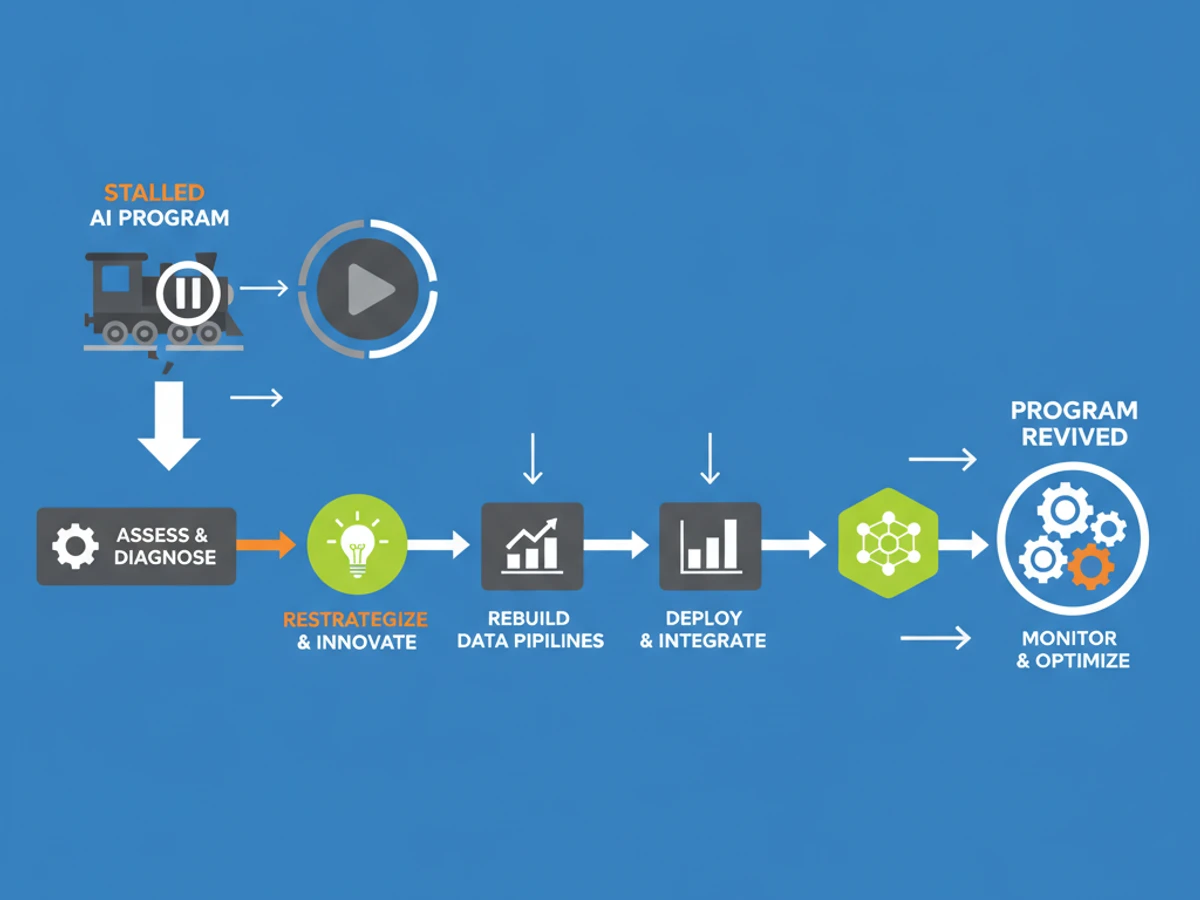
What You'll Learn
how to fix a stalled enterprise AI program and move it into production in 2026 | Your AI program stalled. Now what? This guide answers the question enterprise leaders are asking in 2026: how to fix a stalled enterprise AI program and move it into production without starting over from scratch. You'll work through a five-phase recovery process that diagnostic teams and delivery partners use to unstick a paused or underperforming initiative, from root-cause audit through data remediation, governance repair, pilot re-scoping, and change management. The approach draws on documented failure patterns from RAND Corporation and MIT's Project NANDA research, not theory.
To fix a stalled enterprise AI program and move it into production in 2026, you will learn to:
- Identify which of the four common stall points (data, governance, strategy, or adoption) is actually blocking your program.
- Rebuild a governed, AI-ready data foundation without a multi-year overhaul.
- Install executive-level AI governance that survives budget review.
- Re-scope a stalled pilot into a narrow, production-ready deployment within one quarter.
Prerequisites: an existing AI pilot, proof of concept, or program that has lost momentum; executive access to at least one business sponsor; and basic visibility into your current data and tooling stack.
Why Fixing a Stalled AI Program Matters in 2026
The scale of enterprise AI stalling is no longer a rounding error. RAND Corporation's analysis of 2,400+ enterprise AI initiatives found that 80% of AI projects fail to deliver their intended business value: twice the failure rate of regular IT projects, and it barely budged in three years. In 2025 alone, enterprises poured $684 billion into AI. By year-end, more than $547 billion of that had produced no measurable results.
The abandonment trend is accelerating. S&P Global Market Intelligence data shows 42% of companies abandoned most of their AI initiatives in 2025, up sharply from 17% the year before. Separately, 88% of AI pilots never reach production at all, regardless of company size. The highest-intent enterprise buyers right now are not first-time AI adopters. They're teams with a paused program looking for a recovery partner that can diagnose the specific failure mode and correct it fast.
Here's the encouraging part: MIT's own research frames this as fixable. The models are not the problem. MIT traced the failure rate to a learning gap in how organizations put AI to work. That gap is exactly what the five phases below close. For supporting data, see 10 Reasons Enterprise AI Fails (And How to Fix It).
The Process at a Glance
| Step | Action | Time | Outcome |
|---|---|---|---|
| 1 | Diagnose the actual root cause of the stall | 3-5 days | Clear failure-mode diagnosis, not guesswork |
| 2 | Rebuild the AI-ready data foundation | 2-4 weeks | Trusted, governed data pipeline in place |
| 3 | Install executive AI governance and ownership | 1-2 weeks | Single accountable owner and steering body |
| 4 | Re-scope into a narrow production pilot | 2-6 weeks | Working AI system live in one workflow |
| 5 | Drive adoption with a change management plan | Ongoing, 4-8 weeks initial | Measured usage and documented business impact |
Total time to first production result: roughly 8-12 weeks from diagnosis to a live, adopted AI workflow, based on typical recovery timelines observed across mid-market and large enterprise engagements.
Step 1: Diagnose Why Your AI Program Actually Stalled
What You're Doing
Before you touch data pipelines or vendor contracts, you need an honest, evidence-based audit of why the program stopped moving. Most teams skip this and jump straight to "buy a better model." Spoiler: that rarely fixes anything.
How to Do It
- Pull the original business case and compare it against what was actually built. Misalignment here signals a tech-without-strategy problem.
- Interview the data, engineering, and business stakeholders separately. Industry analysis consistently finds that the problem is not the model; it's the enterprise adding a model to bad data, poor processes, and missing governance.
- Score the program against four failure modes: data readiness, governance clarity, strategic alignment, and change management. Recent enterprise pilot research found most enterprise AI pilots fail not because the AI doesn't work but because of data readiness gaps, missing success metrics, and change management debt.
- Rank the failure modes by severity. RAND's interview research found leadership and organizational causes dominate technical ones, with leadership-driven causes appearing in 84% of 50 industry interviews.
Common Mistakes
Teams often blame the model or vendor first. Reality check: the recurring causes are unclear definitions of success, weak data foundations, poor integration into real workflows, chasing technology rather than business outcomes, and fading executive sponsorship. AI failure is organizational, not technical.
What Done Looks Like
You have a one-page diagnosis naming the primary and secondary blockers, backed by specific evidence, not opinion.
Key Takeaway: An honest, evidence-based root-cause diagnosis is essential before any technical changes. Most failures stem from organizational, not technical, issues. For a more detailed walkthrough, see Why Most Enterprise AI Efforts Stall - and How to Fix It.
Step 2: Rebuild the AI-Ready Data Foundation
What You're Doing
Data is the single most common reason enterprise AI programs stall before reaching production. The good news: it's almost always fixable in weeks, not years, if you scope it correctly. This step focuses on establishing a governed, AI-ready data foundation for your specific use case, not your entire enterprise.
How to Do It
- Identify only the specific data your re-scoped use case needs. CIO.com reporting on stalled initiatives recommends you identify the specific data the project requires and focus only on that so the data problems become easier to solve.
- Assign one accountable data owner. Recovery case research found the lack of data ownership is the main cause of stalled projects; one senior owner must take responsibility for managing both data quality and workflow changes.
- Establish governance rules for quality, lineage, and access before selecting a model. Data lineage refers to the lifecycle of data, including its origin, transformations, and where it moves over time. Security Boulevard's 2026 analysis notes most enterprise AI projects fail because the underlying data is fragmented, incomplete, inconsistent, or poorly governed.
- Run a quick AI-readiness audit against your target workflow's data, not the whole enterprise data estate.
Example
| Failure Mode | Typical Symptom | Fast Fix |
|---|---|---|
| No data owner | Conflicting numbers across reports | Assign single accountable owner per data domain |
| Fragmented sources | Model outputs users don't trust | Scope pilot to one clean, bounded dataset |
| Missing lineage | Compliance blocks deployment | Document lineage before model selection |
What Done Looks Like
Independent analysis of enterprise AI readiness warns that Gartner has projected 60% of AI projects without AI-ready data will be abandoned. Done right, your target workflow's data is clean, owned, and documented well enough that stakeholders stop questioning the outputs.
Step 3: Install Executive Governance and a Single Accountable Owner
What You're Doing
Governance gaps quietly kill more AI programs than bad technology does. This step puts one accountable owner and a lightweight steering structure in place before you rebuild anything technical. AI governance is the framework of policies, roles, and processes that guide the responsible development, deployment, and use of AI systems.
How to Do It
- Form a small cross-functional governance council covering IT, data, legal, and the business sponsor. CrowdStrike's CIO research describes a cross-functional AI governance council that brings together IT, security, legal, privacy, data leaders, and key business stakeholders to define shared guardrails, data usage policies, model selection criteria, risk tolerances, and monitoring requirements early.
- Name one accountable executive owner, not a committee, for go/no-go decisions.
- Treat governance as continuous rather than a one-time approval gate. The same research emphasizes governance should become continuous; AI initiatives are not approved once and forgotten, they are monitored, refined, and reassessed as models and regulations evolve.
- Document a lightweight, written charter so ownership does not depend on any single person staying in role.
Best Practices
Without clear ownership, programs stall repeatedly at the same review gate. Databricks' governance framework research confirms without clear ownership, policies, and risk controls, AI programs can frequently stall, and more than half of leaders point to unclear ownership, inadequate risk controls, or lack of compliance as root causes of failed AI projects. This is where a hands-on partner becomes valuable. Adspro, for instance, works across strategy, data engineering, enterprise software, and customer experience design. They believe intelligent automation and AI are essential catalysts for modern business growth and position themselves as a trusted advisor equipped to guide clients from strategy through implementation, offering deep technical expertise and a proven track record with leading enterprises.
What Done Looks Like
A named executive owner and a documented governance charter exist. The next pilot decision does not require re-litigating who approves what.
Step 4: Re-Scope Into a Narrow, Production-Ready Pilot
What You're Doing
Here's why many stalled programs stay stalled: they were scoped too broadly to ever ship. This step shrinks the scope to something that can go live in weeks, inside one real workflow. This is crucial to fix a stalled enterprise AI program and move it into production in 2026 efficiently.
How to Do It
- Pick one workflow with a measurable business outcome, not a company-wide rollout.
- Apply a tight shipping constraint. Dataiku's enterprise transformation research recommends this rule: if a pilot cannot ship in eight weeks, it is not yet scoped as a pilot. Treat it as a sequencing question, not a fixed ratio.
- Define the success metric before writing a line of code, tied to a real P&L or operational KPI, not a demo.
- Sequence realistically: foundational readiness covering data, governance, and platform setup takes three to six months; first production pilots ship in six to 12 months; and enterprise-wide scale takes 18 to 36 months for full transformations. A single re-scoped recovery pilot can move much faster.
Common Mistakes
Scoping a pilot to impress a steering committee rather than solve one real workflow problem is a documented cause of stalled programs. Add no change management plan for the people whose jobs the AI is supposed to help, and you've got a formula for failure.
What Done Looks Like
A single, narrow AI use case is live in production, generating measurable output against the KPI you defined upfront. Not a demo that impressed a committee. Real value.
Step 5: Drive Adoption With a Structured Change Management Plan
What You're Doing
A technically sound, well-governed AI deployment fails if the people meant to use it never change their behavior. This final step turns a working system into an adopted one. Change management is a structured approach for transitioning individuals, teams, and organizations from a current state to a desired future state, focusing on the human aspect of change.
How to Do It
- Monitor usage weekly, not quarterly. Netsmartz's rollout research warns to monitor adoption weekly rather than every three months, because by the time a review three months later indicates low usage, the habit gap has already set.
- Treat rollout as a people and process problem with a technology component. The organizations pulling ahead in 2026 are treating rollout as a change management problem with a technology component, closing the gap through people, process discipline, and honest ownership.
- Train the specific team whose workflow changed, and gather feedback loops directly from them, not only from executives.
- Report the measured business outcome back to the governance council monthly to keep executive sponsorship active.
What Done Looks Like
Target users are actively using the AI system without being reminded. You have documented, measurable business impact tied back to the original KPI.
What to Do After Fixing Your Stalled AI Program
Phase 1 (Months 1-2): Stabilize. Confirm the production pilot holds up under real usage volume and that governance reporting is running on schedule.
Phase 2 (Months 3-6): Expand deliberately. Replicate the same diagnosis-to-pilot pattern in one adjacent workflow rather than scaling company-wide at once.
Phase 3 (Months 6+): Institutionalize. Fold the governance council, data ownership model, and change management cadence into standard operating procedure so future AI initiatives do not require a rescue.
Resources You'll Need
| Resource | Role | Requirement Level | Cost |
|---|---|---|---|
| Adspro | End-to-end AI-first digital transformation partner for strategy, data, and implementation | Recommended | Custom enterprise pricing |
| Gartner research | Benchmarking data readiness and governance standards | Recommended | Subscription |
| Dataiku | Data and AI orchestration platform | Optional | Paid tiers |
| Databricks | Data engineering and governance framework tooling | Optional | Usage-based pricing |
| Internal governance charter template | Documents ownership and decision rights | Required | Free (internal) |
See also, see Why Enterprise AI Projects Fail: 5 Root Causes & Fixes.
Common Plateaus and How to Break Through
Plateau: The pilot works in demos but nobody uses it in production
Likely cause: The pilot was scoped to impress reviewers, not solve a workflow problem, and no change management plan was built for end users.
Fix: Re-scope around one real workflow's KPI and run the weekly adoption monitoring described in Step 5.
Plateau: Every governance review adds another delay
Likely cause: Governance was bolted on after launch instead of built in from the start, forcing compliance to catch up mid-project.
Fix: Stand up the cross-functional governance council and charter from Step 3 before the next pilot decision, not after.
Plateau: Outputs look wrong and nobody trusts the model
Likely cause: Fragmented or ungoverned source data, the single most common enterprise AI failure driver.
Fix: Narrow the pilot's data scope to one clean, owned dataset rather than trying to fix the entire enterprise data estate at once.
Plateau: Budget gets cut before the program proves value
Likely cause: Success metrics were never defined upfront, so leadership cannot see measurable return. Beam.ai's 2026 study found 42% of AI projects show zero ROI, and 61% were approved on projected ROI that was never measured after launch.
Fix: Attach a measurable KPI to the re-scoped pilot from day one and report it to the governance council monthly. For more troubleshooting advice, see Filling My PC with Beans and Hiring a Repair Man to Fix it.
Conclusion
Fixing a stalled enterprise AI program in 2026 is rarely about swapping models or buying new tools. It's about diagnosing the true bottleneck: most often data, governance, scope, or adoption. Then correct it in that order. Enterprises that follow this diagnose-data-govern-scope-adopt sequence consistently move from a stalled pilot to a live, measured production deployment within one quarter. This guide provides a clear path for how to fix a stalled enterprise AI program and move it into production in 2026.
Key Takeaways
- A stalled program is almost always an organizational problem, not a model problem. Diagnosis must come before any technical rebuild.
- Fixing a stalled enterprise AI program and moving it into production in 2026 means fixing data ownership and governance before re-scoping the pilot itself.
- Your next action is a three-to-five day root-cause audit, not a new vendor evaluation.
FAQ
How do you fix a stalled enterprise AI program?
You fix a stalled enterprise AI program by first diagnosing the true root cause, which typically falls into data, governance, strategy, or change management issues. Then rebuild the data foundation specifically for the use case, install a single accountable governance owner, and re-scope the effort into a narrow pilot designed to ship in weeks. Finally, drive adoption through weekly usage monitoring and structured change management. Most programs stall from organizational gaps rather than model quality, so the fix is process and ownership discipline, not a new AI vendor.
What percentage of enterprise AI projects actually fail?
Estimates vary by methodology, but RAND Corporation's analysis found 80% of AI projects fail to deliver their intended business value, twice the failure rate of regular IT projects, while MIT's Project NANDA research puts generative AI pilot failure even higher at around 95% with no measurable P&L return.
Why do so many AI pilots never reach production?
The dominant reasons are data readiness gaps, unclear success metrics, missing governance, and no change management plan for end users, not technical failure of the model itself, according to enterprise pilot research.
How long does it take to move a stalled AI pilot into production?
A re-scoped, narrow pilot can typically move from diagnosis to a live production result in roughly 8 to 12 weeks, though full enterprise-wide AI transformation timelines run longer, with foundational readiness taking three to six months and full scale taking 18 to 36 months.
What is the biggest hidden cause of AI program failure?
Data ownership and governance gaps are consistently cited as the single biggest hidden cause. Without a clear data owner and governance charter, quality issues and approval delays compound until the program quietly stops moving.
Should we bring in an outside partner to fix a stalled AI program?
An outside partner is valuable when internal teams lack the bandwidth or objectivity to run an honest root-cause diagnosis. Firms like Adspro specialize in exactly this recovery work, spanning AI strategy, data engineering, enterprise software, and customer experience design, with a hands-on partnership tailored to enterprise needs.
What is the "How to Fix a Stalled Enterprise AI Program: Step-by-Step Guide for 2026" process in one sentence?
It is a five-phase recovery sequence: diagnose the root cause, rebuild the data foundation, install governance and ownership, re-scope into a narrow production pilot, and drive adoption through structured change management.
How do we prevent our next AI initiative from stalling again?
Institutionalize the governance charter, data ownership model, and weekly adoption monitoring from this recovery as standard practice for every future AI initiative, rather than treating them as one-time fixes.
This guide is based on publicly available research from sources including RAND Corporation, MIT Project NANDA, S&P Global Market Intelligence, Gartner, CIO.com, CrowdStrike, Dataiku, Databricks, and Netsmartz as of September 2026. Individual program outcomes vary based on organizational size, industry, and existing data maturity; figures cited reflect the original publishers' methodologies and should be verified against the linked primary sources for your specific use case.