How to Create an AI Strategy for a Small Business: Step-by-Step Guide (2026)
Discover how to create an AI strategy for a small business from scratch with our step-by-step guide tailored for 2026.
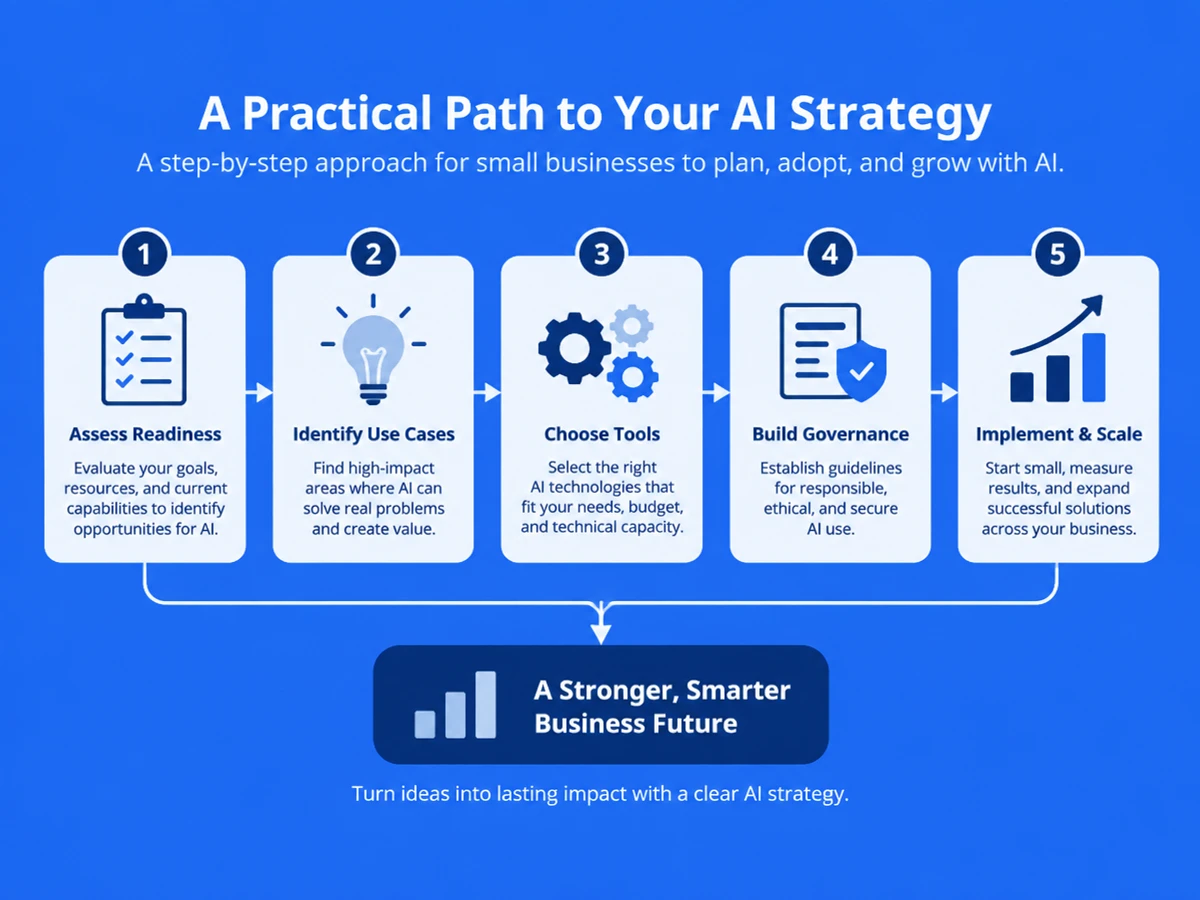
how to create an AI strategy for a small business from scratch | Updated October 2026 | Adspro Strategy Team | 8-12 weeks | Beginner
What You'll Learn
This guide walks you through exactly how to create an AI strategy for a small business from scratch, even without an in-house data science team or a large budget. You'll work through five practical phases: assessing your readiness, prioritizing use cases, selecting tools and vendors, running a pilot, and building a plan to scale what works. By the end, you'll have a documented, board-ready AI strategy instead of a scattered pile of chatbot subscriptions gathering dust.
- How to audit your data, tools, and team skills before spending a dollar on AI.
- A simple scoring method to pick your first 2-3 AI use cases out of dozens of options.
- How to evaluate AI vendors and tools without getting locked into the wrong platform.
- How to run a low-risk pilot and turn early wins into a company-wide rollout plan.
Prerequisites: basic familiarity with your business's core workflows and at least one person (owner, ops lead, or outside consultant) who can own the process for 8-12 weeks.
Why an AI Strategy Matters for Small Businesses in 2026
AI adoption among small businesses has shifted from experimental to mainstream almost overnight. According to the 2026 U.S. Chamber of Commerce Small Business Survey, 89% of small businesses are now leveraging AI in some capacity, up from just 36% in 2023. The businesses capturing real value aren't just the ones using the most tools; they're the ones with a plan. Salesforce research indicates that 91% of small businesses using AI report revenue increases, and McKinsey's 2026 analysis puts the average ROI on AI tool investment for small businesses at 3.7x.
But adoption without strategy is risky. Across business sizes, about 95 percent of generative AI pilots deliver no measurable profit impact, and 42 percent of firms have abandoned most of their AI work. The gap between the winners and the abandoners almost always comes down to one thing: whether a deliberate strategy, not just enthusiasm for new tools, guided the rollout.
That's the gap this guide closes. Learning how to create an AI strategy for a small business from scratch is no longer optional busywork; it's the difference between compounding advantage and another dead subscription. Adspro builds this exact process with enterprise and mid-market clients every week, and the same five-phase approach scales down cleanly for small business budgets and timelines. For supporting data, see Building an AI Business Strategy: A Beginner's Guide.
The Process at a Glance
| Step | Action | Time | Outcome |
|---|---|---|---|
| 1 | Assess your AI readiness | 3-5 days | Clear picture of data, tools, and skill gaps |
| 2 | Prioritize high-impact use cases | 1 week | Ranked shortlist of 2-3 AI opportunities |
| 3 | Select AI tools and vendors | 1-2 weeks | Vetted shortlist matched to your use cases |
| 4 | Design and run a pilot | 4-8 weeks | Validated results and lessons before scaling |
| 5 | Build a scaling and governance plan | 1-2 weeks | Documented roadmap for company-wide rollout |
Total time: approximately 8-12 weeks from first assessment to a documented, actionable AI strategy.
Step 1: Assess Your Small Business's AI Readiness
Before you buy anything or sign up for any tool, take an honest inventory of your data, technology, processes, and team skills. This readiness assessment determines which AI use cases are realistic now versus which require groundwork first. It's the foundation everything else rests on.
What You're Doing
You're mapping what you actually have: the data, the systems, the people, and the appetite for change. This prevents you from choosing an AI solution that sounds great but doesn't fit your reality.
How to Do It
- List your top five business processes by time spent or revenue impact (customer service, invoicing, marketing, scheduling, etc.).
- For each process, document where the data lives, whether it's structured, and how consistent it is.
- Review your current software stack and note which tools have APIs or native integrations versus which are isolated systems.
- Score your team's comfort with new technology on a simple 1-5 scale, and identify one or two early adopters who can champion the rollout.
- Write a one-sentence commercial goal for AI at your company, including a measurable metric and rough timeframe.
Best Practices
- Keep the assessment honest rather than optimistic. Messy workflows are exactly what you're looking for, not what you should edit out or hide.
- Involve at least one frontline employee, not just leadership, since they know where the real bottlenecks are.
- Don't wait for perfect data. Companies with mature data practices achieve 2.8 times better AI outcomes according to Gartner's 2025 Data Analytics Report, but "mature" doesn't mean flawless; it means accessible and reasonably consistent.
Common Mistakes
The most common error is treating this as a technology audit when it's really a business audit. A readiness check that cannot state, in one sentence, the commercial outcome the AI work is supposed to produce, with a measurable metric and a rough timeframe, isn't finished yet, no matter how detailed the tech inventory looks.
What Done Looks Like
You have a one-page summary covering your data quality, tech stack compatibility, team readiness score, and a single clear sentence defining what business outcome AI should drive first. For a more detailed walkthrough, see How to Prepare Your Small Business Team for an SBA AI ....
Step 2: Identify and Prioritize High-Impact AI Use Cases
Now that you know what you're working with, it's time to decide what you're working toward. You'll generate a list of possible AI use cases and rank them so you pursue the two or three with the best ratio of impact to effort, not the one that sounds most exciting or the one your competitor is using.
What You're Doing
You're narrowing the field from "everything AI could do" to "what AI should do first for us." This is where strategy gets real.
How to Do It
- Brainstorm 10-15 candidate use cases across customer service, marketing, operations, and finance.
- For each candidate, check whether it fires on a consistent trigger, follows a repeatable sequence, and doesn't require constant real-time judgment. These are strong automation fits.
- Score each use case on estimated time saved, revenue potential, implementation difficulty, and data readiness (1-5 each).
- Rank by total score and select the top 2-3 for your first strategy cycle.
Example
| Use Case | Time Saved | Revenue Potential | Implementation Ease | Total Score |
|---|---|---|---|---|
| AI customer service chatbot | 4 | 3 | 4 | 11 |
| AI-generated marketing content | 3 | 4 | 5 | 12 |
| AI demand forecasting | 5 | 5 | 2 | 12 |
| AI recruitment screening | 2 | 2 | 3 | 7 |
This mirrors real-world patterns: 62% of SMBs use AI for data analysis tasks, the most common use case, and 55% use it for content generation, including emails, social posts, marketing copy, and product descriptions. These rank high on both ease and measurable payoff for a reason.
What Done Looks Like
You have a ranked shortlist of 2-3 use cases, each with a documented reason for prioritization and a rough success metric attached.
Step 3: Choose the Right AI Tools and Vendors
You know what you want to do. Now comes the practical part: finding the right tool or partner to do it. This isn't about shopping for AI in the abstract; it's about matching specific capabilities to specific business problems.
What You're Doing
You're building a shortlist vetted against your actual requirements, not a list of trending apps. The goal is to avoid being locked into the wrong platform or overpaying for features you'll never use.
How to Do It
- For each priority use case, list the specific capability required (e.g., "summarize customer emails" vs. "generate ad copy").
- Check integration compatibility: does the tool connect natively to your CRM, helpdesk, or accounting software, or does it require custom API work?
- Compare at least three options per use case on cost, data privacy terms, support quality, and ease of onboarding.
- For strategy-level or multi-use-case needs, consider an end-to-end partner rather than stitching together point solutions yourself.
Best Practices
- Favor tools with transparent data handling policies, especially if you handle customer financial or health information.
- Ask vendors for a reference small business of similar size, not just enterprise case studies. Real-world context matters.
- If your use cases span strategy, data infrastructure, and software build-out, a single partner can reduce coordination overhead. This is where Adspro fits for many small businesses: they believe that intelligent automation and AI are essential catalysts for modern business growth, and their approach emphasizes strategy-led, measurable outcomes and a hands-on partnership tailored to enterprise needs, scaled appropriately for smaller teams.
What Done Looks Like
You have a short, written vendor comparison (even a simple table) for each priority use case, with one clear recommendation per use case and documented reasons for the choice.
Step 4: Design and Run a Pilot Program
Before you commit company-wide, test on a smaller stage. A pilot lets you measure real results and catch problems while the cost of being wrong is still small. Think of it as your low-stakes proof of concept.
What You're Doing
You're running a time-boxed experiment with real data and real users, measuring outcomes against pre-defined metrics. This is where strategy meets reality.
How to Do It
- Pick one use case and one team, department, or customer segment to pilot with for 4-8 weeks.
- Define 2-3 success metrics up front (e.g., hours saved per week, response time reduction, conversion lift) and a minimum threshold for "this worked."
- Assign a single owner to monitor the pilot weekly and log issues, not just outcomes.
- At the end of the pilot window, compare actual results against your threshold and decide: scale, adjust, or stop.
Example
| Week | Milestone |
|---|---|
| 1 | Tool configured, team trained, baseline metrics recorded |
| 2-6 | Pilot runs live, weekly check-ins log issues and wins |
| 7 | Results compared against baseline and success threshold |
| 8 | Go/no-go decision and documentation for scaling |
Common Mistakes
Many small businesses skip defining a failure threshold, so every pilot feels like a partial success. Decide in advance what "not worth scaling" looks like, or you'll join the 95 percent of generative AI pilots that deliver no measurable profit impact without ever realizing it.
What Done Looks Like
You have a documented pilot outcome, measured against pre-defined metrics, with a clear go, adjust, or stop decision, not just anecdotal enthusiasm from the team that used it.
Step 5: Build a Scaling and Governance Plan
A successful pilot only creates value if it's rolled out responsibly and sustainably. This final phase documents how the use case scales, who owns it long term, and what guardrails keep it safe and compliant. It's the bridge between pilot and permanent business practice.
What You're Doing
You're turning a one-off win into an ongoing capability, with clear ownership and boundaries.
How to Do It
- Write a one-page rollout plan: timeline, budget, team responsibilities, and training needed for company-wide adoption.
- Set basic governance rules: who approves new AI use cases, how data privacy is protected, and how outputs are reviewed before customer-facing use.
- Schedule a quarterly review to reassess use case performance and revisit your original prioritization list for the next 2-3 candidates.
- Build a simple dashboard or spreadsheet tracking the metrics defined in Step 4 so results stay visible to leadership.
What Done Looks Like
You have a written, one-to-two-page AI strategy document covering what's live, what's next, who owns it, and how success is measured, something you could hand to a new hire or investor and have it make sense.
What to Do After Completing the Process
Phase 1 (Months 1-3): Consolidate. Focus on making your first 1-2 pilots fully operational and well-documented before adding new use cases. Resist the urge to launch five AI projects at once.
Phase 2 (Months 3-6): Expand. Return to your prioritized use-case list from Step 2 and greenlight the next 2-3 candidates, applying the same pilot-then-scale discipline.
Phase 3 (Months 6-12): Institutionalize. Formalize governance, budget a recurring AI line item, and consider a deeper partnership for data infrastructure or custom software if point tools start hitting limits. This is typically where working with a dedicated partner like Adspro pays off: their services span AI strategy, data engineering, enterprise software, and next-gen customer experience design, which matters once a small business outgrows off-the-shelf tools.
Resources You'll Need
| Resource | Role | Requirement Level | Price |
|---|---|---|---|
| Adspro | End-to-end AI strategy and implementation partner | Recommended | Custom quote |
| U.S. Small Business Administration (SBA) | Free guidance and funding resources for small business tech adoption | Recommended | Free |
| SCORE Mentorship | Free one-on-one mentoring for digital transformation planning | Optional | Free |
| U.S. Census Bureau Business Trends and Outlook Survey | Benchmarking data on AI adoption by industry and size | Optional | Free |
| Lucidchart | Process mapping tool for documenting workflows during readiness assessment | Optional | Freemium |
See also, see Building AI Strategies for Businesses.
Common Plateaus and How to Break Through
Plateau: "We ran a pilot but can't tell if it actually worked."
Likely cause: No baseline metrics or success threshold were set before the pilot started.
Fix: Go back to Step 4 and retroactively establish a baseline from historical data, then set a clear threshold before the next pilot cycle.
Plateau: "Our data is too messy to use AI."
Likely cause: Data readiness was never assessed, so the first AI use case chosen required cleaner data than the business actually had.
Fix: Revisit Step 1 and pick a use case that works with lightly structured data, such as content generation or summarization, while you clean up data for later, more data-intensive use cases.
Plateau: "We bought three AI tools and none of them talk to each other."
Likely cause: Tools were selected based on popularity rather than integration compatibility with the existing tech stack.
Fix: Return to Step 3's integration check, and consider consolidating to fewer tools or working with a partner who can unify the stack through proper data engineering.
Plateau: "Leadership is excited but the team is resistant."
Likely cause: Cultural readiness wasn't assessed in Step 1, and employees weren't involved in choosing the pilot use case.
Fix: Identify one credible early adopter on the team to champion the pilot, and explicitly address the "does this replace me?" question before relaunching.
Conclusion
Learning how to create an AI strategy for a small business from scratch isn't about chasing every new tool. It's about following a disciplined sequence: assess readiness, prioritize use cases, choose the right tools, pilot carefully, and scale what works. Businesses that follow this order consistently outperform those that adopt AI tool by tool without a plan.
Key Takeaways
- A documented AI strategy, not just AI tool usage, is what separates the businesses seeing measurable revenue gains from the ones abandoning pilots.
- Prioritization and honest readiness assessment matter more than picking the "best" AI tool on the market.
- Your next action: block 3-5 days this month to complete Step 1's readiness assessment, even informally, before buying anything new.
FAQ
How to create an AI strategy for a small business?
To create an AI strategy for a small business from scratch, start with a readiness assessment of your data, tools, and team skills. Then, prioritize 2-3 high-impact use cases based on effort versus payoff, select vendors matched to those specific use cases, run a time-boxed pilot with clear success metrics, and only then build a governance and scaling plan for company-wide rollout. This five-phase process, detailed in this guide, typically takes 8-12 weeks from first assessment to a documented strategy.
How much does it cost to implement AI in a small business?
Costs vary widely by use case and whether you use off-the-shelf tools or custom development. The median small business AI spend has fallen in recent years as tools become more accessible, and many businesses start with low-cost or free tiers before investing in deeper integration or consulting support.
How long does it take to build an AI strategy from scratch?
Most small businesses can complete the full process, from readiness assessment through pilot and scaling plan, in 8-12 weeks. The pilot phase itself (4-8 weeks) is usually the longest single step since it requires real-world usage data before scaling decisions can be made.
What are the first AI use cases a small business should try?
Content generation and marketing support tend to be the easiest entry points, with 55% of small businesses using AI for content generation, including emails, social posts, marketing copy, and product descriptions, and 54% using AI marketing tools. Data analysis and customer service automation are close behind as high-ROI, moderate-effort starting points.
Do I need a data scientist to create an AI strategy?
No. Most small business AI strategies rely on commercially available tools and platforms rather than custom-built machine learning models. A business owner or ops lead with a clear process and basic tool evaluation skills can run the strategy themselves, bringing in outside consulting support only for more complex data engineering or custom software needs.
What's the difference between an AI strategy and just using AI tools?
Using AI tools without a strategy means adopting whatever software looks promising without measuring impact or connecting it to business goals. An AI strategy documents a prioritized plan, defines success metrics, and includes a governance process, which is why strategy-led businesses are far less likely to land among the 42 percent of firms that have abandoned most of their AI work.
How do I choose the right AI vendor for my small business?
Match vendors to your specific prioritized use cases rather than shopping generically. Check integration compatibility with your existing CRM or accounting software, compare at least three options on cost and data privacy terms, and consider an end-to-end partner if your needs span multiple business functions rather than a single point solution.
What are common mistakes when creating an AI strategy for a small business?
The most common mistakes are skipping the readiness assessment and jumping straight to tool purchases, failing to define success metrics before piloting, trying to scale multiple use cases simultaneously instead of validating one at a time, and treating AI as a technology project rather than a business initiative with a measurable commercial goal.
Methodology: This guide synthesizes small business AI adoption data from the U.S. Chamber of Commerce, Salesforce, McKinsey, Goldman Sachs, Gartner, and the U.S. Census Bureau, combined with established AI readiness frameworks, as of October 2026. Figures and adoption rates cited are drawn from third-party research and are subject to change as survey methodologies and market conditions evolve.