How to Choose an AI Strategy Consulting Firm — Step-by-Step Guide (2026)
Discover essential tips on how to choose an AI strategy consulting firm for enterprise transformation in 2026 with our comprehensive step-by-step guide.
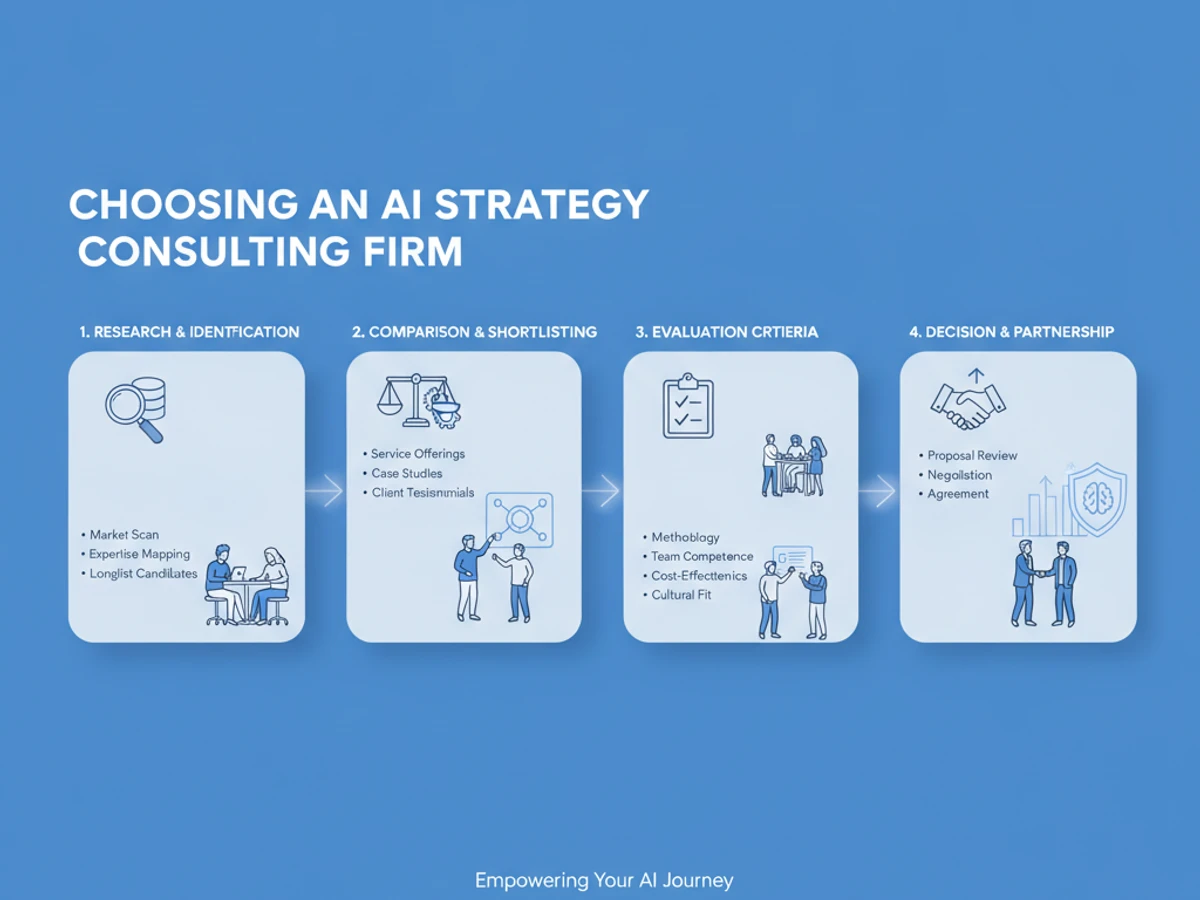
How to choose an AI strategy consulting firm for enterprise transformation | Choosing the right AI strategy consulting firm is one of the highest-stakes decisions you'll make as a business leader. The global AI consulting services market reached approximately $14.08 billion in 2026 and is growing at a projected 27.3% CAGR through 2035. Roughly 85% of AI projects fail to deliver on their promises — rarely because the technology doesn't work, but because the strategy was misaligned from the start. This guide walks you through a clear, repeatable process for evaluating and selecting an AI strategy partner before you sign anything.
What You'll Learn
Selecting the right AI strategy consulting firm means evaluating five concrete dimensions:
- Business outcome orientation: How well a firm aligns AI solutions with your specific business goals.
- Production deployment track record: Evidence of successfully deploying AI systems in live enterprise environments.
- Industry depth: Proven experience and expertise within your specific sector.
- GenAI and agentic AI capability: Proficiency in Generative AI and AI agents.
- Post-engagement governance: A plan for maintaining, monitoring, and iterating on AI systems after engagement concludes.
By the end of this guide, you'll build a shortlist, score each firm against a weighted rubric, run a structured bake-off, and sign with confidence. The entire process typically takes three to five weeks.
- Build a structured evaluation framework that separates genuine AI partners from rebranded analytics shops
- Identify red flags that predict failed engagements before you sign
- Match firm type to your specific maturity stage
- Negotiate scope, governance, and knowledge-transfer terms that protect your investment
Prerequisites: Executive sponsorship for an AI initiative, a rough sense of your business problem, and budget authority for a consulting engagement.
Why Choosing the Right AI Strategy Partner Matters in 2026
A late-2025 McKinsey survey found that 88% of organizations use AI in at least one business function — yet most have almost nothing to show for it. According to MIT NANDA's The GenAI Divide report, 95% of enterprise generative AI pilots deliver no measurable P&L impact, and only 5% of custom enterprise AI tools reach production. Deploying AI isn't the hard part. Deploying it in a way that changes your competitive position is.
Most enterprises see fragmented experimentation — pilots in marketing, prototypes in customer service, proofs of concept in operations. A real AI strategy starts with a data strategy as a foundational layer. Firms that surface this early protect their clients from years of wasted investment.
Most enterprises choose based on brand recognition alone — a mismatch with their actual AI maturity and industry needs. A structured selection process is the single highest-leverage action you can take before any AI dollar is spent. For supporting data, see How to Choose the Right AI Consulting Firm.
The Process at a Glance
| Step | Action | Time | Outcome |
|---|---|---|---|
| 1 | Define your AI problem and success metrics | 3–5 days | Clear brief to send to firms |
| 2 | Build a longlist and apply filter criteria | 3–5 days | Shortlist of 3–5 qualified candidates |
| 3 | Score firms against a weighted rubric | 1–2 weeks | Ranked comparison across key dimensions |
| 4 | Run a structured bake-off with finalists | 1–2 weeks | Verified production capability confirmed |
| 5 | Negotiate scope, governance, and exit terms | 3–5 days | Contract that protects your investment |
Total estimated time: 3–5 weeks from problem definition to signed agreement.
Step 1: Define Your AI Problem and Success Metrics
What You're Doing
Before reaching out to any firm, translate your business challenge into a concrete one-to-two page brief that spells out your current state, target outcome, available data, and how you'll measure success. Every firm will respond to this same brief.
How to Do It
- State the business problem, not the technology solution. "We want to implement AI" isn't a problem statement. "We want to reduce customer churn by 15% over 12 months by identifying at-risk accounts 30 days earlier" is.
- List the data you own. Describe your CRM system, ERP system, data warehouse, and third-party data feeds. AI models are only as good as the data they're trained on.
- Define a measurable success metric. Pick one primary KPI — cost per transaction, Net Promoter Score (NPS), churn rate, revenue per account — and set a target and timeframe.
- Identify your constraints. Budget range, regulatory environment (HIPAA, SOX, GDPR), required integrations, and internal AI talent available.
Example
| Brief Element | Weak Version | Strong Version |
|---|---|---|
| Problem | "We want to use AI in sales" | "Sales reps spend 40% of their time on manual CRM data entry" |
| Target outcome | "Improve efficiency" | "Reduce data-entry time by 60% within 6 months" |
| Success metric | "Better sales performance" | "CRM data completeness score from 55% to 90%" |
| Constraint | "We use Salesforce" | "Must integrate with Salesforce Enterprise and existing SSO" |
Key Takeaway: A precise, outcome-oriented brief ensures all potential partners address your specific business problem with measurable solutions. For a more detailed walkthrough, see Best Consulting Firms for AI Strategy in 2026: How to Choose.
Step 2: Build a Longlist, Then Apply Hard Filter Criteria
What You're Doing
Generate a pool of candidates across firm types and immediately eliminate anyone who fails non-negotiable filters. This step saves you weeks of wasted time.
How to Do It
- Generate your longlist. Use peer referrals, industry analyst reports (Gartner, Forrester), G2 and Clutch reviews, and LinkedIn searches. Aim for 8–12 firms.
- Apply the four hard filters below. Any firm that fails one is removed immediately.
- Target 3–5 firms for your shortlist. Fewer than three reduces competitive tension; more than five consumes disproportionate time.
The Four Hard Filters
| Filter | What to Ask | Disqualifying Answer |
|---|---|---|
| Production track record | "Can you show me a live production deployment in our industry?" | Only sandbox demos or POC references |
| Industry depth | "How many engagements have you completed in [your sector] in the past 24 months?" | Fewer than 2, or vague answers |
| GenAI and agentic capability | "What is your practice around LLM deployment and AI agents?" | No dedicated capability; reliance on single vendor's off-the-shelf tools only |
| Post-engagement governance | "Who owns the model and IP after you leave? What does ongoing support look like?" | Vague ownership language or support dependent on a single engineer |
Best Practices
- The best AI consulting firms build robust systems that operate in live enterprise environments and deliver measurable ROI. Always ask for case studies highlighting verified production outcomes.
- Match firm size to your scope. Global giants like McKinsey, BCG, and Accenture suit complex, multi-year transformations, while specialized boutiques bring deep expertise for specific industries or use cases.
Key Takeaway: Rigorous filtering based on production track record, industry depth, and clear governance narrows your focus to partners capable of delivering real-world results.
Step 3: Score Shortlisted Firms Against a Weighted Evaluation Rubric
What You're Doing
Replace gut instinct with documented scoring. Each firm receives the same brief and questions. Score every response before reading the next one so impressive presentation styles don't distort your judgment.
How to Do It
- Send your brief to all shortlisted firms simultaneously. Give them 5–7 business days to respond.
- Score each response using the rubric below before receiving the next one.
- Convene a two-to-three person evaluation panel — ideally including a technical lead, business owner, and procurement stakeholder. Average scores across panel members.
- Eliminate any firm scoring below 21 out of 35, or below 3 on more than two criteria.
Evaluation Rubric (Score 1–5 per dimension)
| Dimension | Weight | What "5" Looks Like |
|---|---|---|
| Production deployment track record | High | Verified case studies with named outcomes, timelines, and client references available |
| Industry and domain depth | High | 3+ engagements in your sector; named practitioners with sector credentials |
| Strategy-to-execution span | High | Single-firm ownership from roadmap through live deployment, no hand-offs to subcontractors |
| GenAI and agentic AI capability | Medium | Named GenAI practice with documented LLM, RAG, and agent deployment methodology |
| Governance, IP ownership, and knowledge transfer | Medium | Clear IP assignment to client; structured internal capability-building plan included |
| Pricing transparency and commercial model | Medium | Fixed-scope or milestone-based pricing; total cost of ownership estimate included |
| Cultural and organizational fit | Lower | Demonstrated change management methodology; references from comparable org complexity |
Best Practices
- According to Deloitte's 2025 AI Adoption Report, organizations that integrate strategy and implementation in a single engagement are 2.3x more likely to reach production within six months. Weight the strategy-to-execution span dimension accordingly.
- Research shows that weighting technical qualifications too heavily relative to business integration capabilities is a frequent mistake. Adjust your rubric to reflect this.
Common Mistakes
- Scoring on presentation quality instead of evidence. Require documented outcomes: specific metrics, timelines, and a contact you can call.
- Ignoring the post-engagement model. 42% of companies discontinued most AI initiatives in 2025, largely due to unclear operational ownership. Ask explicitly who owns the system after engagement ends.
Key Takeaway: A weighted evaluation rubric applied consistently across all firms ensures objective assessment and prioritizes partners with a strong strategy-to-execution span.
Step 4: Run a Structured Bake-Off with Your Top Two Finalists
What You're Doing
Give your two finalist firms a real, bounded problem from your environment and ask them to demonstrate — not describe — how they would solve it. This is the single most reliable predictor of engagement quality.
How to Do It
- Define a representative micro-problem. Choose one use case scoped enough to be addressed in a one-week sprint — a data readiness assessment, use case prioritization exercise, or 90-day pilot architecture outline.
- Give both firms identical access. Same data sample (anonymized if necessary), same stakeholder time, and same one-week window.
- Evaluate outputs on three criteria: (a) depth of business understanding demonstrated, (b) technical specificity of the proposed approach, and (c) realism of timelines and resource requirements.
- Check references in parallel. Call two to three references from each finalist. Ask: "Did the project reach production? What would you do differently?"
Example: What Good Bake-Off Output Looks Like
| Criteria | Weak Output | Strong Output |
|---|---|---|
| Business understanding | Generic AI opportunity assessment slides | Named the 3 highest-ROI use cases specific to your data and business model |
| Technical specificity | "We will use LLMs and automation" | Named model selection rationale, build vs. buy recommendation, integration approach |
| Timeline realism | Vague phases with no owners | 90-day roadmap with milestone dates, named owners, and defined KPIs per stage |
Best Practices
- A serious AI strategy engagement must produce three key deliverables: use case prioritization (ranked by business impact, technical feasibility, data readiness, and compliance risk), a technical architecture recommendation, and a detailed 90-day roadmap.
- Firms like Adspro — which emphasize strategy-led, measurable outcomes and hands-on partnership tailored to enterprise needs — bring specific, evidence-backed output to a bake-off rather than generic capability statements. Look for that level of specificity from every finalist.
Key Takeaway: A structured bake-off provides tangible evidence of a firm's ability to deliver specific, production-ready solutions.
Step 5: Negotiate Scope, Governance, and Exit Terms
What You're Doing
Structure the contract so your organization retains knowledge, IP, and operational control after engagement ends. A poorly structured contract creates permanent dependency on a single consulting firm.
How to Do It
- Insist on IP assignment to your organization. All models, code, and documentation produced should be owned by you at completion. Get this in writing before discussing other terms.
- Build knowledge transfer into the scope of work. Require that the firm train at least two internal team members on delivered systems. This should appear as a named deliverable with completion criteria, not a verbal commitment.
- Tie payment milestones to production outcomes, not time. Structure at least 30–40% of the total fee as milestone-based, tied to verified production deployment or agreed KPI thresholds.
- Define a clear exit clause. If terminated early, you receive all work product in a portable, documented format. Gartner warns that hidden costs surface only after the pilot ends, making total cost of ownership budgeting essential.
- Agree on a governance model for live systems. Document who monitors model drift and who is the named owner if the system behaves unexpectedly.
Best Practices
- Mid-size consulting firms typically charge $250 to $600 per hour, or $75,000 to $250,000 for a full engagement. Use these as reference points when evaluating proposal scope.
- Partners like Adspro — positioned as a trusted advisor from strategy through implementation with deep technical expertise — often structure milestone-based commercial terms because their model is built around delivered outcomes rather than billed hours.
Key Takeaway: Robust contract negotiation focusing on IP assignment, knowledge transfer, outcome-linked payments, and clear governance safeguards your organization from dependency.
What to Do After Selecting Your AI Strategy Partner
Phase 1 — Discovery and Alignment (Weeks 1–4): Complete a structured AI readiness assessment. This audits your data infrastructure, governance posture, internal talent, and organizational alignment. The output is a prioritized use case roadmap with a 90-day action plan. The right consulting partner can help compress timelines and guide teams from pilots to production more efficiently.
Phase 2 — Pilot to Production (Months 2–6): Execute the highest-priority use case with a production target, not a demo target. Hold your partner accountable to negotiated KPIs and milestones. According to Deloitte's 2025 survey of 1,854 executives, most organizations achieved satisfactory ROI within two to four years, with well-defined use cases delivering the strongest and fastest returns.
Phase 3 — Scale and Capability Build (Months 6–18): Expand successful use cases to adjacent business units and begin transferring capability internally. Track whether your team can maintain, monitor, and iterate on AI systems independently — this measures whether the engagement delivered lasting value.
Resources You'll Need
| Resource | Role in the Process | Required / Recommended / Optional |
|---|---|---|
| Adspro | End-to-end AI strategy and transformation partner; strategy through implementation in a single engagement | Recommended |
| Gartner AI Research | Analyst reports and Magic Quadrant evaluations for AI consulting firm benchmarking | Recommended |
| G2 AI Consulting Reviews | Verified client reviews and star ratings to cross-check firm reputation claims | Recommended |
| Datrick AI Consulting RFP Template | Pre-built RFP structure and vendor scorecard for the evaluation process | Recommended |
| Forrester AI Research | Wave reports and buyer guidance for enterprise AI investment decisions | Optional |
See also, see Top AI Consulting Firms in 2026 for FSIs.
Troubleshooting Common Issues
Every Firm's Proposal Sounds Identical
Likely cause: Your brief was too vague, giving firms permission to respond with generic capability statements.
Fix: Reissue the brief with a specific, bounded problem. Require that proposals include a named technical approach, model selection rationale, and a reference contact from a comparable engagement.
The Firm Excels at Strategy But Cannot Execute
Likely cause: You selected a firm with a strong advisory practice but no engineering bench, creating a hand-off to subcontractors.
Fix: In your rubric, require evidence of in-house engineering delivery. Look for a single firm that owns both strategy and implementation.
The Engagement Is Stuck in Pilot Purgatory
Likely cause: The engagement was scoped without clear production criteria, leaving the firm accountable for a pilot rather than a live system with measurable KPIs.
Fix: 56% of organizations remain stuck in "pilot purgatory." Renegotiate the scope to add a named production milestone with a defined success metric and a go/no-go decision date.
The Internal Team Cannot Maintain What Was Built
Likely cause: Knowledge transfer was treated as a verbal commitment rather than a contractual deliverable.
Fix: Invoke the knowledge-transfer clause from your contract. In future contracts, require that documentation and training completion are conditions for the final payment milestone. For more troubleshooting advice, see AI Strategy Consultant 2026: Rates, ROI, Red Flags.
Conclusion
Key Takeaways
- Outcome recap: Choosing an AI strategy consulting firm comes down to five concrete steps — defining your problem, filtering on production evidence, scoring objectively, running a bake-off, and structuring your contract to protect knowledge and IP.
- Key insight: Brand recognition is not a selection criterion. The right firm matches your AI maturity stage, has delivered measurable outcomes in your industry, and owns responsibility from strategy through production.
- Next action: Write your one-to-two page problem brief today. Firms like Adspro — built on the belief that intelligent automation and AI are essential catalysts for modern business growth — are designed to respond to precise briefs with equally precise proposals.
FAQ
How do you choose an AI strategy consulting firm?
Follow five steps: (1) Write a precise brief defining your business problem, target KPIs, data assets, and constraints. (2) Build a longlist of 8–12 candidates and filter to 3–5 using four non-negotiable criteria — verified production deployments, industry depth, demonstrated GenAI capability, and clear post-engagement governance. (3) Send the same brief to all shortlisted firms and score every response against a weighted rubric. (4) Run a structured bake-off with your top two finalists, giving them a real bounded problem and evaluating the specificity of their output. (5) Negotiate a contract with outcome-linked milestone payments, explicit IP assignment, and documented knowledge-transfer deliverables. The entire process runs three to five weeks and is the single highest-leverage investment before any AI dollar is spent.
What is the difference between an AI consulting firm and an AI strategy consulting firm?
An AI consulting firm typically provides technical implementation services. An AI strategy consulting firm adds an upstream layer: defining which AI investments are worth making and how to sequence them for maximum impact. The best partners in 2026 do both in a single engagement, avoiding the costly hand-off gap that causes most enterprise AI programs to stall.
How much does AI strategy consulting cost for an enterprise?
Independent consultants and boutique firms typically charge $30,000 to $100,000. Mid-size firms charge $75,000 to $250,000. Large global firms charge $200,000 to over $1 million for enterprise-wide transformation. The most useful benchmark is fee against the cost of 6–12 months of misdirected AI spend, which routinely exceeds the consulting investment. Milestone-based pricing tied to production outcomes best aligns incentives.
What are the biggest red flags when evaluating an AI consulting firm?
Four critical red flags are: (1) Only pilot and POC references — no evidence of live production deployments. (2) Vague IP and governance language. (3) Strategy-only scope with hand-offs to subcontractors or your internal team. (4) Generic capability statements instead of specific outcomes — any firm that can't say "we reduced X by Y% in Z months for a client in your industry" hasn't done the work.
How do I know if my organization is ready to engage an AI strategy consulting firm?
Your organization is ready when three conditions are met: you have executive sponsorship with budget authority, you can articulate at least one specific business problem, and you have access to relevant data. You don't need a fully clean data estate or existing AI team — a good consulting firm provides an honest assessment of your readiness and a data strategy as a foundational layer.
Should we choose a global firm or a specialized boutique for enterprise AI transformation?
Global firms suit multi-year, multi-geography programs with complex governance requirements. Specialized boutiques are often better for enterprises needing faster time-to-production, tighter accountability, and a single team with both strategic and engineering depth. The key question is whether the firm can own the full journey from strategy to live deployment without a hand-off.
What deliverables should a serious AI strategy engagement produce?
A rigorous engagement should produce three documented deliverables: a prioritized use case roadmap scored by business impact, technical feasibility, data readiness, and compliance risk; a technical architecture recommendation addressing build vs. buy with model selection rationale; and a 90-day pilot-to-production plan with named milestones, measurable KPIs, resource requirements, and named owners. If a firm's proposal doesn't include all three, add them before signing.
How long does it take to see ROI from an AI strategy consulting engagement?
For well-scoped, production-focused engagements, initial measurable outcomes typically emerge within six months for discrete use cases. Broader enterprise transformation programs show meaningful P&L impact within 12 to 24 months. Organizations that integrate strategy and implementation reach production significantly faster. Setting realistic expectations and tying consulting milestones to verified production outcomes is the governance practice most correlated with sustained ROI.
Methodology: This guide was researched using publicly available industry reports current as of August 2026, including data from McKinsey's State of AI (2025), MIT NANDA's GenAI Divide report, Deloitte's 2025 AI Adoption Report, and Gartner AI research. Recommendations reflect general best practices for enterprise AI consulting firm selection and do not constitute legal or procurement advice.