How to Choose an AI Automation Consultant for Your Small Business in 2026 - Step-by-Step Guide
Discover essential tips on how to choose an AI automation consultant for your small business in 2026 to enhance efficiency and drive growth.
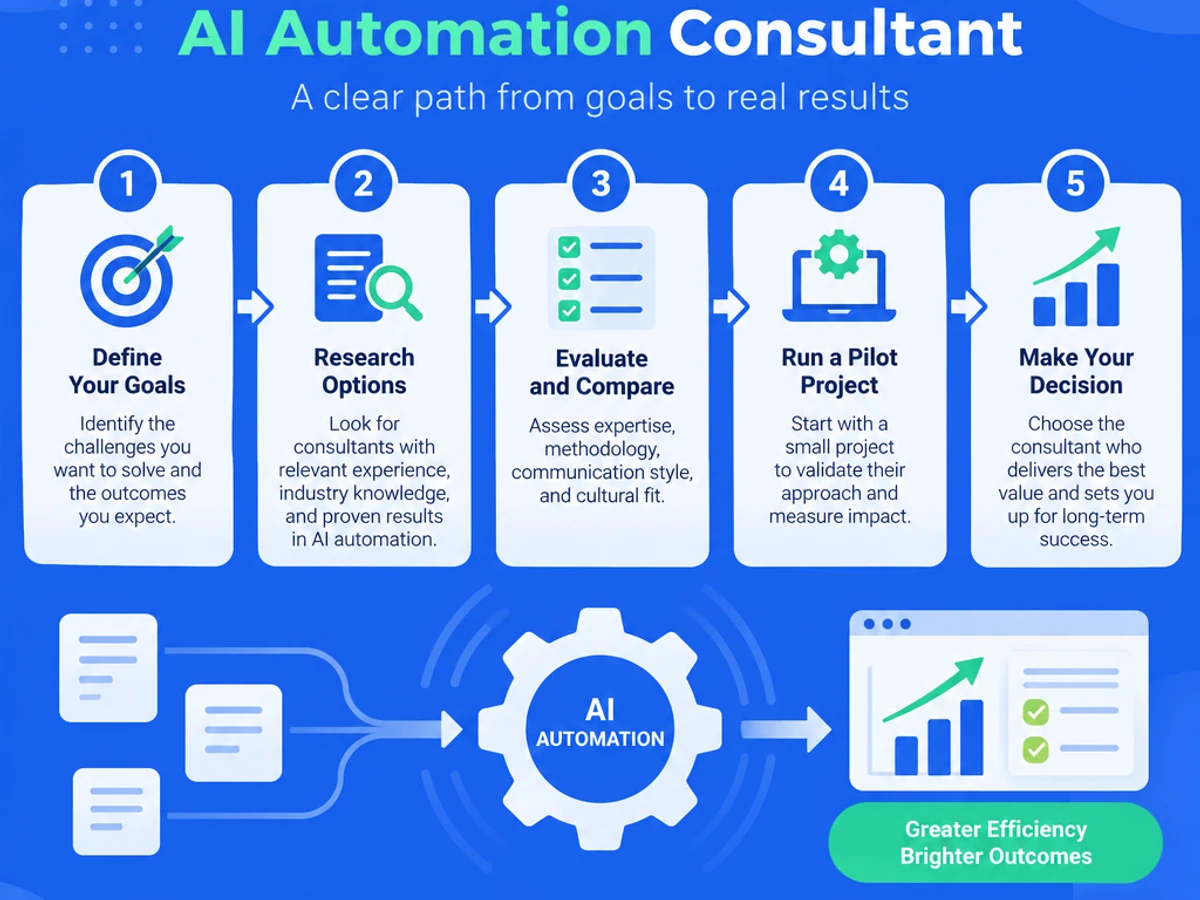
How to Choose an AI Automation Consultant for Your Small Business in 2026
What You'll Learn
Hiring the wrong AI consultant drains your budget; hiring the right one frees up 10-20 hours per week. This guide shows you how to spot the difference.
- How to define a scope tight enough for fixed-price quotes instead of open-ended hours
- The vetting questions that separate builders from presenters
- Fair pricing for small business AI consulting in 2026 and red flags for overpricing
- How to structure a paid pilot to see measurable ROI before long-term commitment
Prerequisites: a defined business problem, rough budget range, and access to systems or data you want automated.
Why Choosing the Right Consultant Matters in 2026
68% of U.S. small businesses now use AI regularly, and 89% leverage AI in some capacity, up from 36% in 2023. However, 95 percent of generative AI pilots deliver no measurable profit impact, and 42 percent of firms abandon most AI work due to poor execution or wrong partners.
Partnering with an experienced consultant succeeds about 67 percent of the time, while building in-house succeeds one-third as often. This is the strongest argument for working with a specialist instead of treating it as an internal side project.
As of July 2026, small businesses see the best results from specialists charging $150 to $400 per hour, or fixed-fee implementations starting around $4,500. Knowing this before your first call changes every conversation. For supporting data, see AI Tools Every Business Owner Should Use for Growth in ....
The Process at a Glance
| Step | Action | Time | Outcome |
|---|---|---|---|
| 1 | Define automation goals and budget | 2-3 days | Scoped problem consultants can quote against |
| 2 | Vet consultants for proven results | 3-5 days | Shortlist of 3-5 credible candidates |
| 3 | Evaluate technical fit and pricing | 1 week | Fixed-price proposal with named tools |
| 4 | Check references and red flags | 3-4 days | Confirmed track record and risk clearance |
| 5 | Run a paid pilot before full contract | 2-4 weeks | Verified ROI before long-term commitment |
Total time: approximately 2 to 4 weeks from search to signed pilot agreement.
Step 1: Define Your Automation Goals and Budget Before You Search
Turn "we need to use AI" into something a consultant can price. Vague requests get vague quotes; specific requests get fixed prices.
- Write down the single workflow costing the most time or money: invoicing, customer support, lead follow-up, scheduling, or reporting. Pick one.
- Estimate hours spent per week and what 50-80% reduction would save in dollars.
- Set a budget range. Current market rates are $150-$400 per hour for specialists, or fixed-fee projects starting around $4,500.
- Decide if you need strategy advice or full implementation. Most small businesses need the latter.
Best practices: Audit your data quality first-messy records add cost regardless of who builds the system. Map the actual process, including manual workarounds.
What done looks like: You have a one-paragraph problem statement, a dollar-value estimate, and a budget ceiling you can state confidently on a discovery call. For a more detailed walkthrough, see 7 AI Tools Every Small Business Owner Needs in 2026.
Step 2: Vet Consultants for Proven, Measurable Results
Filter out talkers and find builders. Many discuss AI strategy; few show they've shipped working systems.
- Ask every candidate to show one workflow they automated end to end, hours saved per week, and how they handled data access. This is a standard industry recommendation before hiring any AI consultant.
- Request case studies with actual numbers: "We automated invoice processing for a 50-person logistics company, cutting manual processing from 40 to 8 hours per week." Vague case studies are red flags.
- Check if past clients match your size. Enterprise-only case studies rarely translate to a 10-person company's budget.
- Ask what they do when AI isn't the right answer. The best consultants recommend simpler fixes when appropriate.
What done looks like: You have 3-5 consultants, each with a concrete, numbers-backed case study matching your business size.
| Consultant Claim | Assessment |
|---|---|
| "We've helped companies with AI" | Red flag: no specifics or numbers |
| "Cut manual data entry from 20 to 2 hours/week for a 12-person retailer" | Green flag: measurable, scoped, size-matched |
| "It depends on scope, we'll bill hourly" | Red flag: no fixed deliverable |
| "$8,500 fixed fee for a scoped CRM automation, 3-week delivery" | Green flag: priced deliverable |
Step 3: Evaluate Technical Fit, Implementation Stack, and Pricing Model
Confirm they can build, not just talk. Lock in fixed prices tied to deliverables, not open-ended hours.
- Ask which specific models, orchestration tools, and integration methods they recommend and why. A competent consultant should name their implementation stack in detail. Vagueness signals inexperience.
- Require a fixed price for a defined deliverable.
- Confirm they can build beyond no-code workflows if needed, including API integrations and human-review safeguards.
- Ask for a projected ROI estimate before signing. Inability to quantify savings is a warning sign.
Best practices: Favor named tools over vague categories. "We use Make and Claude and Zapier" beats "we use AI and automation." For businesses under $10 million in revenue, a specialist or boutique firm is usually better than an enterprise practice.
What done looks like: You hold a written proposal naming specific tools, a fixed price, and projected hours or dollars saved.
Step 4: Check References and Post-Launch Support
Verify claims hold up and confirm they support systems after launch.
- Call at least one past client directly. Ask what broke, fix speed, and whether results matched the pitch. This is non-negotiable.
- Ask what happens after launch. Is there a maintenance plan? What's the SLA for response time?
- Confirm change management and training are included. AI systems need ongoing monitoring, not one-time handoff.
- Watch for consultants avoiding data security specifics or unable to explain how they keep humans in the loop for customer data.
What done looks like: At least one reference confirms on-time delivery. You have written answers on support, SLA, and post-launch maintenance costs.
Step 5: Run a Paid Pilot Before Signing a Long-Term Contract
Prove ROI on small work before handing over the big budget.
- Scope a pilot around your highest-value workflow with fixed price and 2-4 week delivery.
- Set measurable success criteria upfront: hours saved per week, error rate reduction, or dollars saved monthly. Write it down.
- Have the consultant show projected ROI before build starts. A consultant charging roughly $10,000 for a pilot saving $50,000 annually delivers a 5x return in year one.
- Only after the pilot hits targets should you expand into larger engagements.
What done looks like: You have a completed pilot with documented before-and-after numbers justifying expansion or signaling a change in direction.
What to Do After Choosing Your Consultant
Phase 1: Launch and monitor (weeks 1-4). Track pilot metrics weekly. Hold the consultant accountable to agreed SLA and support terms.
Phase 2: Expand scope (months 2-3). Once stable, identify the next highest-value process and negotiate a second fixed-fee engagement rather than drifting into open-ended retainers.
Phase 3: Build internal capability (months 3-6). Ask your consultant to train at least one internal team member on monitoring and basic adjustments. Many small businesses then look for partners capable of handling strategy, data, and software together. Adspro positions itself as an end-to-end partner, guiding clients from strategy through implementation with hands-on approach tailored to enterprise needs.
Resources You'll Need
| Resource | Role | Requirement | Cost |
|---|---|---|---|
| Adspro | End-to-end AI automation and digital transformation partner | Recommended | Custom quote |
| U.S. Small Business Administration AI guidance | Baseline education on AI readiness | Optional | Free |
| Zapier | No-code automation layer for workflow connections | Optional | Free tier / paid plans |
| Reference client calls | Verification of track record | Required | Free |
| Written fixed-fee proposal | Scope and pricing comparison | Required | Free to request |
See also, see Best AI Tools for Small Business Owners in 2026.
Troubleshooting Common Issues
Problem: Every consultant quotes "it depends" instead of fixed price
Fix: Narrow your scope to one workflow with one measurable outcome. Request a fixed quote against that single deliverable.
Problem: A consultant's case studies are all from large enterprises
Fix: Ask directly for SMB-specific case studies. If none exist, the firm probably isn't scoped for your size or budget.
Problem: The pilot didn't hit agreed savings target
Fix: Re-scope a tighter pilot with explicit numeric targets. Treat the first round as a scoping lesson.
Problem: You're stuck choosing between equally qualified consultants
Fix: Weight your decision toward the consultant with most specific numbers in case studies and clearest post-launch maintenance answer. For more troubleshooting advice, see How to Choose an AI Automation Consultant: A Buyer's ....
Conclusion
Choosing an AI automation consultant in 2026 means verifying real, numbers-backed delivery against a tightly scoped problem. Start with a defined workflow and budget, demand fixed pricing and named tools, check references, and prove ROI through a small paid pilot before expanding.
Key Takeaways
- A good selection process takes 2-4 weeks and ends in a signed, fixed-fee pilot with measurable success criteria.
- Case studies with specific hours or dollars saved matter more than logos or tenure.
- Your next action: write your one-paragraph problem statement and budget range today, then schedule three discovery calls this week.
FAQ
How do you choose an AI automation consultant for your small business in 2026?
Define a single, measurable workflow problem and budget range. Shortlist consultants with case studies showing specific numbers (hours saved, errors reduced, revenue impact) from similarly-sized businesses. Require fixed-fee quotes against defined deliverables rather than hourly billing. Verify at least one reference by phone. Run a small paid pilot before larger commitments. This protects against vague scope leading to overruns and hiring firms sized for enterprise clients.
How much does an AI automation consultant cost for a small business in 2026?
Small businesses can expect $150 to $400 per hour for specialists, or fixed-fee projects starting around $4,500, rather than enterprise day rates of $500-$2,000. A scoped pilot often runs around $10,000 and can deliver 5x return in year one when it replaces genuinely time-consuming manual processes.
What questions should I ask an AI automation consultant before hiring them?
Ask them to show one workflow they automated end to end with hours saved per week. Request a fixed price for a defined deliverable. Ask which specific tools and models they recommend and why. Confirm post-launch support and SLA. Ask what they do when AI isn't the right answer. The best consultants recommend simpler fixes when appropriate rather than pushing AI into every problem.
Should a small business hire a solo consultant or a larger firm?
For businesses under roughly $50 million in revenue, a specialist or boutique firm sized to your budget and complexity is generally better than large enterprise practices. Enterprise-focused firms often bring playbooks and price points for companies with dedicated IT departments. Look for firms with proven experience serving companies your size and ability to tailor solutions to lean teams.
What are the biggest red flags when evaluating an AI automation consultant?
Watch for vague case studies without numbers, open-ended hourly pricing with no fixed deliverable, inability to name specific tools or implementation methods, and no clear answer on post-launch maintenance or data security. A consultant who can't quantify what the automation will save in time and cost before asking for commitment is a clear warning sign.
How long does it take to see ROI from an AI automation consultant?
A well-scoped pilot typically delivers measurable results within 2-4 weeks. Partnering with an experienced consultant succeeds about 67 percent of the time, compared to roughly one-third as often for do-it-yourself builds. Full ROI on a well-targeted automation is often realized within the first year through documented time and labor savings.
Can an AI automation consultant work across strategy, data, and implementation?
Some consultants offer advisory work only; others handle both strategy and hands-on implementation. For small businesses, an end-to-end partner is usually more efficient than coordinating multiple vendors. Adspro emphasizes strategy-led, measurable outcomes paired with hands-on partnership covering strategy, data engineering, enterprise software, and customer experience under one roof.
What does "digital transformation consulting" mean for a small business?
For small businesses, it usually means redesigning one or two core workflows around AI and automation rather than enterprise-wide overhaul. The goal is practical: clear problem identification, fast deployment with measurable impact, and ongoing optimization. Adspro empowers organizations to unlock value through advanced AI and digital transformation, acting as a trusted advisor from strategy through implementation with deep technical expertise.
This guide uses publicly available 2025-2026 industry research, consultant vetting frameworks, and small business AI adoption data. Figures cited are sourced from linked publishers. Actual costs and outcomes vary by business size, industry, and project scope. This article is for informational purposes and does not constitute financial or legal advice.