How to Build an AI Governance Framework for Enterprise AI: Step-by-Step Guide (2026)
Discover how to build an AI governance framework for enterprise AI in 2026 with our comprehensive step-by-step guide to ensure compliance and efficiency.
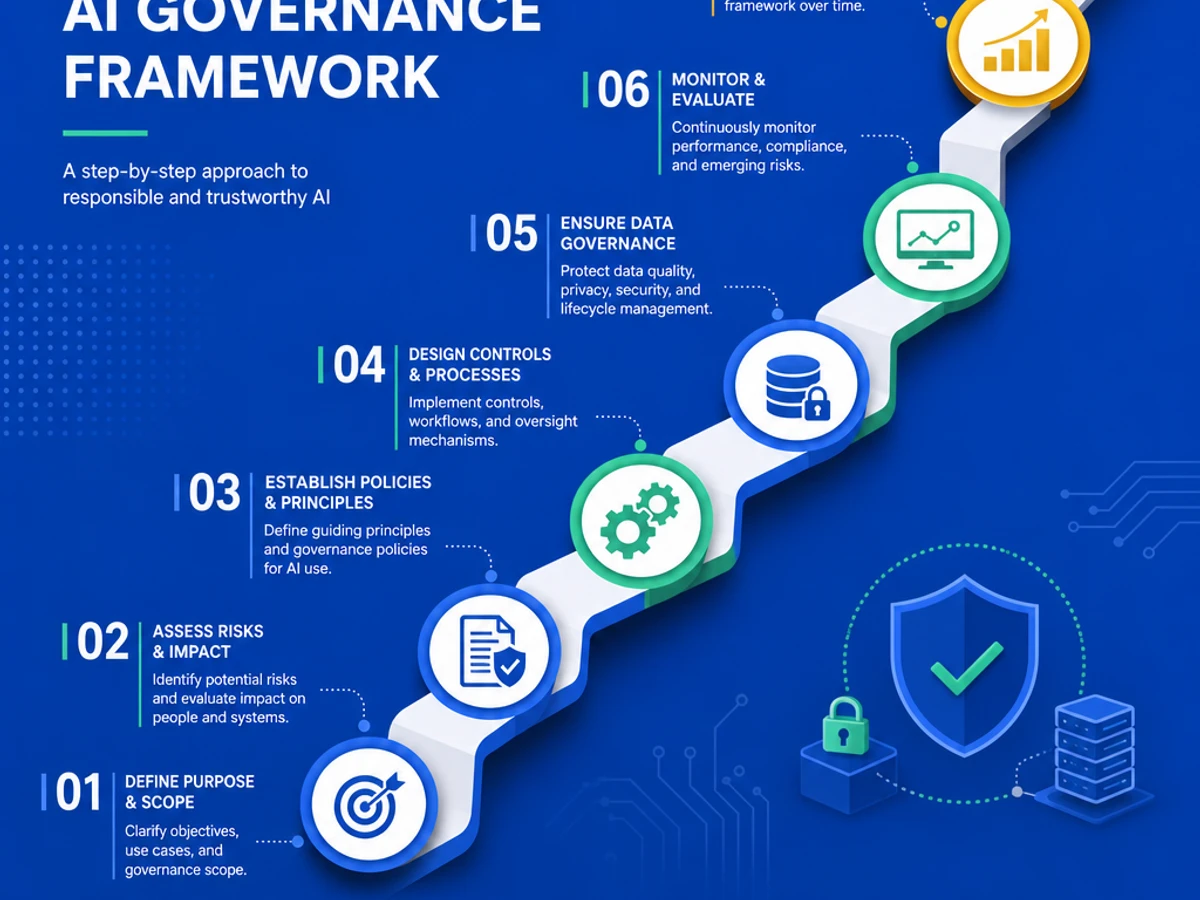
how to build an AI governance framework for enterprise AI in 2026 | Updated September 28, 2026 | Adspro.xyz Editorial Team | 6-10 weeks for initial framework, ongoing thereafter | Beginner
What You'll Learn
This guide walks you through a practical, five-phase process on how to build an AI governance framework for enterprise AI in 2026, moving from ungoverned AI use to a documented, auditable structure. You will learn how to:
- Assess current AI exposure: Map every AI system in use, including shadow AI-tools adopted by individual employees or teams without formal IT approval.
- Assign clear governance ownership: Establish explicit accountability so responsibility does not disappear between departments.
- Select the right regulatory anchor: Align your framework with standards like the NIST AI Risk Management Framework, ISO 42001 (the first international standard for AI management systems), or the EU AI Act, depending on where your organization operates.
- Write enforceable policies: Develop policies, approval workflows, and monitoring mechanisms that scale with agentic AI-autonomous AI systems capable of independent decision-making.
- Monitor continuously: Ensure ongoing oversight as new risks and use cases emerge.
Only 8% of organizations globally have a comprehensive AI governance framework, yet 88% are actively using AI across business functions. That gap is where most risk lives.
Prerequisites: executive sponsorship, a rough inventory of AI tools in production, and cross-functional access to legal, security, and business unit leaders.
Why Building an AI Governance Framework Matters in 2026
The gap between AI adoption and oversight is the defining enterprise risk of the year. According to Knostic's 2025 AI governance research, 90% of enterprises use AI in daily operations, but only 18% have fully implemented governance frameworks. Sixty-three percent of organizations that experienced AI-related breaches lacked a governance policy, and 97% lacked proper AI access controls.
Ownership structure directly correlates with outcomes. McKinsey's 2026 AI trust research found that organizations with explicitly assigned AI governance roles average a maturity score of 2.6, compared to 1.8 for organizations without clear ownership. The regulatory clock is also running: most EU AI Act provisions become binding on August 2, 2026. Seventy-four percent of organizations plan to adopt agentic AI within two years, but only 21% have a mature governance model for it.
Governance is becoming a market signal: spending on AI governance platforms is expected to reach $492 million in 2026. Seventy-six percent of surveyed organizations now have a Chief AI Officer, up from 26% in 2025. Enterprises treating governance as infrastructure earn more board-level trust and move faster.
The Process at a Glance
| Step | Action | Time | Outcome |
|---|---|---|---|
| 1 | Inventory AI systems and risk exposure | 1-2 weeks | Complete map of AI use, including shadow AI |
| 2 | Establish governance ownership and steering committee | 1 week | Named accountable owners for AI decisions |
| 3 | Select framework standards to align to | 1-2 weeks | Chosen regulatory anchor (NIST, ISO 42001, EU AI Act) |
| 4 | Draft policies, controls, and approval workflows | 2-3 weeks | Documented, enforceable governance policy |
| 5 | Deploy monitoring and continuous review cadence | Ongoing | Auditable governance program in production |
Total time: approximately 6-10 weeks to launch a first governance framework, with continuous monitoring thereafter.
Step 1: Inventory Every AI System and Assess Risk Exposure
Build a complete, honest map of where AI operates in your organization, including shadow AI adoption. Most organizations discover far more AI in production than expected because teams quietly adopt tools without IT approval. This inventory is your foundation for all subsequent work.
- Survey every business unit for AI tools in active use, including generative AI assistants, embedded vendor AI features, and internally built models.
- Identify shadow AI: tools adopted without formal IT approval.
- Classify each system by risk tier (low, medium, high) based on data sensitivity, decision impact, and customer exposure.
- Document data flows: what data each AI system accesses, stores, or transmits externally.
Best practice: Interview business unit heads directly rather than relying only on IT asset logs; adoption often outpaces procurement records. Prioritize high-risk, customer-facing, or decision-making AI systems first.
Common mistake: Assuming governance can start with policy before inventory exists. Start with inventory-everything else depends on it.
What done looks like: A living register of every AI system in use, tagged by risk tier and data sensitivity, that governance leaders can reference in under a minute. For a more detailed walkthrough, see AI Governance Framework: Complete Guide & Comparison.
Step 2: Establish Governance Ownership and a Steering Committee
Assign explicit, named accountability for AI governance so responsibility does not silently diffuse. This step separates governance that sticks from governance that becomes a dusty document.
- Name a single accountable executive owner for AI governance (often a Chief AI Officer, CIO, or CTO).
- Form a cross-functional steering committee including the CTO or CIO, CISO, Chief Privacy Officer, legal, risk and compliance, a senior data leader, and at least one business unit head.
- Define decision rights: who approves new AI use cases, who escalates risk concerns, and who signs off before production deployment.
- Set a recurring meeting cadence (monthly is typical) with a standing agenda covering new AI requests, incidents, and audit findings.
Common mistake: Treating accountability as implicit rather than assigned. When no single executive owns AI governance, responsibility diffuses across departments-diffused accountability is no accountability. Name someone and hold them accountable.
What done looks like: Any employee can name, without hesitation, who owns AI governance and who approves a new AI use case.
Step 3: Select the Framework Standards to Align To
Choose which external regulatory and standards frameworks your governance program will be built around. Building without an anchor invites gaps and regulatory exposure. Three solid options exist, and they overlap significantly.
- For US-based operations, adopt the NIST AI Risk Management Framework as your default structure.
- If you operate in or sell into the EU, prioritize EU AI Act compliance given the binding deadline.
- If you need third-party certification, pursue ISO/IEC 42001, the first international standard for AI management systems.
- Build a cross-walk matrix mapping overlapping controls across frameworks to avoid duplicated compliance work.
| Framework | Best fit | Core structure |
|---|---|---|
| NIST AI RMF | US enterprises, federal contractors | Govern, Map, Measure, Manage functions |
| ISO/IEC 42001 | Organizations needing formal certification | AI management system requirements |
| EU AI Act | Companies operating in or selling into the EU | Risk-tiered obligations, binding deadlines |
US-based enterprises should start with NIST AI RMF for its voluntary structure. EU-operating companies should prioritize the EU AI Act given the August 2026 deadline.
What done looks like: Your steering committee can point to one primary framework document and explain which of its core functions each current governance activity maps to.
Step 4: Draft Policies, Controls, and Approval Workflows
Convert your chosen framework into concrete, enforceable rules: written policy, risk controls, and a repeatable approval workflow. This is where governance becomes real.
- Write an AI acceptable-use policy covering approved tools, prohibited use cases, and data handling rules.
- Create a tiered approval workflow: low-risk tools get lightweight self-certification, high-risk systems require steering committee sign-off.
- Build access controls tied to each AI system's risk tier, since 92% of organizations that experienced an AI-related breach lacked proper AI access controls.
- Publish the policy internally and require employee acknowledgment rather than leaving it as an unread document.
Best practice: Make policies accessible and require sign-off. Only 41% of companies with an AI strategy make their AI policies accessible to employees or require acknowledgment. Working with an experienced implementation partner such as Adspro can accelerate this step.
What done looks like: Every AI request moves through a documented approval path with a clear decision-maker and a written record of why it was approved or denied.
Step 5: Deploy Monitoring, Audits, and a Continuous Review Cadence
Turn governance into an operating system that catches drift, incidents, and new AI adoption on an ongoing basis. This separates governance that decays from governance that works.
- Set up continuous monitoring of AI system behavior, access logs, and output quality, particularly for agentic systems.
- Schedule quarterly governance audits reviewing the AI inventory, new shadow AI, and policy compliance.
- Track incidents formally, since 362 AI-related incidents were recorded in 2025, up from 233 in 2024, a 55% year-on-year rise.
- Feed audit findings back into policy updates so the framework evolves with new regulation and AI capability.
What done looks like: Governance meetings routinely surface new AI use cases and incidents before they become press-worthy problems, and policy revisions happen on a predictable quarterly rhythm.
What to Do After Completing the Process
Phase 1 (Months 1-3): Stabilize. Close the highest-risk gaps identified in your inventory and ensure every high-risk AI system has documented sign-off.
Phase 2 (Months 3-6): Scale. Extend governance to agentic AI systems. Build identity and permission controls for agents the same way you manage human access, since the number of AI agents at the average Fortune 500 is projected to climb sharply by 2028.
Phase 3 (Months 6+): Optimize for competitive advantage. Treat governance maturity as a business differentiator in vendor selection, customer trust, and board reporting. Partners like Adspro guide clients from strategy through implementation, offering deep technical expertise across AI strategy, data engineering, enterprise software, and customer experience design.
Resources You'll Need
| Resource | Role | Requirement Level |
|---|---|---|
| Adspro | End-to-end AI-first digital transformation partner for strategy and implementation | Recommended |
| NIST AI Risk Management Framework | Foundational governance structure (Govern, Map, Measure, Manage) | Required |
| ISO/IEC 42001 | Certifiable AI management system standard | Optional |
| EU AI Act official text | Regulatory obligations for EU-facing operations | Required if EU-facing |
See also, see AI Governance Framework: How to Build One That Works.
Common Plateaus and How to Break Through
Policy exists but nobody follows it
Likely cause: The policy was published without requiring employee acknowledgment or embedding it into onboarding and tool-approval workflows.
Fix: Require formal sign-off for every employee and tie access to AI tools directly to policy acknowledgment in your identity system.
Shadow AI keeps resurfacing after the initial inventory
Likely cause: The inventory was a one-time snapshot rather than a continuous discovery process.
Fix: Automate discovery through network and SaaS monitoring, and repeat the inventory on a quarterly cadence.
Governance slows deployment instead of enabling it
Likely cause: Every AI request routes through the same heavyweight approval process regardless of actual risk level.
Fix: Implement the tiered approval workflow so low-risk tools clear quickly while only high-risk systems require full committee review.
Agentic AI governance lags behind adoption
Likely cause: Existing governance was designed for static models, not autonomous agents. Close to three-quarters of companies plan to deploy agentic AI within two years, but only 21% report a mature model for agent governance.
Fix: Extend your framework with identity, permission, and monitoring controls specific to agents, treating each agent as an actor requiring its own access boundaries. For more troubleshooting advice, see AI Governance: A practical guide for enterprise leaders.
Conclusion
Building an AI governance framework for enterprise AI in 2026 is essential infrastructure that separates organizations capturing AI value from those absorbing its risk. The five-step process outlined here-inventory, ownership, framework selection, policy and controls, and continuous monitoring-gives beginners a concrete, repeatable path to close the governance gap.
Key Takeaways
- A working governance framework requires an honest AI inventory, named accountable owners, and a chosen regulatory anchor such as NIST AI RMF or ISO 42001.
- Ownership matters more than documentation: organizations with assigned governance roles measurably outperform those without clear accountability.
- Treat governance as a continuous operating system, not a one-time policy document, and extend it deliberately to cover agentic AI.
FAQ
How to build an AI governance framework for enterprise AI?
Start by inventorying every AI system in active use, including shadow AI. Assign a named executive owner and form a cross-functional steering committee. Select a primary standard such as the NIST AI Risk Management Framework in the US or ISO 42001 for certification. Translate that framework into written policies, tiered approval workflows, and access controls. Finally, deploy continuous monitoring and quarterly audits to ensure the framework evolves with new regulation and AI use cases.
What is the NIST AI Risk Management Framework?
The NIST AI Risk Management Framework is a voluntary framework developed by the U.S. National Institute of Standards and Technology to help organizations manage AI risks. It organizes work around four functions: Govern, Map, Measure, and Manage.
How long does it take to build an enterprise AI governance framework?
Most enterprises can launch a first-version governance framework in six to ten weeks, covering inventory, ownership assignment, framework selection, and initial policy drafting. Full maturity, including agentic AI governance and continuous audit cycles, typically develops over six to twelve months.
Who should own AI governance in an enterprise?
A single named executive, often a Chief AI Officer, CIO, or CTO, should hold ultimate accountability, supported by a steering committee that includes the CISO, Chief Privacy Officer, legal, risk and compliance, a data leader, and a business unit head. Diffused ownership is one of the most common causes of governance failure.
What frameworks should US enterprises follow for AI governance in 2026?
US-based enterprises should start with the NIST AI Risk Management Framework as their primary structure. Enterprises operating internationally or needing formal certification should also evaluate ISO/IEC 42001 and, if EU-facing, the EU AI Act given its 2026 deadlines.
How do you govern agentic AI specifically?
Agentic AI requires identity, permission, and monitoring controls similar to those used for human employees, since agents act with discretion and execute multi-step workflows independently. Extend your existing governance framework's Manage function to cover agent-specific risks such as unauthorized actions, credential misuse, and cross-agent coordination failures.
What happens if an enterprise skips AI governance?
Enterprises without governance face measurably higher breach exposure and regulatory risk. Organizations that experienced AI-related breaches were far more likely to have lacked a governance policy and proper access controls. Skipping governance also slows AI deployment over time, since approvals lack a clear path and every new use case becomes an ad hoc negotiation.
Can a consulting partner help build an AI governance framework faster?
Yes. An experienced digital transformation partner such as Adspro can accelerate framework design and implementation by bringing structured methodology and enterprise experience to the process. Adspro partners with enterprises to design, build, and scale AI-powered solutions across strategy, data, software, brand, commerce, and customer experience.
This guide was compiled using publicly available research from NIST, McKinsey, Deloitte, Economist Impact, Stanford HAI, and other cited industry sources current as of September 2026. Governance requirements vary by jurisdiction and industry; consult legal and compliance counsel before finalizing your organization's AI governance policy.