Enterprise AI Transformation: A Practical Guide to Implementing AI in Your Business
Discover essential strategies for successful enterprise AI transformation and learn how to effectively implement AI in your business for optimal results.
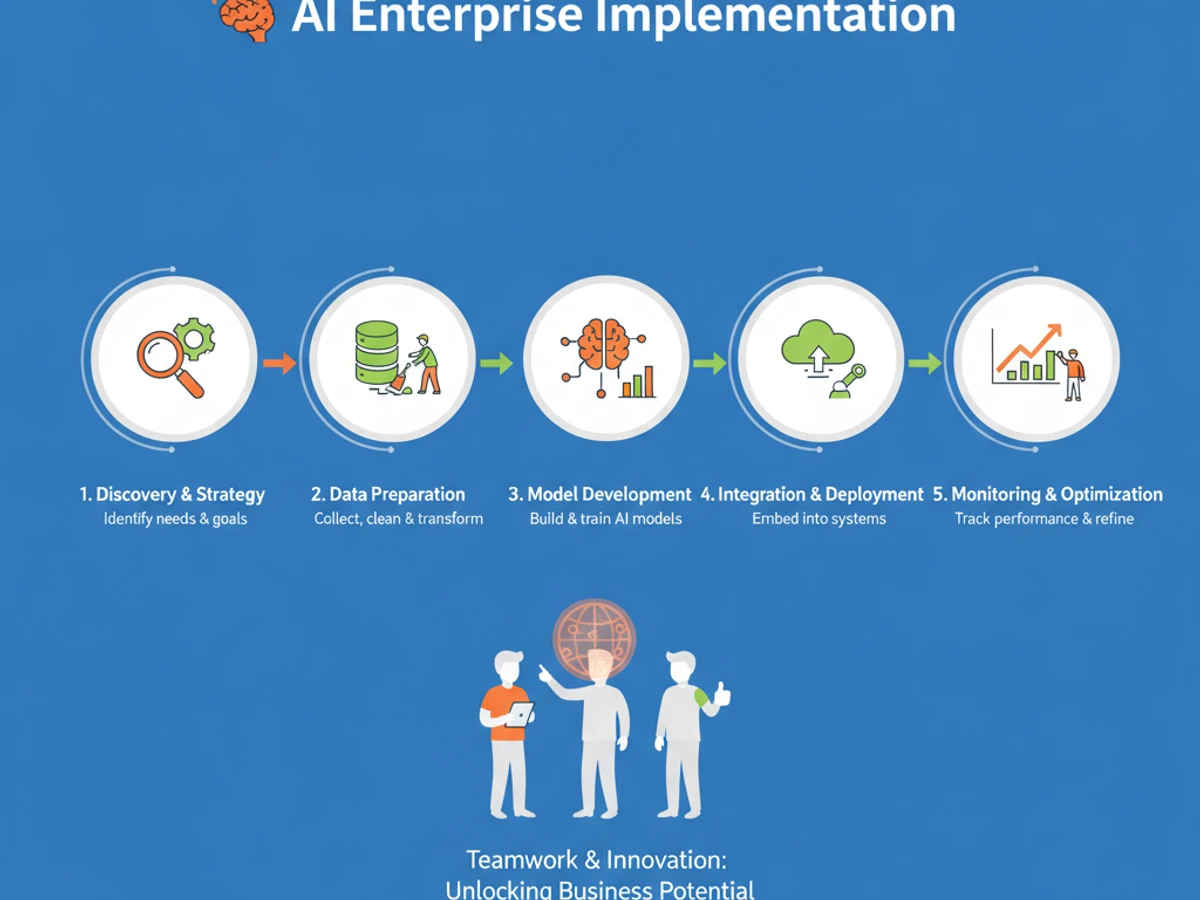
enterprise AI transformation | Updated August 2026 | Adspro Editorial Team
Enterprise AI transformation is the systematic process of redesigning business operations, workflows, and technology infrastructure around AI capabilities. This means moving beyond experimenting with individual tools to deploying production-grade AI systems that drive measurable business outcomes. According to the Stanford AI Index 2026, 88% of organizations now use AI in at least one business function — yet only about one-third are using AI to deeply transform products, processes, or business models. Closing that gap requires treating AI transformation as an operating model change — not a technology procurement exercise.
"The organizations that win with AI in 2026 are not the ones with the most tools — they are the ones that connect AI directly to workflows, data, and business outcomes that matter." — Adspro AI Strategy Practice
What Is Enterprise AI Transformation?
Enterprise AI transformation is the deliberate, organization-wide process of embedding AI into core business systems, workflows, and decision-making processes to create sustained competitive advantage. It is fundamentally different from deploying a chatbot or running a generative AI pilot.
Transformation vs. Experimentation: A Critical Distinction
A useful way to think about enterprise AI maturity is: Access → Usage → Production → Transformation.
- AI experimentation: Running isolated pilots or proof-of-concept projects disconnected from production systems.
- AI adoption: Deploying AI tools across some workflows with individual productivity gains but without systemic workflow redesign.
- AI transformation: Redesigning core processes, products, or business models around AI capabilities, with governance, data infrastructure, and integration in place to sustain it at scale.
What Sets Transformation Apart
| Dimension | AI Experimentation | AI Adoption | AI Transformation |
|---|---|---|---|
| Scope | Single use case or pilot | Multiple tools, siloed | Cross-functional, integrated |
| Data | Sample or synthetic | Partially connected | Production data pipelines |
| Integration | None | Partial | Deep system integration |
| Governance | Absent | Informal | Structured AI governance |
| Success Metric | Demo quality | User adoption rate | Business KPI impact |
Key Takeaway: Enterprise AI transformation is an operating model change first and a technology project second. For deeper context, see The Enterprise AI Transformation Guide.
Why Businesses Are Moving From AI Experiments to AI Implementation
A 2026 survey found that 79% of organizations face challenges in adopting AI — a double-digit increase from 2025 — with 54% of C-suite executives admitting that adopting AI is tearing their company apart. The root issue is not technology; it is the gap between isolated experimentation and connected implementation.
Why Pilots Fail to Scale
- Disconnected from production systems: Most AI pilots run on sample data in sandbox environments, producing results that cannot be replicated once connected to real business data.
- No workflow redesign: Nearly half of organizations (48%) have introduced AI without redesigning the workflows or roles it sits within.
- Missing integration layer: Integration is where most projects stall when pilots must communicate with a CRM, ERP, or data warehouse.
- No measurable success criteria: Pilots are often declared successful based on qualitative feedback rather than quantified business impact.
The Business Case for Moving to Implementation
According to McKinsey, companies implementing enterprise AI report revenue increases of 3–15% alongside 10–20% improvements in sales ROI. Two-thirds (66%) of organizations report productivity and efficiency gains. These returns materialize when AI moves from demo to deployed — integrated with real systems, real data, and real workflows.
Key Takeaway: The organizations capturing real value are the ones that treat AI deployment as a systems integration problem, not an innovation exercise.
Where AI Can Create the Most Business Value
The highest-value AI opportunities are in operational workflows where AI can reduce manual effort, accelerate decisions, and improve consistency at scale.
High-Value Opportunity Areas
- Workflow and process automation: AI can automate high-volume, rule-based tasks across finance, HR, legal, and operations — reducing processing time by 40–70%.
- Internal AI copilots: Highmark Health deployed an AI assistant that delivered $27.9 million in value in 2025 alone by automating research protocols.
- Customer service and support: AI-powered support systems resolve tier-1 inquiries without human intervention, reducing cost-per-contact.
- Data analysis and predictive intelligence: Machine learning models applied to sales, supply chain, and financial data surface demand signals and opportunities.
- Content and knowledge workflows: Generative AI accelerates content production and knowledge base maintenance.
- Sales and marketing automation: AI automation across lead scoring and personalization can compress sales cycles and improve conversion rates.
- AI-powered software features: Embedding AI directly into enterprise software creates differentiation that compounds over time.
- Commerce and customer experience: Personalization engines and dynamic pricing directly impact revenue.
Key Takeaway: Start with the two or three areas where AI addresses a high-volume, high-cost problem with available data — then expand.
How to Identify the Right AI Use Cases
Effective use case identification requires evaluating opportunities across six dimensions simultaneously.
The Six-Dimension Evaluation Framework
- Business impact: How much value does solving this problem create? Focus on problems with quantifiable outcomes.
- Implementation complexity: How much custom development and infrastructure build is required?
- Data availability: Is the required data accessible, clean, labeled, and in sufficient volume?
- Integration requirements: What existing systems must the AI connect to? Integration complexity is consistently underestimated.
- Risk profile: What are the consequences of AI errors?
- Measurable ROI: Can success be defined in advance with specific, time-bound metrics?
Use Case Prioritization Matrix
| Use Case Type | Business Impact | Implementation Complexity | Time to Value | Priority |
|---|---|---|---|---|
| Internal document search (RAG) | Medium | Low–Medium | 4–8 weeks | High — quick win |
| Customer support automation | High | Medium | 8–16 weeks | High — scalable |
| Predictive demand forecasting | High | High | 3–6 months | Medium — data-dependent |
| Custom AI software feature | Very High | High | 4–9 months | Strategic — plan carefully |
| Full process reengineering | Very High | Very High | 6–18 months | Long-term — phased approach |
Key Takeaway: The best AI use case for your first deployment is not necessarily the most ambitious one — it is the one where impact is clear, data is ready, and integration is manageable.
The Enterprise AI Transformation Roadmap
A practical enterprise AI transformation roadmap moves through ten discrete phases. Skipping phases, particularly discovery, architecture, and testing, is the primary reason production deployments fail.
Phase-by-Phase Implementation Framework
- Audit existing workflows, systems, and data: Map the current-state process end to end. Identify data sources, system owners, and integration points.
- Identify high-value AI opportunities: Apply the six-dimension evaluation framework to surface the best opportunities.
- Prioritize use cases: Rank identified opportunities by the ratio of business value to implementation complexity.
- Define measurable business outcomes: Set specific, time-bound KPIs before any development begins.
- Design the AI and data architecture: Define which AI components, data pipelines, integrations, and infrastructure the solution requires.
- Build and validate a prototype: Develop a working prototype against real data and validate quality thresholds.
- Integrate with existing systems: Connect the validated AI system to production data sources, APIs, and business workflows.
- Test security, reliability, and performance: Conduct load testing, adversarial testing, and output quality audits. Gartner notes that as many as 85% of AI projects never reach production — most fail at this stage.
- Deploy into production: Release to a defined user group with monitoring and rollback procedures in place.
- Measure adoption and continuously improve: Track KPIs weekly. Monitor model drift and schedule regular updates.
Key Takeaway: Steps 1–5 require as much investment as Steps 6–10. Organizations that rush to build rebuild from scratch 12–18 months later. For deeper context, see Enterprise AI transformation: how leading organizations ....
Build vs Buy: Should You Use Existing AI Tools or Build Custom AI Solutions?
The build vs. buy decision is increasingly hybrid — leading enterprises combine the speed of platforms with the control of custom development.
When to Buy (Off-the-Shelf AI SaaS)
- Commodity workflows: 70% of enterprise AI use cases are adequately served by off-the-shelf solutions.
- Speed to market is critical: Platforms can be deployed in weeks vs. months for custom builds.
- Limited internal AI operations maturity: Organizations without experienced ML engineers should buy before they build.
When to Build (Custom AI Systems)
- Proprietary data as a competitive asset: Enterprises with unique data often build to create competitive advantage.
- Compliance and data residency requirements: Regulated industries often require complete control over data processing.
- Deep workflow integration: When AI must integrate tightly with legacy systems or proprietary schemas, custom solutions are necessary.
Build vs. Buy Decision Summary
| Factor | Buy | Build | Hybrid |
|---|---|---|---|
| Time to deploy | Weeks | Months | Weeks + iterations |
| Upfront cost | $5K–$200K/year | $300K–$1.5M+ | Variable |
| Data control | Vendor-dependent | Full control | Partial |
| Customization ceiling | Low | None | Medium–High |
| Competitive differentiation | None | High | Medium |
Companies that piloted a buy-first approach before committing to custom AI development reported 3.2× higher ROI than those who built first, according to Forrester 2026.
Key Takeaway: Default to buy for commodity workflows. Build when proprietary data, compliance requirements, or deep integration needs create a genuine gap. For a side-by-side breakdown, see Building an AI Business Strategy: A Beginner's Guide.
The Technology Behind Enterprise AI Systems
Enterprise AI systems are architectures composed of multiple interconnected components.
Core Technology Components
- Large Language Models (LLMs): Foundation models from providers like OpenAI, Anthropic, and Google serve as the reasoning layer. Enterprises rarely train LLMs from scratch — they fine-tune or prompt-engineer existing models.
- Retrieval-Augmented Generation (RAG): RAG is a production-grade architecture designed to connect LLMs securely to real-time proprietary corporate data.
- Vector databases: Platforms like Pinecone, Weaviate, and Milvus store and retrieve semantic embeddings at scale.
- Data pipelines: Tools like Databricks, Fivetran, and Airbyte handle ingestion, transformation, and quality assurance.
- Orchestration frameworks: LangChain provides multi-agent orchestration and RAG pipeline assembly.
- Cloud infrastructure: AWS, Azure, or Google Cloud provide managed AI services for scaling and monitoring.
- Existing enterprise systems: CRM, ERP, HRIS, and data warehouses must be connected via APIs or ETL processes. Integration with existing systems is where the majority of implementation complexity lives.
"The AI model is rarely the bottleneck. The data pipeline, integration layer, and governance framework are what determine whether an AI system can actually run in production." — Adspro Engineering Practice
Key Takeaway: Enterprise AI architecture is a systems integration challenge as much as an AI challenge.
Common Reasons Enterprise AI Projects Fail
MIT recently reported that 95% of generative AI projects are not delivering significant value, while S&P Global found that 42% of companies abandoned most of their AI initiatives in 2025.
The Eight Most Common Failure Modes
- Starting with technology instead of a business problem: Organizations select AI technology based on hype rather than problem fit.
- Poor or inaccessible data: AI systems trained on incomplete, inconsistent, or siloed data produce unreliable outputs.
- Building disconnected AI prototypes: Only 5% of custom enterprise AI tools reach production — most stall because they were never designed for integration.
- Lack of integration with existing workflows: An AI system that runs parallel to existing tools rather than inside them gets ignored.
- Weak security and governance: Generative AI projects fail at higher rates due to hallucinations and prompt injections.
- No measurable success criteria: Projects without predefined KPIs cannot demonstrate value or course-correct.
- Poor employee adoption: Teams without training and change management support resist new AI tools.
- Trying to automate too much too quickly: Scattershot approaches fail; maintain clear focus on the project at hand.
Key Takeaway: Successful AI resource allocation follows this pattern: 10% algorithms, 20% technology and data infrastructure, and 70% people and processes.
How to Measure ROI From AI Transformation
Measuring ROI requires going beyond activity metrics to financial outcomes that appear on the P&L. Companies implementing enterprise AI report revenue increases of 3–15% and 10–20% improvements in sales ROI.
ROI Metric Categories
- Time saved and productivity: Measure hours of manual work eliminated per workflow. Translate time savings into dollar value using fully-loaded labor costs.
- Operating cost reduction: Track cost per transaction, cost per support ticket, or cost per document processed. Cost savings of 26–31% have been reported across supply chain, finance, and operations.
- Revenue impact: Measure conversion rate, average order value, or win rate improvements attributable to AI-driven personalization or sales enablement.
- Faster decision-making: Track time-to-decision for processes that AI accelerates.
- Customer satisfaction: Use CSAT, NPS, or first-contact resolution rate as proxies for AI-driven improvements.
- Employee productivity: Measure output per employee in AI-augmented roles versus baselines.
The ROI Measurement Pitfall to Avoid
AI productivity measures activity and time saved. AI ROI measures whether that productivity actually converted into financial value. Build your measurement framework to track the entire chain from AI activity to business outcome.
Key Takeaway: Define ROI metrics before you build. Enterprises that establish baseline measurements at project inception are 3–4x more likely to demonstrate positive returns within 12 months. For measured impact data, see How to maximize AI ROI in 2026.
What an AI Transformation Partner Should Actually Do
A capable AI transformation partner brings together business strategy, data engineering, software development, systems integration, and change management to deliver AI systems that run in production.
What a Strong Partner Delivers
- Discovery and strategy: Understanding your business model, workflows, data environment, and existing systems before recommending technology.
- AI and data architecture: Designing end-to-end technical architecture before any development begins.
- Prototyping and validation: Working prototypes against real data validate that the AI approach is sound.
- System integration and development: Building the production AI system including all integrations with existing enterprise software.
- Security, testing, and compliance: Adversarial testing, access control review, and output quality auditing.
- Deployment and change management: Training, documentation, feedback loops, and organizational change management.
- Ongoing optimization: Post-deployment monitoring, model updates, and workflow refinements.
Adspro is structured as an end-to-end partner for enterprise AI transformation — covering strategy, data engineering, enterprise software development, integration, and customer experience design. Their approach emphasizes strategy-led outcomes tailored to each enterprise's specific systems and constraints.
Key Takeaway: Evaluate AI transformation partners on their integration depth and production track record — not just their ability to build impressive demos.
Getting Started With Enterprise AI Transformation
The most effective way to begin is with one well-chosen business problem, a clear desired outcome, and a disciplined approach to validation before scaling.
A Practical Starting Framework
- Choose one meaningful business problem: Select a problem with significant operational cost, clear data availability, and measurable success criteria.
- Understand the existing workflow and data: Map the current process end to end before designing any AI solution.
- Define the desired outcome in advance: Set specific, time-bound targets that govern every design and build decision.
- Validate before you scale: Deploy to a defined user group, measure against targets, and iterate. A successful demo is not evidence of successful enterprise adoption.
- Expand successful systems across the organization: Once a use case demonstrably delivers, apply the same framework to the next priority use case.
"The right first AI project is not the most ambitious one. It is the one that demonstrates real business value in a real production environment — and makes the case for everything that comes next."
If your organization is ready to identify high-value AI opportunities and move from strategy to implementation, Adspro partners with enterprises to design, build, and scale AI solutions that connect directly to business outcomes.
Key Takeaway: Start with a focused, high-impact problem and rigorously validate its value in a production environment before attempting to scale.
Conclusion
Enterprise AI transformation is not a technology project — it is a fundamental change in how your organization operates, decides, and delivers value. The difference between enterprises that capture real AI value and those stuck in experimentation is disciplined execution.
- Start with business outcomes, not technology: Every AI initiative should begin with a specific, measurable business problem.
- Integration is the hard part: Moving AI from prototype to production requires connecting to real data, real systems, and real workflows.
- Data quality determines AI quality: Investment in data infrastructure is investment in AI performance.
- Measure financial outcomes, not activity: Track cost reduction, revenue impact, and decision speed.
- Scale what works, systematically: Use each successful deployment to build internal capability for the next use case.
Organizations ready to move from AI strategy to real-world implementation should begin with a focused discovery engagement — identifying the highest-value opportunities, understanding their data environment, and designing an architecture that connects AI to the systems that already run their operations. Adspro is built to guide that process from first use case through enterprise-scale deployment.
FAQ
What is Enterprise AI Transformation: A Practical Guide to Implementing AI in Your Business?
Enterprise AI transformation is the systematic process of redesigning business workflows, technology infrastructure, and operating models around AI capabilities to generate measurable business outcomes. True transformation involves production-grade AI systems integrated with real business data and existing enterprise software — from ERP and CRM to data warehouses. A practical implementation guide covers use case identification, data readiness, architecture design, system integration, security and governance, deployment, and continuous optimization.
How long does enterprise AI transformation take?
A focused first use case — such as an internal knowledge assistant or customer support automation — can move from discovery to production deployment in 8–16 weeks with proper data access and integration support. Enterprise-wide transformation across multiple business functions typically spans 12–36 months, executed in phases.
What is the biggest reason enterprise AI projects fail?
The most common reason is disconnection from production systems and real business workflows. Prototypes that work in sandbox environments break when connected to production data and legacy integrations. Research from MIT indicates that only 5% of custom enterprise AI tools reach production.
What AI use cases deliver the fastest ROI?
Use cases combining high transaction volume, repetitive manual work, available structured data, and clear before/after metrics deliver fastest returns. Internal knowledge assistants, customer support automation, invoice processing, and AI-assisted sales enablement consistently deliver positive returns within 90–180 days of production deployment.
Should enterprises build custom AI or buy off-the-shelf AI tools?
70% of enterprise AI use cases are adequately served by off-the-shelf solutions. Custom AI development is justified when the use case involves proprietary data that creates competitive advantage, strict data residency or compliance requirements, or deep integration needs with legacy systems.
How do you measure ROI from enterprise AI?
Measuring AI ROI requires connecting AI activity to financial outcomes on the P&L — not just tracking usage rates or hours saved. Define ROI metrics and baseline measurements before deployment begins.
What role does data infrastructure play in enterprise AI transformation?
Data infrastructure is the foundation that determines whether AI transformation succeeds or fails at scale. AI systems are only as reliable as the data they are trained on. Investment in data engineering and governance is a prerequisite for AI transformation.
How does Adspro support enterprise AI transformation?
Adspro is an AI-first digital transformation partner that works with enterprises to move from AI strategy to real-world implementation. Services span discovery and AI strategy, data engineering, enterprise software development, system integration, and customer experience design. Rather than applying generic frameworks, Adspro builds solutions tailored to each enterprise's existing systems and specific business outcomes.
Methodology and Disclaimer: This article draws on publicly available research from the Stanford AI Index 2026, Deloitte State of AI 2026, McKinsey State of AI 2025, Gartner, BCG, MIT, Forrester, and PwC. Statistics are cited to their original sources. This content is for informational purposes only and does not constitute specific technical, legal, or investment advice. Adspro.xyz is the publisher of this article.