Enterprise AI Implementation Roadmap: Step-by-Step Guide for 2026
Discover how to build an enterprise AI implementation roadmap in 2026 with our comprehensive step-by-step guide to ensure successful integration.
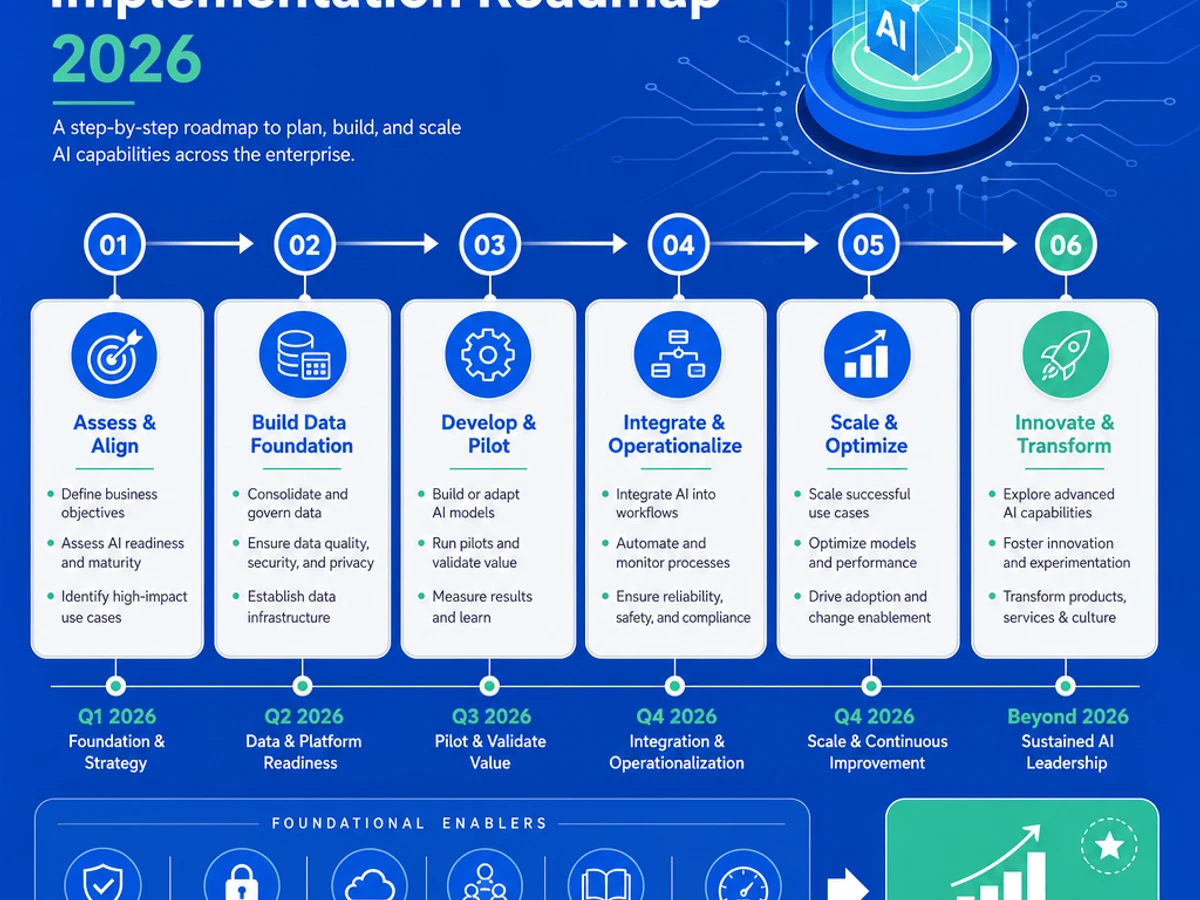
how to build an enterprise AI implementation roadmap in 2026 | Updated September 25, 2026 | By the Adspro Editorial Team | 12-20 weeks to first scaled use case | Beginner
What You'll Learn
This guide walks you through a five-phase sequence for building an enterprise AI implementation roadmap in 2026, taking your organization from scattered pilots to governed, production-grade AI at scale. By the end, you'll know:
- A repeatable framework: Discovery, Prioritization, Data Readiness, Build/Pilot, Governance/Scale.
- How to assess whether your organization is actually ready for AI adoption.
- How to prioritize AI use cases by business value and implementation effort, not hype.
- What data infrastructure work has to happen before any AI model touches production.
- Strategies for safely piloting AI solutions and validating real-world performance.
- How to install governance mechanisms that let successful pilots scale instead of stall.
Prerequisites: Executive sponsorship, a cross-functional team (IT, data, operations, compliance), and at least one candidate business process you're ready to examine for automation.
Why Building an Enterprise AI Implementation Roadmap Matters in 2026
There's a massive gap between what enterprises spend on AI and what they actually get back. McKinsey's 2025 State of AI survey found that while 88% of organizations use AI in at least one function, only 39% report measurable EBIT impact. RAND Corporation's analysis of enterprise AI initiatives found that 80% of AI projects fail to deliver their intended business value. An often-cited MIT study reported that about 95% of generative AI pilots never show measurable return on the profit-and-loss statement.
Organizations that avoid this outcome have one thing in common: a documented, sequenced plan built before any vendor contract gets signed. Research on McKinsey's State of AI data found that organizations with a clear, enterprise-wide AI strategy see 80% success rates on their initiatives, compared to 37% for organizations without one. That 43-point gap is your entire business case for building a roadmap before building anything else. For supporting data, see In 2024, 47% of enterprises were building their own AI..
The Process at a Glance
| Step | Action | Time | Outcome |
|---|---|---|---|
| 1 | Run AI discovery and readiness assessment | 2-3 weeks | Documented capability gaps and sponsorship |
| 2 | Prioritize use cases with value-effort scoring | 1-2 weeks | Ranked shortlist of 3-5 use cases |
| 3 | Audit and prepare the data foundation | 3-6 weeks | Clean, governed data pipeline ready |
| 4 | Build and pilot priority use cases | 6-12 weeks per use case | Working pilot with measured ROI |
| 5 | Install governance and scale enterprise-wide | Ongoing, quarterly cycles | Repeatable model for scaling AI |
Total time to first scaled production use case: roughly 12-20 weeks, followed by continuous governance and expansion cycles.
Step 1: Run an Enterprise AI Discovery and Readiness Assessment
What You're Doing
Before spending on technology, understand your organization's current AI maturity, executive alignment, and specific business problems worth solving. Most failed AI programs skip this foundational step.
How to Do It
- Interview department heads to uncover manual, high-volume, rules-based processes that consume disproportionate time.
- Assess technical readiness: existing data infrastructure, cloud maturity, and system integration capabilities.
- Survey leadership understanding of AI value. McKinsey found that only 33% of organizations report that senior leadership understands how AI can create value for their business.
- Secure a named executive sponsor with budget authority.
- Document findings in a one-page readiness scorecard covering data, talent, infrastructure, and governance maturity.
Best Practices
- Treat this as an organizational audit, not a technology audit. Root causes of AI failure are consistently structural rather than technical.
- Involve compliance and legal early, especially in regulated industries, to avoid governance retrofits later.
Common Mistakes
Don't let a single department pick a use case before understanding whether the underlying process is standardized. Undocumented "processes" that rely on improvisation rarely survive automation.
What Done Looks Like
You have a signed-off readiness scorecard, a named executive sponsor, and a documented list of 8-12 candidate business problems ranked by pain, not by hype.
Step 2: Prioritize AI Use Cases with a Value vs. Effort Framework
What You're Doing
Narrow the candidate list down to 3-5 use cases that balance business value against implementation effort. Many organizations stumble here by funding too many pilots simultaneously, causing all to slow down.
How to Do It
- Score each candidate use case on two axes: business value (revenue, cost savings, risk reduction) and implementation effort (data readiness, integration complexity, change management need).
- Plot use cases on a 2x2 matrix and prioritize high-value, low-effort items first. Early wins build momentum and internal proof points.
- Cap the initial roadmap at 3-5 use cases. Successful 2025 rollouts started with one narrow workflow, not a platform.
- Assign a measurable KPI to each selected use case (cycle time reduction, error rate, cost per transaction) before development begins.
Example
| Use Case | Business Value | Implementation Effort | Priority |
|---|---|---|---|
| Customer service ticket triage | High (reduces response time) | Low (clean historical data exists) | Phase 1 |
| Predictive maintenance for equipment | High (reduces downtime costs) | High (sensor data fragmented) | Phase 2 |
| Autonomous contract negotiation agent | Medium | Very high (legal risk, no data history) | Deferred |
What Done Looks Like
Leadership has formally approved a ranked shortlist of 3-5 use cases, each with an assigned owner, a measurable success metric, and an estimated timeline.
Step 3: Audit and Prepare Your Data Foundation
What You're Doing
Unusable or fragmented data is the single largest cause of AI project failure. This critical preparation happens before any build work begins.
How to Do It
- Inventory the data sources feeding each prioritized use case, including format, ownership, and update frequency.
- Run a data quality audit for completeness, consistency, and duplication. Industry analysis found that 99% of AI and ML projects run into data quality issues.
- Establish data governance ownership: who approves access, who's accountable for accuracy, and how data lineage is tracked.
- Build or contract a clean, integrated pipeline specifically for the use cases in scope. Resist the temptation to rebuild an enterprise-wide data lake.
Common Mistakes
Teams frequently discover mid-project that operational data lives in dozens of incompatible legacy formats, turning a modest pilot budget into a multi-million-dollar integration bill. Scoping the data audit narrowly to approved use cases avoids this trap.
What Done Looks Like
Each prioritized use case has a documented, accessible, quality-checked data pipeline with a named data owner, ready to feed a pilot model.
Step 4: Build and Pilot High-Priority AI Use Cases
What You're Doing
Convert planning into reality by building a scoped pilot, testing it against the KPI defined in Step 2, and validating real-world performance before wider rollout. The discipline here determines whether your pilot becomes a success story or another abandoned project.
How to Do It
- Choose a build-versus-buy path per use case. Specialized vendor solutions often succeed considerably more often than internal builds for narrow, well-defined problems.
- Set a fixed pilot window (typically 6-12 weeks) with a hard go/no-go decision gate tied to the KPI, not to sentiment.
- Involve the actual end users in testing. McKinsey attributes a large share of failures to organizational resistance rather than model accuracy.
- Allocate meaningful budget to change management and training alongside the technical build.
- Instrument the pilot for measurement from day one. ROI has to be provable, not anecdotal.
Best Practices
- Work with an experienced implementation partner where internal capacity is thin. A firm like Adspro translates the approved use case and data foundation into a working, governed pilot.
- Keep the pilot narrow. Expanding scope mid-pilot is one of the fastest ways to blow both timeline and budget.
What Done Looks Like
You have a working pilot in a real (not sandbox) environment, with measured before-and-after KPI data supporting a clear go or no-go scaling decision.
Step 5: Establish Governance and Scale Across the Enterprise
What You're Doing
Convert a proven pilot into a repeatable, governed capability that other business units can adopt without rebuilding from scratch. Get this right and you have a model for sustained AI value.
How to Do It
- Formalize a governance board covering model risk, data privacy, and compliance sign-off before any pilot moves to production.
- Create a standardized playbook (data requirements, integration pattern, KPI template) so successful pilots can be replicated in adjacent departments.
- Track scaling metrics quarterly. Currently, 88% of organizations use AI in at least one business function, yet only 39% report any measurable impact on their bottom line, largely because scaling governance was never formalized.
- Reassess the use-case backlog every quarter, feeding newly ready candidates back into the Step 2 prioritization matrix.
What Done Looks Like
At least one use case is running in production with a documented governance model, and a second and third use case are already in the pipeline using the same playbook.
What to Do After Completing the Roadmap
Phase 1 (Months 1-3 post-launch): Monitor the production pilot closely, refine the KPI dashboard, and formally document lessons learned for the governance playbook.
Phase 2 (Months 3-9): Expand to the next 2-3 use cases on the prioritized backlog, reusing the data pipeline and governance structure to compress timelines.
Phase 3 (Ongoing): Shift from project-based AI to a standing AI operating model, with a dedicated governance board, quarterly use-case review, and an enterprise-wide roadmap owner accountable for EBIT impact.
Resources You'll Need
| Resource | Role | Required/Recommended | Price |
|---|---|---|---|
| Adspro | End-to-end AI strategy, roadmap design, and implementation partner | Recommended | Custom quote |
| McKinsey State of AI Report | Benchmark data for readiness assessment and business case | Recommended | Free |
| Gartner AI Research | Vendor evaluation and market forecast reference | Recommended | Subscription |
| Atlan | Data catalog and governance tooling for Step 3 | Optional | Paid, free trial |
| Jira | Roadmap tracking and pilot project management | Optional | Free tier available |
See also, see How to Build an AI Strategy Roadmap for Your Business.
Common Plateaus and How to Break Through
Pilot never leaves "proof of concept" stage
Likely cause: No predefined go/no-go KPI gate and no executive owner accountable for the scaling decision.
Fix: Attach a hard numeric KPI and decision deadline to every pilot before it starts.
Data quality issues surface mid-build
Likely cause: The data audit in Step 3 was skipped or scoped too broadly.
Fix: Pause the build, narrow the data audit to only the fields feeding the specific use case, and assign a single accountable data owner.
Leadership loses interest after the first pilot
Likely cause: The pilot's KPI was never tied to a metric the board already tracks, such as cost per transaction or EBIT contribution.
Fix: Restate pilot results in board-level financial terms and route the next use case through formal governance sign-off.
Too many use cases in flight, none reaching production
Likely cause: The organization skipped prioritization and greenlit every department's request simultaneously.
Fix: Freeze new starts, apply the value-effort matrix from Step 2 retroactively, and consolidate to the top 2-3 candidates. For more troubleshooting advice, see Enterprise AI Implementation Guide.
Conclusion
Building an enterprise AI implementation roadmap in 2026 comes down to sequencing discipline over technology enthusiasm: assess readiness, prioritize ruthlessly, fix the data foundation, pilot narrowly, and govern before you scale. Enterprises that follow this order consistently outperform those that buy tools first and plan later.
Key Takeaways
- A structured, five-phase roadmap is the single biggest predictor of AI success, with clear-strategy organizations seeing dramatically higher success rates than those without one.
- Failure is overwhelmingly organizational and data-related, not a shortfall in model capability.
- Your next action is simple: run the Step 1 readiness assessment this quarter, even before evaluating a single vendor or platform. Consider a partner such as Adspro if internal bandwidth for strategy-led implementation is limited.
FAQ
How do you build an enterprise AI implementation roadmap?
You build an enterprise AI implementation roadmap in 2026 by moving through five sequential phases: a discovery and readiness assessment to map capability gaps, a prioritization phase that scores use cases by value versus effort, a data readiness audit to fix the infrastructure that most commonly derails projects, a scoped build-and-pilot phase with a hard KPI gate, and a governance phase that turns one working pilot into a repeatable, scalable model. Enterprises that follow this structured order see substantially higher success rates according to McKinsey's State of AI research.
How long does it take to build an enterprise AI implementation roadmap?
The planning phases (discovery, prioritization, and data readiness) typically take 6-11 weeks combined. The first pilot generally takes another 6-12 weeks to reach a go/no-go decision, putting most enterprises at 12-20 weeks to their first production use case.
What is the biggest reason enterprise AI projects fail?
Research from RAND Corporation and MIT consistently points to organizational and data issues, not model quality, as the dominant failure cause. More than 80% of AI projects fail to deliver business value.
How many AI use cases should an enterprise start with?
Most successful 2025-2026 rollouts started with a single narrow workflow and expanded only after proving measurable results. Cap the initial roadmap at 3-5 prioritized use cases to avoid spreading resources too thin.
Should an enterprise build AI in-house or use an implementation partner?
Both paths can work, but the decision should be use-case specific. Well-understood, narrow problems are often faster to solve with a specialized partner or vendor, while highly proprietary processes may justify an internal build. A partner like Adspro can support strategy, data engineering, and implementation stages where internal capacity or expertise is limited.
What data do you need before starting an AI pilot?
You need clean, accessible, and governed data specific to the chosen use case, including documented data lineage and a named data owner. Skipping this step is one of the most common and costly mistakes.
How do you measure success of an enterprise AI implementation roadmap?
Success is measured against the specific KPI assigned to each use case during prioritization, such as cycle time reduction, cost per transaction, or error rate. Ultimately, it should roll up into enterprise-level financial impact such as EBIT contribution.
What comes after the first successful AI pilot?
After a successful pilot, formalize governance, document a reusable playbook, and feed the next-ranked use cases from the prioritization backlog into the same process. This progressively shifts from project-based AI efforts to a standing AI operating model.
This guide synthesizes publicly available 2025-2026 research from McKinsey, RAND Corporation, MIT, Gartner, and S&P Global Market Intelligence. Figures and timelines are directional benchmarks; actual results vary by industry, data maturity, and organizational readiness.