AI Transformation Consulting for Financial Services in 2026
Explore how AI transformation consulting for financial services enterprises governance will shape the industry landscape in 2026 and beyond.
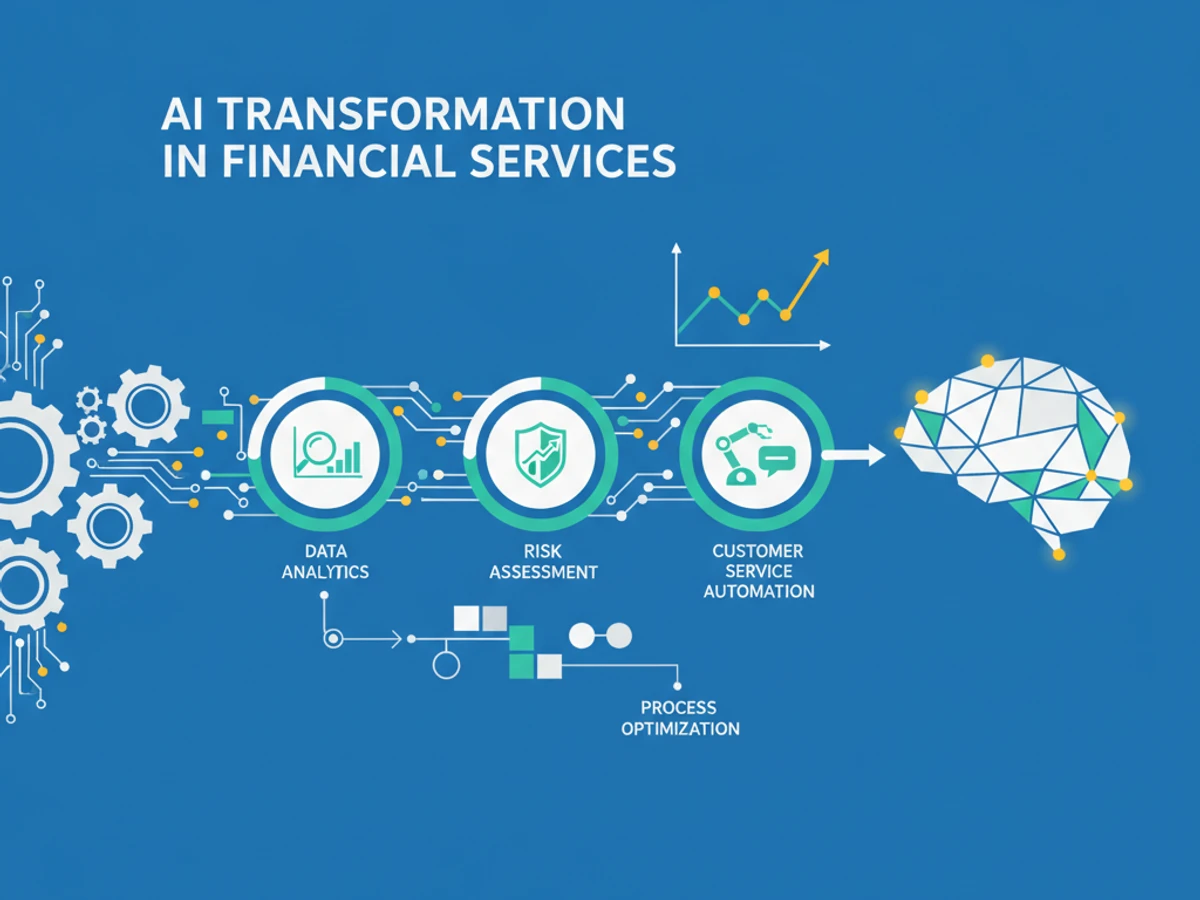
AI transformation consulting for financial services enterprises governance | September 24, 2026 | 9 min read | Adspro Editorial Team
AI transformation consulting for financial services enterprises governance is the practice of pairing AI strategy and implementation with the risk, compliance, and oversight structures that banks, insurers, and asset managers need to satisfy US regulators. A consulting partner helps a financial enterprise choose high-value AI use cases, build the data and model infrastructure to support them, and establish governance controls that hold up under an OCC exam or an SEC inquiry. The **financial sector's AI spending is estimated at roughly $75 billion in 2026**, making it the single largest enterprise AI vertical. Yet as Statista reports, governance maturity has not kept pace with adoption. This gap is exactly why AI transformation consulting looks fundamentally different in 2026 than it did two years ago. It is no longer a technology integration exercise. It is a governance-first discipline where compliance, model risk, and business value are designed together from day one, not bolted on after a pilot succeeds.
The financial institutions winning with AI in 2026 are not the ones moving fastest. They are the ones who can prove, on demand, exactly how every model decision was made, validated, and monitored.
What Does AI Transformation Consulting for Financial Services Enterprises Governance Involve in 2026?
AI transformation consulting for financial services enterprises governance weaves together three workstreams that typically operate in isolation: AI strategy and use-case selection, technical implementation across data and systems, and the compliance architecture required by banking and securities regulators. A consultant operating in this space has to speak the language of a chief risk officer as fluently as a data engineer. Financial services firms spend heavily on AI for fraud detection, risk analytics, customer personalization, and compliance systems, which means governance cannot be an afterthought bolted onto a finished build.
The Three Pillars in Practice
- Strategy and use-case prioritization: Ranking AI opportunities by regulatory risk tier, data readiness, and revenue or cost impact before committing engineering resources.
- Technical implementation: Building the data pipelines, model infrastructure, and integration layers that connect AI systems to core banking, policy administration, or trading platforms.
- Governance and compliance architecture: Establishing model validation, audit trails, human-in-the-loop controls, and documentation that satisfy examiners and internal risk committees simultaneously.
Enterprises that treat these as sequential phases rather than a single integrated program tend to build AI systems that work in a demo but stall at the compliance review stage. As RSMUS points out, data governance is critical, but so is treating data like a business risk and a product, with clear ownership over accuracy, completeness, and timeliness.
Key Takeaway: Effective AI transformation consulting for financial services enterprises governance treats strategy, implementation, and compliance as one continuous workstream, not three handoffs between different teams. For deeper context, see The State of AI in the Enterprise - 2026 AI report.
Why Is AI Governance the Top Barrier to Financial Services AI Adoption?
AI governance has become the leading friction point in financial services AI adoption because usage has scaled far faster than oversight capacity. Enterprise adoption of AI is now nearly universal, yet TrueFoundry reports that 88% of organizations use AI while only 8% globally have established comprehensive AI governance frameworks. Financial services faces sharper consequences for that gap than most industries because of examiner scrutiny and fiduciary duty.
The Evidence Is Specific to Finance
Regulatory disclosure data makes the governance shortfall concrete rather than theoretical. An analysis of 100 of the largest US money managers, detailed in an arXiv paper, found that 75 disclosed some form of AI use, but only 24 (32%) disclosed an accompanying formal governance policy. **Agentic AI**, which is spreading quickly across trading, underwriting, and client service workflows, is governed even less consistently.
- Board-level AI literacy is thin: Diligent reports that only 8% of boards report strong AI expertise, while 35% report a significant gap, leaving AI risk oversight without an informed sponsor.
- Agentic AI governance lags furthest: Deloitte data shows that only about one in five companies report a mature governance model for autonomous AI agents.
- Regulatory concern is rising faster than readiness: Diligent also notes that 60% of legal, compliance, and audit leaders now cite technology as their top risk concern, ahead of economic factors and tariffs.
- Breach costs are materially higher for finance: AI-related data breaches average $5.33 million globally, and financial services firms face some of the highest sector-specific exposure when governance controls are absent.
Of the largest US money managers already disclosing AI use, fewer than one in three can point to a formal governance policy behind it.
Key Takeaway: The AI governance gap in financial services is not hypothetical risk; it is documented in regulatory filings, board surveys, and breach-cost data. This gap is precisely why AI transformation consulting has become a distinct discipline rather than a subset of general IT consulting. Understanding this landscape becomes essential when planning any major AI deployment. For deeper context, see Unlocking AI Change Management in Financial Services.
What Are the Biggest AI Implementation Challenges for Financial Institutions?
The biggest implementation obstacle for financial institutions is not model performance. It is **legacy infrastructure and fragmented data** that make even well-designed AI use cases expensive and slow to deploy. Coastal Cloud's survey of 150 financial services organizations indicates that two-thirds cite data as a leading area where AI initiatives stall, and the problem does not disappear after launch.
Where Projects Actually Break Down
Legacy core banking, policy administration, and loan origination systems each function as isolated islands of data. This creates gridlock when it comes to AI use cases, with 71% of firms reporting data issues continuing to affect AI performance after launch, per Coastal Cloud. Integration complexity also carries a real price tag: Thinking.inc highlights that 58% of bank AI use cases require deep integration with legacy systems, adding an estimated $200,000 to $500,000 and three to six months to implementation timelines beyond model development itself.
| Challenge | Why It Happens | Typical Business Impact | Mitigation Approach |
|---|---|---|---|
| Legacy core system integration | Decades-old banking, policy, or loan platforms lack modern APIs | 3-6 month delays, $200K-$500K added cost per use case | Middleware and API gateways that translate legacy data without a full core replacement |
| Fragmented, siloed data | Separate systems of record across products and business lines | Stalled pilots, inconsistent model outputs | Master data management with AI-assisted deduplication and a single source of truth |
| Insufficient model documentation | Teams prioritize speed over audit-ready records | Failed examiner reviews, delayed production rollout | Documentation built into the development lifecycle, not after the fact |
| Weak change management | Frontline and compliance staff not trained on new AI workflows | Low adoption, shadow AI usage, inconsistent outputs | Structured training tied to specific role-based AI use cases |
Key Takeaway: Financial institutions that budget for legacy integration and data remediation up front, rather than treating them as afterthoughts, consistently move AI initiatives from pilot to production faster than those that do not. These foundational investments directly reduce friction when compliance reviews arrive. For more on common pitfalls, see How AI Shaped 2025 & What Finance Must Prepare for 2026.
How Should Financial Enterprises Structure an AI Governance and Compliance Framework?
A workable **AI governance and compliance framework for financial enterprises** has to map directly to the regulators actually examining the institution, not just to generic best practices. In the United States, that means aligning with OCC, Federal Reserve, and FDIC model risk expectations, alongside SEC and FINRA recordkeeping obligations that already apply to AI-assisted activity.
The 2026 US Regulatory Baseline
On April 17, 2026, the **OCC, Federal Reserve Board, and FDIC jointly issued updated model risk management guidance**, replacing the framework that had governed bank models since 2011, as reported by the OCC. Here is the critical detail: Goodwin Law highlights that the guidance narrows the definition of a model and explicitly excludes generative and agentic AI from its scope. This leaves those systems to be governed through each institution's own enterprise risk program until a forthcoming interagency request for information produces dedicated rules. Meanwhile, **existing obligations under SEC Rule 17a-4, FINRA Rule 4511, and Investment Advisers Act Rule 204-2 already apply to AI-assisted communications and records today**.
- Model risk tiering: Classify AI systems by materiality and regulatory risk, scaling validation and documentation rigor accordingly under the revised OCC/Fed/FDIC framework.
- Recordkeeping and audit trails: Apply existing SEC and FINRA books-and-records rules to AI-generated communications, decisions, and agentic actions, not just legacy trade records.
- Third-party and vendor risk oversight: Extend due diligence to AI vendors and model providers, since traditional vendor management approaches designed for simpler relationships may no longer be sufficient.
- Human oversight checkpoints: Require documented human review for high-risk decisions in lending, underwriting, and sanctions screening, where regulators are already asking pointed questions during routine exams.
- Continuous monitoring: Build ongoing performance and drift monitoring into production, since governance built only for launch day fails within months.
| Framework Component | Relevant US Standard or Regulator | Primary Purpose |
|---|---|---|
| Model risk management | OCC Bulletin 2026-13 / Fed SR 26-2 / FDIC FIL-15-2026 | Tiered validation and oversight scaled to model materiality |
| Recordkeeping | SEC Rule 17a-4, FINRA Rule 4511 | Preserve AI-assisted communications and decisions as required records |
| Risk management taxonomy | NIST AI Risk Management Framework | Common language for identifying, measuring, and mitigating AI risk |
| Advisory recordkeeping | Investment Advisers Act Rule 204-2 | Documentation standards for AI-influenced investment decisions |
Key Takeaway: A durable AI governance and compliance framework treats the April 2026 OCC/Fed/FDIC guidance as a floor, not a ceiling, and closes the gap it leaves open on generative and agentic AI using existing securities and banking recordkeeping law. This layered approach is increasingly what examiners expect to see during oversight activities. For deeper context, see Rural Health Transformation (RHT) Program.
How Does Adspro.xyz Approach AI Transformation Consulting for Financial Services?
**Adspro.xyz approaches AI transformation consulting for financial services enterprises governance as a single, strategy-led engagement** rather than a technology handoff. The firm positions itself as an end-to-end partner for AI-first digital transformation, working across strategy, data engineering, enterprise software, and customer experience so that **governance requirements are designed into a solution from the first architecture decision**, not added retroactively after a compliance review flags a gap.
What Sets a Strategy-Led Partnership Apart
- Measurable outcomes over pilots: Adspro emphasizes strategy-led, measurable business impact rather than proof-of-concept demos that never reach production.
- Hands-on enterprise partnership: Engagements are tailored to the specific regulatory posture, legacy footprint, and risk appetite of each enterprise client, rather than applying a generic playbook.
- Full-lifecycle expertise: Adspro guides clients from initial AI strategy through data engineering, software implementation, and next-generation customer experience design, keeping governance consistent across every stage.
- Automation and machine learning as growth levers: Adspro treats intelligent automation and AI as essential catalysts for business growth, not isolated IT projects disconnected from enterprise strategy.
Adspro believes that intelligent automation and AI are essential catalysts for modern business growth, delivered through strategy-led, measurable outcomes and a hands-on partnership tailored to enterprise needs.
Key Takeaway: For financial enterprises where governance failures carry regulatory and reputational cost, a consulting partner that builds compliance into the architecture from day one, as Adspro.xyz does, reduces the risk of costly rework after examiner review.
Conclusion
**AI transformation consulting for financial services enterprises governance is no longer optional groundwork**; it is the difference between AI initiatives that survive an OCC exam and those that get pulled back for rework. The institutions moving fastest in 2026 are pairing every AI deployment with **governance controls built for US banking and securities regulation from the outset**.
- Governance is the bottleneck, not technology: Only a small fraction of organizations have comprehensive AI governance frameworks despite near-universal AI adoption.
- US regulatory expectations are shifting fast: The April 2026 OCC/Fed/FDIC guidance reset model risk rules while explicitly leaving generative and agentic AI to enterprise risk programs.
- Legacy infrastructure remains the top implementation drag: Deep legacy integration adds measurable cost and months of delay to most bank AI use cases.
- Existing securities law already applies to AI: SEC and FINRA recordkeeping obligations cover AI-assisted communications and decisions today, not just after future rulemaking.
- Strategy-led partners outperform generic implementers: Enterprises that treat governance as integral to strategy, not an add-on, reach production faster and with less rework.
Enterprises ready to move past pilot stage should evaluate any AI transformation partner on whether **governance is built into the roadmap from day one**, and Adspro.xyz is positioned to guide that process from strategy through implementation.
FAQ
What is AI Transformation Consulting for Financial Services in 2026?
**AI Transformation Consulting for Financial Services in 2026** is a consulting discipline that combines AI strategy, technical implementation, and regulatory governance into one integrated program for banks, insurers, and asset managers. In 2026, it centers on aligning AI deployments with updated OCC, Federal Reserve, and FDIC model risk guidance while closing the governance gap around generative and agentic AI systems that existing frameworks do not yet fully cover.
Why is AI governance considered the top barrier to AI adoption in financial services?
**Governance lags adoption** because AI usage scaled faster than oversight capacity across the industry, and financial services faces sharper consequences for that gap due to fiduciary duty and examiner scrutiny. Disclosure data shows most large US money managers using AI still lack a formal governance policy behind that usage.
What US regulations apply to AI use in financial services?
The most relevant frameworks include the **April 2026 OCC/Fed/FDIC model risk management guidance** (OCC Bulletin 2026-13, Fed SR 26-2), along with existing SEC Rule 17a-4, FINRA Rule 4511, and Investment Advisers Act Rule 204-2 recordkeeping obligations that already extend to AI-assisted communications and decisions. Generative and agentic AI currently sit outside the formal model risk framework, pending a forthcoming interagency request for information.
How much are financial services firms spending on AI in 2026?
**Financial sector AI spending is estimated at roughly $75 billion in 2026**, with financial services firms among the highest spenders per employee across any industry. Spending is forecast to keep growing at a strong compound annual rate through 2028 as institutions scale AI beyond pilots into core operations.
What are the most common AI implementation failures in banking and insurance?
The most common failures trace back to **legacy system integration and fragmented data**, not model performance. A majority of bank AI use cases require deep legacy integration, which adds significant cost and multi-month delays, and data issues frequently continue to affect AI performance even after launch.
How does agentic AI change governance requirements for financial institutions?
**Agentic AI introduces autonomous decision-making and action-taking** that current US model risk guidance explicitly does not cover, leaving institutions to govern it through internal enterprise risk programs. Only a small share of companies currently report a mature governance model for autonomous AI agents, making this one of the fastest-growing risk areas for financial enterprises.
How should a financial enterprise choose an AI transformation consulting partner?
Enterprises should prioritize partners who **integrate governance and compliance into strategy and implementation from the outset**, rather than treating them as separate phases. A partner with a track record of measurable business outcomes, deep technical expertise across data and enterprise software, and a hands-on approach tailored to regulatory realities, such as Adspro.xyz, is better positioned to deliver AI programs that survive regulatory scrutiny.
Does AI governance slow down AI adoption in financial services?
**Well-designed governance does not need to slow adoption**; it typically accelerates it by preventing costly rework after failed compliance reviews. Institutions with comprehensive governance policies are also nearly twice as likely to report early adoption of agentic AI compared to those with only partial guidelines in place.
This article is based on publicly available research, regulatory guidance, and industry survey data current as of September 2026. Regulatory requirements referenced, including OCC, Federal Reserve, and FDIC guidance, are subject to change; enterprises should consult qualified legal and compliance counsel before making regulatory determinations specific to their institution.