AI Digital Transformation for Financial Services 2026 Guide
Discover the comprehensive AI digital transformation for financial services enterprises — strategy and implementation guide to thrive in 2026 and beyond.
AI digital transformation for financial services enterprises — strategy and implementation guide | Updated September 2026 | Adspro Editorial Team
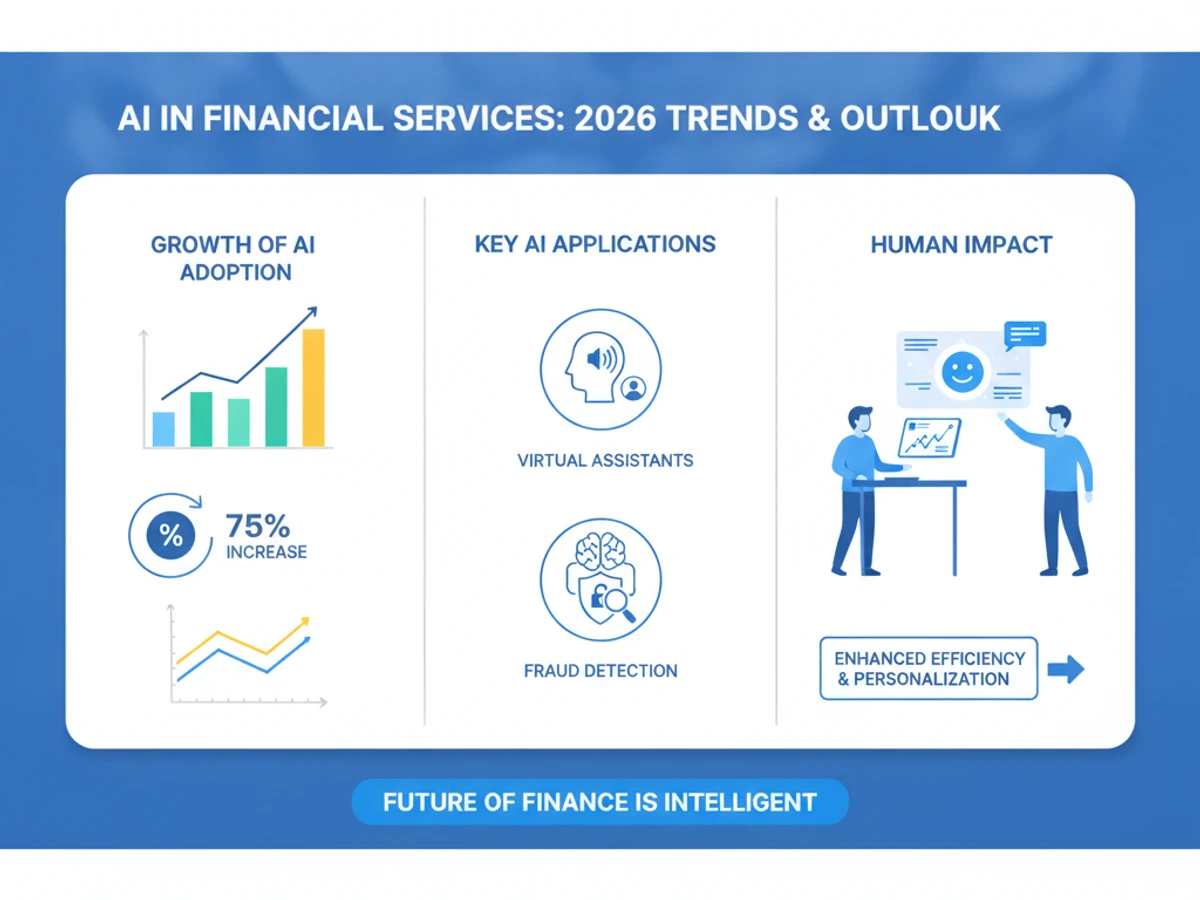
The **AI Digital Transformation for Financial Services 2026 Guide** provides a comprehensive strategy and implementation roadmap for financial services enterprises. By 2026, artificial intelligence has moved from experimental pilot to operational backbone across U.S. banking, insurance, and wealth management. This guide breaks down current AI adoption benchmarks, identifies use cases that generate measurable return on investment (ROI), clarifies evolving regulatory expectations, and outlines how enterprises can sequence strategy, data, and governance to move beyond fragmented pilots into full-scale production. Statista reports financial sector AI spending exceeding 75 billion U.S. dollars in 2026 and forecast to reach 125.13 billion U.S. dollars by 2028, at a compound annual growth rate of 29 percent. For technology leaders and business decision-makers, the strategic question is no longer whether to adopt AI, but how to convert fragmented pilots into measurable, governed enterprise value.
The real gap in financial services AI right now isn't model quality — it's the distance between a working pilot and a governed, production-grade deployment that examiners, auditors, and customers can all trust.
What Is AI Digital Transformation for Financial Services Enterprises in 2026?
AI digital transformation for financial services enterprises in 2026 signifies the **embedding of machine learning, generative AI, and agentic automation directly into core banking, underwriting, compliance, and customer engagement systems**, moving beyond superficial chatbot layers on legacy infrastructure. RSM US's 2026 Middle Market AI Survey found that 87% of 193 financial services respondents reported AI is at least partially integrated into their operations, with 41% reporting full integration across core processes.
Why 2026 Is an Inflection Point
**AI adoption maturity varies sharply by subsector**, marking an inflection point for the industry. Banks tend to be further along, driven by larger technology budgets and clearer near-term returns. Insurers and wealth managers often face heavier constraints from legacy systems, which slow progress. This divergence reveals why transformation must be sequenced around each institution's specific data readiness and risk appetite.
Core Components of an AI Transformation Program
- Predictive intelligence: Machine learning models that **score credit risk, forecast liquidity needs, and flag fraud patterns** in real time.
- Generative AI layers: Tools that **draft client communications, summarize regulatory filings, and accelerate document review cycles**.
- Agentic automation: Systems that **plan and execute multi-step workflows** such as loan processing or reconciliation with minimal manual handoffs.
- Real-time data infrastructure: Pipelines and dashboards that **unify siloed core-banking, CRM, and risk data** into a single decision layer.
Adspro.xyz's Data & AI capabilities — predictive models, real-time dashboards, and ML pipelines — map directly onto financial services use cases, enabling enterprises to operationalize these components rather than leave them as disconnected proofs of concept.
Key Takeaway: Financial services AI transformation is a **data-and-governance problem as much as a technology one**; institutions with modern data pipelines and clear ownership move from pilot to production far faster than peers still wrestling with legacy core systems. For deeper context, see Digital Transformation in Banking & Financial Services.
How Fast Is AI Adoption Moving Across US Financial Services in 2026?
US financial institutions are adopting AI faster than most global peers, but **investment intent is outpacing production deployment**. As of 2025, 65 percent of financial services institutions reported actively deploying or using AI, with capital markets firms leading at 68 percent. Over 60 percent reported active use of generative AI, up from 52 percent in 2024. Finastra's research shows 42% of U.S. institutions plan to increase their AI investment by more than 50% in 2026.
Where US Institutions Are Ahead
| AI Use Case | US Live Adoption Rate | Global Adoption Rate |
|---|---|---|
| Data analysis and reporting | 47% | 40% |
| Document intelligence extraction | 41% | 35% |
| Credit underwriting and decisioning | 35% | 31% |
The Barriers Slowing Full-Scale Rollout
- Regulatory and compliance hurdles: **Half of U.S. executives identified regulatory and compliance hurdles** as a major challenge to scaling modernization efforts.
- Talent and skills gap: **50% cited the talent and skills gap** as a top barrier compared to 43% globally.
- Legacy system constraints: Core banking platforms built decades ago **slow data integration for newer AI workloads**, particularly at insurers and wealth managers.
Key Takeaway: US financial institutions lead global peers in live AI use cases, but **regulatory complexity and talent shortages** — not model performance — are the primary drag on scaling past the pilot stage. For deeper context, see The State of AI in the Enterprise - 2026 AI report.
Which AI Use Cases Deliver the Highest ROI in Financial Services Enterprises?
Front-office use cases generate the strongest measurable returns, with **document-heavy workflows and customer engagement leading the pack**. Document processing generates an overall return of 32 percent, while customer experience and engagement rank second. Over half of firms noted that the primary impact of AI adoption was operational efficiencies.
High-Value Use Cases by Function
| Use Case | Primary Function | Reported Impact |
|---|---|---|
| Document processing | Front office / Operations | 32% overall ROI |
| Customer experience & engagement | Front office | Second-highest ROI ranking |
| Fraud detection | Risk & Security | Used by 90% of institutions |
| Anti-money laundering (AML) | Compliance | Deployed at 64% of US banks |
| Algorithmic trading | Capital Markets | Used by 82% of firms |
Industry data compiled by BusinessStats shows **90% of institutions use AI for fraud, 82% for algorithmic trading**, 73% of wealth firms have AI robo-advisors, and 64% of US banks have AI for anti-money laundering.
Ninety-five per cent of generative AI implementations in financial services remain in pilot phases rather than scaled production, and only 4 of the 50 largest banks reported realised return on investment from AI use cases in 2025.
Emerging Frontier: Agentic AI
Agentic AI is the emerging frontier. **Agentic AI refers to autonomous systems that can plan, reason, and execute complex multi-step tasks** — such as processing loan applications or orchestrating compliance workflows — with minimal human intervention. Approximately 70 percent of financial services firms are exploring agentic AI, but only 14 percent have deployed it at full scale.
Key Takeaway: Document processing, fraud detection, and customer experience deliver the clearest near-term ROI; enterprises chasing agentic AI before mastering these fundamentals risk repeating the **95% pilot-stagnation pattern** seen industry-wide. For measured impact data, see Where AI is Delivering Real ROI in Financial Services.
What Regulatory and Governance Requirements Shape AI Adoption in US Financial Services?
US financial institutions operate under an evolving patchwork of existing rules applied to AI, rather than a single new AI law, and that patchwork now carries real supervisory weight. **No new AI-specific federal regulations have been enacted as of early 2026**. The SEC and FINRA are applying existing rules on supervision, recordkeeping, communications, fiduciary duty, and marketing to AI use. Model risk guidance changed substantially in 2026.
Key Frameworks Enterprises Must Track
| Regulator / Framework | Focus Area | 2026 Status |
|---|---|---|
| Federal Reserve, OCC, FDIC (SR 26-2) | Model risk management | Supersedes SR 11-7; applies mainly to banks over $30B in assets |
| FINRA | Supervision, GenAI oversight | New dedicated GenAI section in 2026 Oversight Report |
| SEC | Exam priorities | AI added to exam priorities |
| Treasury FS AI RMF | Governance, third-party risk | ~230 control objectives, published February 2026 |
Detailed Regulatory Requirements
- SR 26-2 Model Risk Guidance: Issued jointly by the Federal Reserve, OCC, and FDIC, this guidance **supersedes the long-standing SR 11-7 framework**. It reaffirms requirements for model inventories, independent validation, ongoing monitoring, and third-party model governance, and is most relevant to banks with more than 30 billion dollars in assets.
- FINRA's 2026 Oversight Report: The SEC added AI to its 2025 exam priorities, and FINRA's 2026 Oversight Report introduced a **dedicated new section on generative AI**, covering governance, recordkeeping, and autonomous agents.
- Treasury's Financial Services AI Risk Management Framework (FS AI RMF): Taft Law's analysis notes this framework was **published in February 2026** by the Cyber Risk Institute and the Financial Services Sector Coordinating Council. It runs to roughly 230 control objectives spanning governance, data management, model development and validation, monitoring, third-party risk, and consumer protection, aligned with the NIST AI Risk Management Framework.
- NIST AI RMF: This is a **voluntary, risk-based structure** for building a scalable internal AI Risk Register and Model Governance Documentation.
The OCC has stated that it "supports banks' efforts to integrate AI into core functions, while managing the risk in a safe and sound manner and in compliance with applicable laws and regulations," and is "actively reviewing" its own supervisory expectations.
Key Takeaway: Enterprises that build governance evidence — **model inventories, audit trails, and documented risk controls** — ahead of formal rulemaking will face far less disruption than those waiting for a single definitive AI statute. For deeper context, see Treasury Releases Two New Resources to Guide AI Use in ....
How Should Enterprises Build an AI Digital Transformation Strategy and Implementation Roadmap?
A durable AI digital transformation follows a **phased roadmap that pairs strategy with data readiness before scaling**. Jumping straight to deployment is the single most common cause of stalled pilots. A focus on data quality, integration, and governance will be foundational in moving from initial AI pilots to durable enterprise capabilities.
A Four-Phase Implementation Framework
| Phase | Primary Focus | Typical Duration | Key Deliverable |
|---|---|---|---|
| 1. Strategy & Data Readiness | Audit data infrastructure, prioritize use cases | 4–8 weeks | AI roadmap and governance charter |
| 2. Pilot & Proof of Value | Build ML pipelines, dashboards, test models | 8–12 weeks | Validated pilot with ROI benchmark |
| 3. Scale & Integrate | Embed into core banking, CRM, risk systems | 3–6 months | Production deployment |
| 4. Govern & Optimize | Monitoring, audit evidence, retraining | Ongoing | Examiner-ready governance program |
What Enterprises Should Prioritize
- Data foundation first: **Unify fragmented core-banking, CRM, and transaction data** before layering predictive or generative models on top.
- Use case prioritization: Start with **document processing, fraud, and customer experience** — the categories already proven to deliver measurable ROI.
- Governance by design: Build **model inventories and audit trails** into the pilot phase rather than retrofitting them after scaling.
- Hands-on partnership: Work with a partner that can move from strategy through implementation, not just deliver a slide-deck roadmap.
Adspro.xyz operates as an end-to-end partner for AI-first digital transformation. Its strategy-led approach — spanning AI strategy, data engineering, enterprise software, and next-gen customer experience design — takes financial services enterprises from governed strategy through measurable, production-scale implementation rather than leaving them stuck in the pilot phase that traps most of the industry.
Key Takeaway: Enterprises that sequence data readiness, prioritized use cases, and embedded governance outperform those chasing every new AI capability simultaneously — and a **hands-on implementation partner materially shortens the path** from pilot to scaled production.
Conclusion
AI digital transformation for financial services enterprises in 2026 is defined less by which model an institution uses and more by **how well it sequences data readiness, governance, and use-case prioritization**. The institutions pulling ahead are treating AI as core infrastructure — governed, monitored, and tied to measurable ROI — rather than a collection of disconnected pilots.
- Adoption is accelerating fast: Financial sector AI spending is exceeding $75 billion in 2026, but **most GenAI deployments remain stuck in pilot phase**.
- ROI concentrates in specific use cases: **Document processing, fraud detection, and customer experience** deliver the clearest, best-documented returns.
- Governance is now a competitive advantage: SR 26-2, the Treasury's FS AI RMF, and FINRA's 2026 GenAI oversight mean **examiner-ready documentation is a requirement**, not an option.
- Data infrastructure is the real bottleneck: **Legacy systems, not model quality**, are the top reason transformation programs stall.
- Partnership shortens the path to scale: A strategy-led, hands-on partner like Adspro.xyz helps enterprises move from roadmap to production faster than internal teams working alone.
Enterprises ready to move past pilot-stage experimentation should start with a **data and governance audit** before selecting any new AI platform or vendor.
FAQ
What is the AI Digital Transformation for Financial Services 2026 Guide?
The AI Digital Transformation for Financial Services 2026 Guide is a strategic framework for U.S. financial services enterprises, detailing how to adopt, govern, and scale artificial intelligence in 2026. It covers AI adoption benchmarks, identifies highest-ROI use cases, clarifies evolving regulatory requirements from the OCC, Federal Reserve, FDIC, SEC, and FINRA, and provides a phased implementation roadmap to transition from initial pilots to full-scale production with measurable value.
How much are US financial institutions spending on AI in 2026?
Financial sector AI spending is **exceeding 75 billion U.S. dollars in 2026** and is forecast to reach 125.13 billion U.S. dollars by 2028, at a compound annual growth rate of 29 percent. Furthermore, 42% of U.S. institutions plan to increase their AI investment by more than 50% in 2026.
What AI use cases deliver the highest ROI in financial services?
Document processing generates the strongest measured return at roughly **32% overall ROI**, followed by customer experience and engagement. Fraud detection and Anti-Money Laundering (AML) are also widely adopted, with 90% of institutions using AI for fraud and 64% of US banks deploying AI for AML.
What US regulations govern AI use in banking and financial services?
There is no single federal AI law for finance yet; instead, regulators apply existing rules to AI. This includes the **Federal Reserve, OCC, and FDIC's SR 26-2 model risk guidance**, FINRA's supervision and recordkeeping rules with a new 2026 GenAI section, SEC exam priorities, and the Treasury-backed Financial Services AI Risk Management Framework (FS AI RMF) aligned to the NIST AI RMF.
How long does an AI digital transformation take for a financial services enterprise?
A typical phased rollout runs from a **4–8 week strategy and data-readiness phase**, through an 8–12 week pilot, into a 3–6 month scale-and-integrate phase, with governance and optimization continuing on an ongoing basis. Timelines vary based on legacy system complexity and regulatory scope.
What is the difference between generative AI and agentic AI in finance?
Generative AI drafts content, summarizes documents, and supports communications, while **agentic AI refers to autonomous systems that can plan, reason, and execute complex multi-step tasks** — such as processing loan applications or orchestrating compliance workflows — with minimal human intervention. Agentic AI adoption is still early, with most firms exploring rather than deploying at scale.
How can Adspro help with AI digital transformation for financial services enterprises?
Adspro.xyz acts as an end-to-end partner for AI-first digital transformation, guiding financial services enterprises from strategy through implementation across data engineering, predictive modeling, enterprise software, and customer experience design. Adspro's strategy-led approach focuses on **measurable, governed outcomes** rather than isolated pilots.
What are the biggest pitfalls in financial services AI adoption?
The most common pitfall is treating AI as a technology purchase rather than a data and governance program. **95 percent of generative AI implementations in financial services remain in pilot phases** rather than scaled production. Legacy data infrastructure, unclear governance ownership, and skipping regulatory documentation during pilots are the leading causes of stalled transformation.
This article synthesizes publicly available industry research, regulatory guidance, and market data current as of September 2026. Figures cited from Statista, RSM US, Finastra, BusinessStats, Taft Law, and others are attributed inline; readers should consult primary regulatory sources such as the Federal Reserve, OCC, FDIC, SEC, and FINRA for the most current compliance requirements before making implementation decisions.